191 posters, 5 topics, 20 sessions, 393 authors, 116 institutions
ePostersLive by SciGen Technologies S.A. All rights reserved.
Obstetric Anaesthesia Annual Scientific Meeting 2023
18 - 19 May, 2023 | EICC Edinburgh

5809691
Improving the transvaginal cervical cerclage service: a quality improvement project at a tertiary obstetrics centre
Poster Presenter
Authors
Affiliations
Part of Topic
Quality Improvement
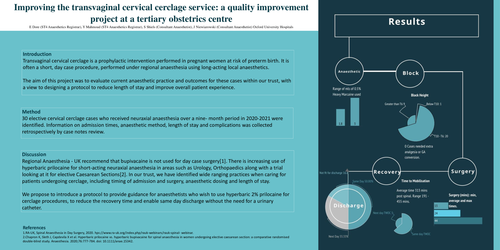
Improving the transvaginal cervical cerclage service: a quality improvement project at a tertiary obstetrics centre
E Dore (ST4 Anaesthetics Registrar), Y Mahmoud (ST4 Anaesthetics Registrar), S Shiels (Consultant Anaesthetist), J Niewiarowski (Consultant Anaesthetist) Oxford University Hospitals
Introduction
Transvaginal cervical cerclage is a prophylactic intervention performed in pregnant women at risk of preterm birth. It is often a short, day case procedure, performed under regional anaesthesia using long-acting local anaesthetics.
The aim of this project was to evaluate current anaesthetic practice and outcomes for these cases within our trust, with a view to designing a protocol to reduce length of stay and improve overall patient experience.
Method
30 elective cervical cerclage cases who received neuraxial anaesthesia over a nine- month period in 2020-2021 were identified. Information on admission times, anaesthetic method, length of stay and complications was collected retrospectively by case notes review.
Discussion
Regional Anaesthesia - UK recommend that bupivacaine is not used for day case surgery[1]. There is increasing use of hyperbaric prilocaine for short-acting neuraxial anaesthesia in areas such as Urology, Orthopaedics along with a trial looking at it for elective Caesarean Sections[2]. In our trust, we have identified wide ranging practices when caring for patients undergoing cerclage, including timing of admission and surgery, anaesthetic dosing and length of stay.
We propose to introduce a protocol to provide guidance for anaesthetists who wish to use hyperbaric 2% prilocaine for cerclage procedures, to reduce the recovery time and enable same day discharge without the need for a urinary catheter.
References