191 posters, 5 topics, 20 sessions, 393 authors, 116 institutions
ePostersLive by SciGen Technologies S.A. All rights reserved.
Obstetric Anaesthesia Annual Scientific Meeting 2023
18 - 19 May, 2023 | EICC Edinburgh

5809264
Epidural analgesia and mode of delivery: introducing a programmed intermittent bolus regime to promote mobilising and increase rate of SVD
Poster Presenter
Authors
Part of Topic
Quality Improvement
Aim
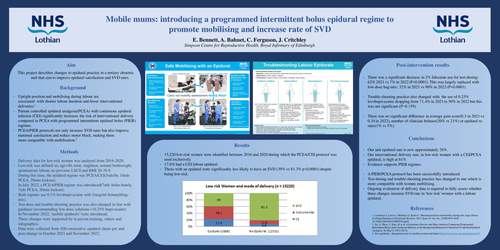
This project describes changes to epidural practice in a tertiary obstetric unit that aim to improve epidural satisfaction and SVD rates.
Background
Upright position and mobilising during labour are associated with shorter labour duration and fewer interventional deliveries.1 - Patient controlled epidural analgesia(PCEA) with continuous epidural infusion (CEI) significantly increases the risk of interventional delivery compared to PCEA with programmed intermittent epidural bolus (PIEB) regimes. - PCEA/PIEB protocols not only increase SVD rates but also improve maternal satisfaction and reduce motor block, making them more compatible with mobilisation.2
Methods
Delivery data for low-risk women was analysed from 2016-2020. - Low-risk was defined as; age<40, term, singleton, normal birthweight, spontaneous labour, no previous LSCS and BMI 20-39.9. - During this time, the epidural regime was PCEA/CEI(5mls/hr, 10mls PCEA, 20min lockout). - In July 2022, a PCEA/PIEB regime was introduced(7mls bolus hourly, 7mls PCEA, 20min lockout). - Both regimes use 0.1% levobupivacaine with 2mcg/ml fentanyl(bagmix). - Test-dose and trouble-shooting practice was also changed in line with guidance recommending low-dose solutions (<0.25% bupivacaine) - In November 2022, ‘mobile epidurals’ were introduced. - These changes were supported by in person training, videos and infographics. - Data were collected from 100 consecutive epidural charts pre and post-change in October 2021 and November 2022.
Results
- 15,220 low-risk women were identified between 2016 and 2020 during which the PCEA/CEI protocol was used exclusively. - 17.6% had a CEI labour epidural. - Those with an epidural were significantly less likely to have an SVD (39% vs 81.3% p<0.0001) despite being low-risk.
- There was a significant decrease in 2% lidocaine use for test-dosing: 62% 2021 vs 7% in 2022 (P<0.0001). This was largely replaced with low-dose bag-mix: 32% in 2021 vs 90% in 2022 (P<0.0001). - Trouble-shooting practice also changed with the use of 0.25% levobupivacaine dropping from 71.4% in 2021 to 50% in 2022 but this was not significant (P=0.159). - There was no significant difference in average pain score(0.3 in 2021 vs 0.34 in 2022), number of clinician boluses(20% vs 21%) or epidural resites(1% vs 5%).
Conclusions
Our unit epidural rate is now approximately 26%. - Our interventional delivery rate, in low-risk women with a CEI/PCEA epidural, is high at 61% - Evidence supports PIEB regimes. - A PIEB/PCEA protocol has been successfully introduced. - Test-dosing and trouble-shooting practice has changed to one which is more compatible with women mobilising. - Ongoing evaluation of delivery data is required to fully assess whether these changes increase SVD rate in 'low-risk' women with a labour epidural.