191 posters, 5 topics, 20 sessions, 393 authors, 116 institutions
ePostersLive by SciGen Technologies S.A. All rights reserved.
Obstetric Anaesthesia Annual Scientific Meeting 2023
18 - 19 May, 2023 | EICC Edinburgh

5809055
The ice globe: A more sustainable method of assessing level of block following regional anaesthesia in obstetric surgery
Poster Presenter
Authors
Affiliations
Part of Topic
Quality Improvement
Background
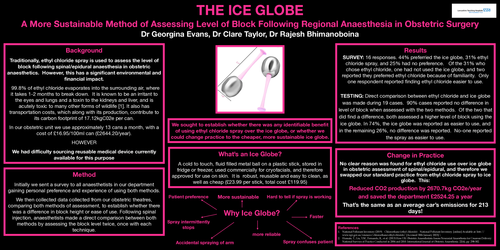
Traditionally, ethyl chloride spray is used to assess the level of block following spinal/epidural anaesthesia in obstetric anaesthetics. However, this has a significant environmental and financial impact.
99.8% of ethyl chloride evaporates into the surrounding air, where it takes 1-2 months to break down. It is known to be an irritant to the eyes and lungs and a toxin to the kidneys and liver, and is acutely toxic to many other forms of wildlife [1]. It also has transportation costs, which along with its production, contribute to its carbon footprint of 17.12kgC02e per can.
In our obstetric unit we use approximately 13 cans a month, with a cost of £16.95/100ml can (£2644.20/year).
HOWEVER
We had difficulty sourcing reusable medical device currently available for this purpose
We sought to establish whether there was any identifiable benefit of using ethyl chloride spray over the ice globe, or whether we could change practice to the cheaper, more sustainable ice globe.
What’s an Ice Globe?
A cold to touch, fluid filled metal ball on a plastic stick, stored in fridge or freezer, used commercially for cryofacials, and therefore approved for use on skin. It is robust, reusable and easy to clean, as well as cheap (£23.99 per stick, total cost £119.95)
Method
Initially we sent a survey to all anaesthetists in our department gaining personal preference and experience of using both methods.
We then collected data collected from our obstetric theatres, comparing both methods of assessment, to establish whether there was a difference in block height or ease of use. Following spinal injection, anaesthetists made a direct comparison between both methods by assessing the block level twice, once with each technique.
Results
SURVEY: 16 responses. 44% preferried the ice globe, 31% ethyl chloride spray, and 25% had no preference. Of the 31% who chose ethyl chloride, one had not used the ice globe, and two reported they preferred ethyl chloride because of familiarity. Only one respondent reported finding ethyl chloride easier to use.
TESTING: Direct comparison between ethyl chloride and ice globe was made during 19 cases. 90% cases reported no difference in level of block when assessed with the two methods. Of the two that did find a difference, both assessed a higher level of block using the ice globe. In 74%, the ice globe was reported as easier to use, and in the remaining 26%, no difference was reported. No-one reported the spray as easier to use.
Change in Practice
No clear reason was found for ethyl chloride use over ice globe in obstetric assessment of spinal/epidural, and therefore we swapped our standard practice from ethyl chloride spray to ice globe. This:
Reduced CO2 production by 2670.7kg CO2e/year
and saved the department £2524.25 a year
That’s the same as an average car’s emissions for 213 days!