191 posters, 5 topics, 20 sessions, 393 authors, 116 institutions
ePostersLive by SciGen Technologies S.A. All rights reserved.
Obstetric Anaesthesia Annual Scientific Meeting 2023
18 - 19 May, 2023 | EICC Edinburgh

5798836
Providing epidural information to labouring women in a language they understand
Poster Presenter
Part of Topic
Quality Improvement
Introduction
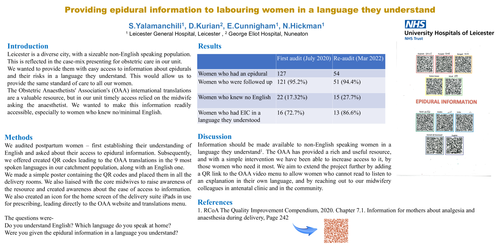
Leicester is a diverse city, with a sizeable non-English speaking population. This is reflected in the case-mix presenting for obstetric care in our unit.
We wanted to provide them with easy access to information about epidurals and their risks in a language they understand. This would allow us to provide the same standard of care to all our women.
The Obstetric Anaesthetists' Association's (OAA) international translations are a valuable resource, but in our unit timely access relied on the midwife asking the anaesthetist. We wanted to make this information readily accessible, especially to women who knew no/minimal English.
Methods
We audited postpartum women – first establishing their understanding of English and asked about their access to epidural information. Subsequently, we offered created QR codes leading to the OAA translations in the 9 most spoken languages in our catchment population, along with an English one.
We made a simple poster containing the QR codes and placed them in all the delivery rooms. We also liaised with the core midwives to raise awareness of the resource and created awareness about the ease of access to information. We also created an icon for the home screen of the delivery suite iPads in use for prescribing, leading directly to the OAA website and translations menu.
The questions were-
Do you understand English? Which language do you speak at home?
Were you given the epidural information in a language you understand?
Discussion
Information should be made available to non-English speaking women in a language they understand1. The OAA has provided a rich and useful resource, and with a simple intervention we have been able to increase access to it, by those women who need it most. We aim to extend the project further by adding a QR link to the OAA video menu to allow women who cannot read to listen to an explanation in their own language, and by reaching out to our midwifery colleagues in antenatal clinic and in the community.
References
1. RCoA The Quality Improvement Compendium, 2020. Chapter 7.1. Information for mothers about analgesia and
anaesthesia during delivery, Page 242