191 posters, 5 topics, 20 sessions, 393 authors, 116 institutions
ePostersLive by SciGen Technologies S.A. All rights reserved.
Obstetric Anaesthesia Annual Scientific Meeting 2023
18 - 19 May, 2023 | EICC Edinburgh

5797612
Assessing accuracy of visual estimation of blood loss during simulated postpartum haemorrhage scenarios.
Poster Presenter
Authors
Part of Topic
Quality Improvement
Assessing accuracy of visual estimation of blood loss during simulated postpartum haemorrhage scenarios
Dr Elin Barham, Dr Iolo Roberts, Dr Thomas Donaldson, Dr David Castillo
Countess of Chester Hospital
Introduction
>500ml of blood loss following normal vaginal delivery
or
>1000ml following operative delivery (1)
Post-Partum Haemorrhage (PPH) is a significant cause of maternal morbidity (2) and mortality (3). Rapid and accurate measurement of blood loss facilitates early identification of PPH allowing early intervention(4). Visual Estimation (VE) is commonly used to assess blood loss. VE is known to be inaccurate (5,6) and at larger volumes can be underestimated by as much as 30-50% (4,6)
Aim: To assess if VE of set blood volumes reflects the inaccuracies described in the literature, necessitating a change in practice.
Method
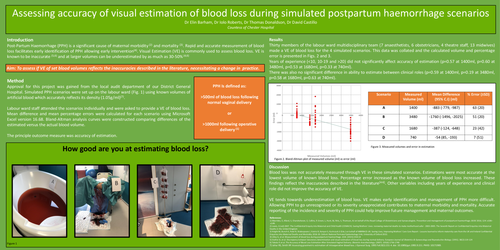
Approval for this project was gained from the local audit department of our District General Hospital. Simulated PPH scenarios were set up on the labour ward (Fig. 1) using known volumes of artificial blood which accurately reflects its density (1.05g/ml)(7).
Labour ward staff attended the scenarios individually and were asked to provide a VE of blood loss. Mean difference and mean percentage errors were calculated for each scenario using Microsoft Excel version 16.68. Bland-Altman analysis curves were constructed comparing differences of the estimated versus the actual blood volume.
The principle outcome measure was accuracy of estimation.
Results
Thirty members of the labour ward multidisciplinary team (7 anaesthetists, 6 obstetricians, 4 theatre staff, 13 midwives) made a VE of blood loss for the 4 simulated scenarios. This data was collated and the calculated volume and percentage error is presented in Figs. 2 and 3.
Years of experience (<10, 10-19 and >20) did not significantly affect accuracy of estimation (p=0.57 at 1400ml, p=0.60 at 3480ml, p=0.53 at 1680ml, p=0.33 at 740ml).
There was also no significant difference in ability to estimate between clinical roles (p=0.59 at 1400ml, p=0.19 at 3480ml, p=0.58 at 1680ml, p=0.63 at 740ml).
Discussion
Blood loss was not accurately measured through VE in these simulated scenarios. Estimations were most accurate at the lowest volume of known blood loss. Percentage error increased as the known volume of blood loss increased. These findings reflect the inaccuracies described in the literature[4-6]. Other variables including years of experience and clinical role did not improve the accuracy of VE.
VE tends towards underestimation of blood loss. VE makes early identification and management of PPH more difficult. Allowing PPH to go unrecognised or its severity unappreciated contributes to maternal morbidity and mortality. Accurate reporting of the incidence and severity of PPH could help improve future management and maternal outcomes.
References
1) Mavrides, E, Allard, S, Chandraharan, E, Collins, P, Green, L, Hunt, BJ, Riris, S, Thomson, AJ on behalf of the Royal College of Obstetricians and Gynaecologists. Prevention and management of postpartum haemorrhage. BJOG 2016; 124: e106– e149.
2) Lewis, G (ed) 2007. The Confidential Enquiry into Maternal and Child Health (CEMACH). Saving Mothers' Lives: reviewing maternal deaths to make motherhood safer - 2003-2005. The Seventh Report on Confidential Enquiries into Maternal Deaths in the United Kingdom
3) Knight M, Bunch K, Patel R, Shakespeare J, Kotnis R, Kenyon S, Kurinczuk JJ (Eds.) on behalf of MBRRACE-UK. Saving Lives, Improving Mothers’ Care Core Report - Lessons learned to inform maternity care from the UK and Ireland Confidential Enquiries into Maternal Deaths and Morbidity 2018-20. Oxford: National Perinatal Epidemiology Unit, University of Oxford 2022.
4) Lilley G, et al. Measurement of blood loss during postpartum haemorrhage. IJOA. (2015) 24:8-14
5) Duthie SJ, et al. Discrepancy between laboratory determination and visual estimation of blood loss during normal delivery. European Journal of Obstetrics & Gynaecology and Reproductive Biology. (1991). 38(2):119-124 6) Toledo P, et al. The Accuracy of Blood Loss Estimation After Simulated Vaginal Delivery. Obstetric Anesthesiology. (2007). 105(6):1736-1740
7) Johar RS, Smith RP. Assessing gravimetric estimation of intraoperative blood loss. J Gynecol Surg. 1993 Fall;9(3):151-4. doi: 10.1089/gyn.1993.9.151. PMID: 10171989.