191 posters, 5 topics, 20 sessions, 393 authors, 116 institutions
ePostersLive by SciGen Technologies S.A. All rights reserved.
Obstetric Anaesthesia Annual Scientific Meeting 2023
18 - 19 May, 2023 | EICC Edinburgh

5797502
FIBTEM A5 correlates well with laboratory clauss fibrinogen results in the obstetric population
Poster Presenter
Authors
Part of Topic
Quality Improvement
FIBTEM A5 correlates well with laboratory Clauss fibrinogen results in the obstetric population
Dr Alex Newton, Dr Iolo Roberts, Dr Thomas Donaldson, Dr David Castillo
Countess of Chester Hospital
The aim of this quality improvement project was to determine whether Fibtem A5 results accurately correlated with the lab Clauss fibrinogen levels in the maternal population.
INTRODUCTION
Rotational thromboelastometry (ROTEM), is a point‐of‐care technology that assesses coagulation from initial clot formation to clot lysis at the patient's bedside.
Thromboelastometry has been demonstrated to be a fast and accurate way of producing actionable values for fibrinogen levels during postpartum haemorrhage (PPH)(1).
The FIBTEM assay is one of many that can be run on the ROTEM sigma machine. Coagulation is activated by a small amount of tissue thromboplastin (tissue factor). The addition of cytochalasin D, works as a platelet blocking substance. This allows the FIBTEM assay to assess fibrinogen levels and fibrin polymerisation in a functional way.
Fibrinogen is an important biomarker in predicting severity of PPH(2).
As part of quality improvement work our department incorporated a ROTEM sigma machine into PPH management using the OBS Cymru protocol(5). Transfusion of fibrinogen concentrate or cryoprecipitate is then based on algorithmic interpretation of FIBTEM A5 results.
METHOD
In line with the locally adopted PPH protocol, paired blood samples were taken after identifying measured blood loss of ≥1000ml. One sample was tested using the ROTEM machine at the point of care and the other sent to the hospital laboratory for Clauss fibrinogen assay.
Values for FIBTEM A5, the amplitude of the thromboelastogram (representing clot firmness) 5 minutes after the initiation of clotting (Fig. 1) and Laboratory fibrinogen were collected manually.
Values encompassing a 9-month period were subsequently reviewed and interpreted using a Spearman (Rs) test to determine correlation using Microsoft Excel software.
RESULTS
Between May 2022 and January 2023, 182 ROTEM samples were tested. Of these, 46 had a paired sample sent for Clauss fibrinogen testing.
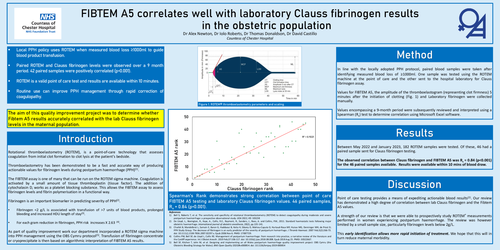
The observed correlation between Clauss fibrinogen and FIBTEM A5 was Rs = 0.84 (p<0.001) for the 46 paired samples available. Results were available within 10 mins of blood draw.
DISCUSSION
Point of care testing provides a means of expediting actionable blood results(2). Our review has demonstrated a high degree of correlation between lab Clauss fibrinogen and the Fibtem A5 values.
A strength of our review is that we were able to prospectively study ROTEM® measurements performed in women experiencing postpartum haemorrhage. The review was however limited by a small sample size, particularly fibrinogen levels below 2g/L.
This early identification allows more rapid initiation of treatment. We hope that this will in turn reduce maternal morbidity.
References