191 posters, 5 topics, 20 sessions, 393 authors, 116 institutions
ePostersLive by SciGen Technologies S.A. All rights reserved.
Obstetric Anaesthesia Annual Scientific Meeting 2023
18 - 19 May, 2023 | EICC Edinburgh

5796428
A review of change of Remifentanil PCA protocol at Queen Elizabeth University Hospital Maternity Unit
Poster Presenter
Authors
Part of Topic
Quality Improvement
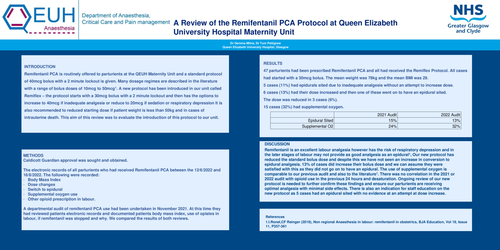
INTRODUCTION Remifentanil PCA is routinely offered to parturients at the QEUH Maternity Unit and a standard protocol of 40mcg bolus with a 2 minute lockout is given. Many dosage regimes are described in the literature with a range of bolus doses of 10mcg to 50mcg1 . A new protocol has been introduced in our unit called Remiflex – the protocol starts with a 30mcg bolus with a 2 minute lockout and then has the options to increase to 40mcg if inadequate analgesia or reduce to 20mcg if sedation or respiratory depression It is also recommended to reduced starting dose if patient weight is less than 50kg and in cases of intrauterine death. This aim of this review was to evaluate the introduction of this protocol to our unit.
METHODS Caldicott Guardian approval was sought and obtained. The electronic records of all parturients who had received Remifentanil PCA between the 12/6/2022 and 16/8/2022. The following were recorded: - Body Mass Index - Dose changes - Switch to epidural - Supplemental oxygen use - Other opioid prescription in labour. A departmental audit of remifentanil PCA use had been undertaken in November 2021. At this time they had reviewed patients electronic records and documented patients body mass index, use of opiates in labour, if remifentanil was stopped and why. We compared the results of both reviews.
RESULTS 47 parturients had been prescribed Remifentanil PCA and all had received the Remiflex Protocol. All cases had started with a 30mcg bolus. The mean weight was 78kg and the mean BMI was 29. 5 cases (11%) had epidurals sited due to inadequate analgesia without an attempt to increase dose. 6 cases (13%) had their dose increased and then one of these went on to have an epidural sited. The dose was reduced in 3 cases (6%). 15 cases (32%) had supplemental oxygen.
DISCUSSION Remifentanil is an excellent labour analgesia however has the risk of respiratory depression and in the later stages of labour may not provide as good analgesia as an epidural 1 , Our new protocol has reduced the standard bolus dose and despite this we have not seen an increase in conversion to epidural analgesia. 13% of cases did increase their bolus dose and we can assume they were satisfied with this as they did not go on to have an epidural. The use of supplemental oxygen is comparable to our previous audit and also to the literature 1 . There was no correlation in the 2021 or 2022 audit with opioid use in the previous 24 hours and desaturation. Ongoing review of our new protocol is needed to further confirm these findings and ensure our parturients are receiving optimal analgesia with minimal side effects. There is also an indication for staff education on the new protocol as 5 cases had an epidural sited with no evidence at an attempt at dose increase.
References 1.I.Ronel,CF Reinger (2019), Non regional Anaesthesia in labour: remifentanil in obstetrics, BJA Education, Vol 19, Issue 11, P357-361