191 posters, 5 topics, 20 sessions, 393 authors, 116 institutions
ePostersLive by SciGen Technologies S.A. All rights reserved.
Obstetric Anaesthesia Annual Scientific Meeting 2023
18 - 19 May, 2023 | EICC Edinburgh

5796183
Transformative changes to a perioperative elective Caesarean section pathway: the Dudley experience
Poster Presenter
Authors
Rinesh Parmar, Katie Philpott, Jessica Watkins, Zoe Ryall, Nick Conway, Mohan Ramamoorthy
Affiliations
ST7 Anaesthetic Registrar, The Dudley Group of Hospitals NHS Foundation Trust, Inpatient Matron, The Dudley Group of Hospitals NHS Foundation Trust, Midwife, The Dudley Group of Hospitals NHS Foundation Trust, Specialist Practice Coach, The Dudley Group of Hospitals NHS Foundation Trust, Consultant Anaesthetist, The Dudley Group of Hospitals NHS Foundation Trust
Part of Topic
Quality Improvement
Transformative changes to a perioperative elective Caesarean section pathway: the Dudley experience
Introduction:
Methods:
A retrospective review of practice in the two weeks prior to the implementation of changes was conducted. This utilised multiple data points collectedfrom a variety of sources including the theatre database which recorded the start, finish and key intra-operative milestones for each case. Sunrise electronic patient records for these patients were reviewed to determine post-operative opiate use and length of stay. Following the implementation of the GoldenPatient pathway and enhanced recovery programme we once again reviewed theatre efficiency, the number ofcancelled cases or cases that overran or had to be conducted in our emergency theatre after the end of theelective list. We reviewed opiate use in the first 24 hours post delivery and total length of stay.
Results:
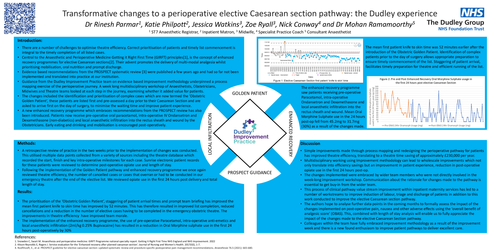
The prioritisation of the ‘Obstetric Golden Patient’, staggering of patient arrival times and prompt team briefing has improved the mean first patient knife to skin timehas improved by 52 minutes. This has therefore resulted in improved list completion, reduced cancellations and a reduction in the number of elective cases having to be completed in the emergency obstetric theatre. The improvements in theatre efficiency have improved team morale.
The implementation of the enhancedrecovery programme, the use of pre-operative Paracetamol, intra-operative anti-emetics and local anaesthetic infiltration (2ml/kg 0.25% Bupivacaine) has resulted in a reduction in Oral Morphine sulphate use in the first 24 hours post-operatively by 30%
The mean first patient knife to skin time was 52 minutes earlier after the introduction of the Obstetric Golden Patient. Identification of complex patients prior to the day of surgery allows appropriate preparation to ensure timely commencement of the list. Staggering of patient arrival, facilitates timely preparation for theatre and efficient running of the list.
The enhanced recovery programme sawpatients receiving pre-operative Paracetamol, intra-operative Ondansetron and Dexamethasone and local anaesthetic infiltration into the rectus sheath and wound. Mean Oral Morphine Sulphate use in the 24 hours post-op fell from 45.2mg to 31.7mg (30%) as a result of the changes made.
Discussion:
Simple improvements made through process mapping and redesigning the perioperative pathway for patients has improved theatre efficiency, translating to a theatre time saving of approximately £230,000 per year. Multidisciplinary working using Improvement methodology can lead to wholescale improvements which not only translate into efficiency savings but an improvement in patient experience, reduction in post-operative opiate use in the first 24 hours post-op. The changes implemented were embraced by wider team members who were not directly involved in the week-long improvement workshop. Communication about the rationale for changes made to the pathway is essential to get buy-in from the wider team. This process ofclinical pathwayvalue streamimprovementwithin inpatient maternity services has led to a number of workstreams to improve induction of labour, triage and discharge of patients in addition to this work conducted to improve the elective Caesarean section pathway. The authors hope to analyse further data points in the coming months to formally assess the impact of the changes implemented on post-operative pain, nausea and other adverse effects using the ‘overall benefit of analgesic score’ (OBAS). This, combined with length of stay analysis will enable us to fully appreciate the impact of the changes made to the elective Caesarean Section pathway. Colleagues withinthe team havefully embraced improvement methodology as a result of the improvement week and there is a new found enthusiasm to improve patient pathways to deliver excellent care.
References:
1. Snowden C, Swart M. Anaesthesia and perioperative medicine: GIRFT Programme national specialty report. Getting It Right First Time NHS England and NHS Improvement. 2022
2. Kitson-Reynolds E, Rogers J. Service evaluation for the ‘Enhanced recovery after planned caesarean section’. Journal of Nursing and Women's Health. 2017(02), 1-7.
3. Roofthooft, E., et al. PROSPECT guideline for elective caesarean section: updated systematic review and procedure‐specific postoperative pain management recommendations. Anaesthesia 76.5 (2021): 665-680.