191 posters, 5 topics, 20 sessions, 393 authors, 116 institutions
ePostersLive by SciGen Technologies S.A. All rights reserved.
Obstetric Anaesthesia Annual Scientific Meeting 2023
18 - 19 May, 2023 | EICC Edinburgh

5795711
SHARED handover for labour ward recovery
Poster Presenter
Part of Topic
Quality Improvement
SHARED Handover For Labour Ward Recovery
Dr Louise Cloney, Dr Tahira Younus, Dr Nuala Lucas, Dr Abigail Richardson
INTRODUCTION
National standards for immediate post-anaesthesia recovery state that the anaesthetist must formally hand over the patient's care to an appropriately trained practitioner [1]. Structured handover tools, such as the SAFE handover, have been shown to reduce critical omissions during handovers in obstetric anaesthesia [2]. Use of such tools has also been encouraged in the latest RCOA Guidelines for the Provision of Anaesthesia Services for an Obstetric Population 2023 [3].We undertook a quality improvement project to assess and improve the effectiveness of anaesthetic handover to recovery in our labourward by the introduction of a structured handover tool.
METHODS
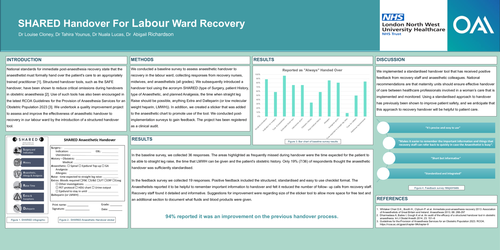
We conducted a baseline survey to assess anaesthetic handover to recovery in the labourward, collecting responses from recovery nurses, midwives, and anaesthetists (all grades). We subsequently introduced a handover tool using the acronym SHARED (type of Surgery, patient History, type of Anaesthetic, and planned Analgesia, the time when straight leg Raise should be possible, anything Extra and Dalteparin (or low molecular weight heparin, LMWH)). In addition, we created a sticker that was added to the anaesthetic chart to promote use of the tool. We conducted post-implementation surveys to gain feedback. The project has been registered as a clinical audit.
RESULTS
In the baseline survey, we collected 36 responses. The areas highlighted as frequently missed during handover were the time expected for the patient to be able to straight leg raise, the time that LMWH can be given and the patient’s obstetric history. Only 19% (7/36) of respondents thought the anaesthetichandover was sufficiently standardised.
In the feedback survey we collected 19 responses. Positive feedback included the structured, standardised and easy to use checklist format. The Anaesthetists reported it to be helpful to remember important information to handover and felt it reduced the number of follow- up calls from recovery staff. Recovery staff found it detailed and informative. Suggestions for improvement were regarding size of the sticker tool to allow more space for free text and an additional section to document what fluids and blood products were given.
94% reported it was an improvement on the previous handover process.
DISCUSSION
We implemented a standardised handover tool that has received positive feedback from recovery staff and anaesthetic colleagues. National recommendations are that maternity units should ensure effective handover of care between healthcare professionals involved in a woman’s care that is implemented and monitored. Using a standardised approach to handover has previously been shown to improve patient safety, and we anticipate that this approach to recovery handover will be helpful to patient care.
REFERENCES