191 posters, 5 topics, 20 sessions, 393 authors, 116 institutions
ePostersLive by SciGen Technologies S.A. All rights reserved.
Obstetric Anaesthesia Annual Scientific Meeting 2023
18 - 19 May, 2023 | EICC Edinburgh

5791798
SAFE-in-Maternity: Safety-2 and Appreciative inquiry For Excellence. A staff and patient safety project.
Poster Presenter
Authors
Part of Topic
Quality Improvement
Safety-2 and Appreciative Inquiry For Excellence
SAFE-in-Maternity: A staff and patient safety project.
Introduction
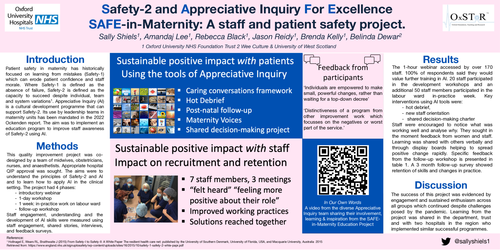
Patient safety in maternity has historically focused on learning from mistakes (Safety-1) which can erode patient confidence and staff morale. Where Safety-1 is defined as the absence of failure, Safety-2 is defined as the capacity to succeed despite individual, team and system variations1. Appreciative Inquiry (AI) is a cultural development programme that can support Safety-2. Its use by leadership teams in maternity units has been mandated in the 2022 Ockenden report. The aim was to implement an education program to improve staff awareness of Safety-2 using AI.
Methods
This quality improvement project QIP was co-designed by a team of midwives, obstetricians, nurses, and anaesthetists. Appropriate hospital QIP approval was sought. The aims were to understand the principles of Safety-2 and AI and to learn how to apply AI in the clinical setting. The project had 4 phases:
Staff engagement, understanding and the development of AI skills were measured using staff engagement, shared stories, interviews, and feedback surveys.
Feedback from Participants:
‘Individuals are empowered to make small, powerful changes, rather than waiting for a top-down decree’ ‘Distinctiveness of a program from other improvement work which focusses on the negatives or worst part of the service.’
Video
A video from the diverse Appreciative Inquiry team sharing their involvement, learning & inspiration from the SAFE-in-Maternity Education Project
Results
The 1-hour webinar accessed by over 170 staff. 100% of respondents said they would value further training in AI. 20 staff participated in the development workshops and an additional 50 staff members participated in the labour ward in-practice week. Key interventions using AI tools were:
Staff were encouraged to notice what was working well and analyse why. They sought in the moment feedback from women and staff. Learning was shared with others verbally and through display boards helping to spread positive change rapidly. Specific feedback from the follow-up workshop is presented in table 1. A 3 month follow-up survey showed retention of skills and changes in practice.
Discussion
The success of this project was evidenced by engagement and sustained enthusiasm across all groups which continued despite challenges posed by the pandemic. Learning from the project was shared in the department, trust and with two hospitals in the region who implemented similar successful programmes.