191 posters, 5 topics, 20 sessions, 393 authors, 116 institutions
ePostersLive by SciGen Technologies S.A. All rights reserved.
Obstetric Anaesthesia Annual Scientific Meeting 2023
18 - 19 May, 2023 | EICC Edinburgh

5788129
Gas-tly business - reducing nitrous oxide waste in NHS Lothian
Poster Presenter
Authors
Lisa Dewar, Clementina Calabria, Julia Critchley, Andrew Grant
Affiliations
Part of Topic
Quality Improvement
Gas-tly business - reducing nitrous oxide waste in NHS Lothian
Clementina Calabria, Lisa Dewar, Julia Critchley, Andrew Grant. Royal Infirmary of Edinburgh, NHS Lothian.
Introduction
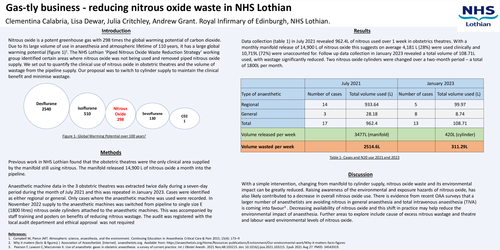
Nitrous oxide is a potent greenhouse gas with 298 times the global warming potential of carbon dioxide. Due to its large volume of use in anaesthesia and atmospheric lifetime of 110 years, it has a large global warming potential (figure 1)1. The NHS Lothian ‘Piped Nitrous Oxide Waste Reduction Strategy’ working group identified certain areas where nitrous oxide was not being used and removed piped nitrous oxide supply. We set out to quantify the clinical use of nitrous oxide in obstetric theatres and the volume of wastage from the pipeline supply. Our proposal was to switch to cylinder supply to maintain the clinical benefit and minimise wastage.
Methods
Previous work in NHS Lothian found that the obstetric theatres were the only clinical area supplied by the manifold still using nitrous. The manifold released 14,900 L of nitrous oxide a month into the pipeline.
Anaesthetic machine data in the 3 obstetric theatres was extracted twice daily during a seven-day period during the month of July 2021 and this was repeated in January 2023. Cases were identified as either regional or general. Only cases where the anaesthetic machine was used were recorded. In November 2022 supply to the anaesthetic machines was switched from pipeline to single size E (1800 litres) nitrous oxide cylinders attached to the anaesthetic machines. This was accompanied by staff training and posters on benefits of reducing nitrous wastage. The audit was registered with the local audit department and ethical approval was not required
Results
Data collection (table 1) in July 2021 revealed 962.4L of nitrous used over 1 week in obstetrics theatres. With a monthly manifold release of 14,900 L of nitrous oxide this suggests on average 4,181 L (28%) were used clinically and 10,719L (72%) were unaccounted for. Follow up data collection in January 2023 revealed a total volume of 108.71L used, with wastage significantly reduced. Two nitrous oxide cylinders were changed over a two-month period – a total of 1800L per month.
Discussion
With a simple intervention, changing from manifold to cylinder supply, nitrous oxide waste and its environmental impact can be greatly reduced. Raising awareness of the environmental and exposure hazards of nitrous oxide, has also likely contributed to a decrease in overall nitrous oxide use. There is evidence from recent OAA surveys that a larger number of anaesthetists are avoiding nitrous in general anaesthesia and total intravenous anaesthesia (TIVA) is coming into favour3 . Decreasing availability of nitrous oxide and this shift in practice may help reduce the environmental impact of anaesthesia. Further areas to explore include cause of excess nitrous wastage and theatre and labour ward environmental levels of nitrous oxide.