191 posters, 5 topics, 20 sessions, 393 authors, 116 institutions
ePostersLive by SciGen Technologies S.A. All rights reserved.
Obstetric Anaesthesia Annual Scientific Meeting 2023
18 - 19 May, 2023 | EICC Edinburgh

5787973
Assessing and improving maternal safety in patients with high BMI using systematic QI methodology
Poster Presenter
Part of Topic
Quality Improvement
AIMS - High
Assessing and improving maternal safety in patients with high BMI using systematic QI methodology
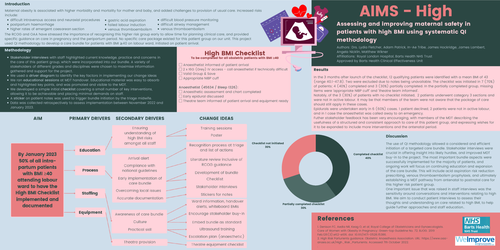
Maternal obesity is associated with higher morbidity and mortality for mother and baby, and added challenges to provision of usual care. Increased risks include: difficult intravenous access and neuraxial procedures; postpartum haemorrhage; higher rates of emergent caesarean section; gastric acid aspiration; failed labour induction; venous thromboembolism; difficult blood pressure monitoring; difficult airway management; venous thromboembolism.
The RCOG and OAA have stressed the importance of recognising this higher risk group early to allow time for planning clinical care, and provided specific guidance on care in pregnancy and the peripartum period. No specific care package existed for this patient group on our unit. This project used QI methodology to develop a care bundle for patients with BMI ⪰40 on labour ward, initiated on patient arrival.
Methodology
Stakeholder interviews with staff highlighted current knowledge, practice and concerns in the care of this patient group, which were incorporated into our bundle. A variety of stakeholders of different grades and disciplines were chosen to maximise information gathered and support for the project. We used a driver diagram to identify the key factors in implementing our change ideas We ran educational sessions at MDT handover. Educational material was easy to absorb and highlighted key points, and was promoted and visible to the MDT. We developed a simple initial checklist covering a small number of key interventions, allowing it to be achievable and placing minimal demands on staff. A sticker on patient notes was used to trigger bundle initiation by the triage midwife. Data was collected retrospectively to assess implementation between November 2022 and January 2023.
Results
In the 3 months after launch of the checklist, 12 qualifying patients were identified with a mean BMI of 43 (range 40.1-47.8). Two were excluded due to notes being unavailable. The checklist was initiated in 7 (70%) of patients; 4 (40%) completed and 3 (30%) partially completed. In the partially completed group, missing items were 'appropriate NIBP cuff' and 'theatre team informed'. Notably, of the 3 (30%) of patients with no checklist initiated, 2 patients underwent category 3 sections and were not in active labour. It may be that members of the team were not aware that the package of care should still apply in these cases. Epidurals were undertaken early in 6 (60%) cases. 1 patient declined, 2 patients were not in active labour, and in 1 case the anaesthetist was called away to an emergency. Futher stakeholder feedback has been very encouraging, with members of the MDT describing the usefulness of a structured and consistent approach to care of this patient group, and expressing wishes for it to be expanded to include more interventions and the antenatal period.
Discussion
The use of QI methodology allowed a considered and efficient initiation of a targeted care bundle. Stakeholder interviews were crucial in offering insight into likely hurdles, and improved MDT buy-in to the project. The most important bundle aspects were successfully implemented for the majority of patients, and ongoing work will focus on continuing education and expansion of the care bundle. This will include acid aspiration risk reduction prescribing, venous thromboembolism prophylaxis, and ultimately establishing a MDT pathway from antenatal to postnatal care for this higher risk patient group. One important issue that was raised in staff interviews was the sensitivity around conversations and interventions relating to high BMI. We aim to conduct patient interviews to assess their thoughts and understanding on care related to high BMI, to help guide further approaches and staff education..