191 posters, 5 topics, 20 sessions, 393 authors, 116 institutions
ePostersLive by SciGen Technologies S.A. All rights reserved.
Obstetric Anaesthesia Annual Scientific Meeting 2023
18 - 19 May, 2023 | EICC Edinburgh

5787841
QR Codes: Bridging the language barrier on epidural consent.
Poster Presenter
Authors
Part of Topic
Quality Improvement
QR Codes: Bridging the language barrier on epidural consent.
Introduction
-
Irish maternity hospitals cater for women from many different nationalities many of whom do not speak English.
-
it is imperative that we provide these women with informed consent in their own languages.
-
Reports from MBRRACE repeatedly highlight differences in maternal mortality rates amongst women from non-white backgrounds compared to white women, and emphasis the need for a continued focus on action to address these disparities.
-
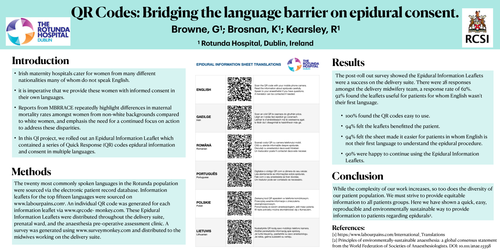
In this QI project, we rolled out an Epidural Information Leaflet which contained a series of Quick Response (QR) codes epidural information and consent in multiple languages.
Methods
The twenty most commonly spoken languages in the Rotunda population were sourced via the electronic patient record database. Information leaflets for the top fifteen languages were sourced on www.labourpains.com1. An individual QR code was generated for each information leaflet via www.qrcode- monkey.com. These Epidural Information Leaflets were distributed throughout the delivery suite, prenatal ward, and the anaesthesia pre-operative assessment clinic. A survey was generated using www.surveymonkey.com and distributed to the midwives working on the delivery suite.
Results
The post-roll out survey showed the Epidural Information Leaflets were a success on the delivery suite.
There were 28 responses amongst the delivery midwifery team, a response rate of 62%.
-
92% found the leaflets useful for patients for whom English wasn’t their first language.
-
100% found the QR codes easy to use.
-
94% felt the leaflets benefitted the patient.
-
94% felt the sheet made it easier for patients in whom English is not their first language to understand the epidural procedure.
-
90% were happy to continue using the Epidural Information Leaflets.
Conclusion
While the complexity of our work increases, so too does the diversity of our patient population. We must strive to provide equitable information to all patients groups. Here we have shown a quick, easy, reproducible and environmentally sustainable way to provide information to patients regarding epidurals2.