191 posters, 5 topics, 20 sessions, 393 authors, 116 institutions
ePostersLive by SciGen Technologies S.A. All rights reserved.
Obstetric Anaesthesia Annual Scientific Meeting 2023
18 - 19 May, 2023 | EICC Edinburgh

5787758
Reducing rates of antenatal anaemia -- utilising serum ferritin as an early marker of iron deficiency
Poster Presenter
Part of Topic
Quality Improvement
Reducing rates of antenatal anaemia – utilising serum ferritin as an early marker of iron deficiency
Introduction
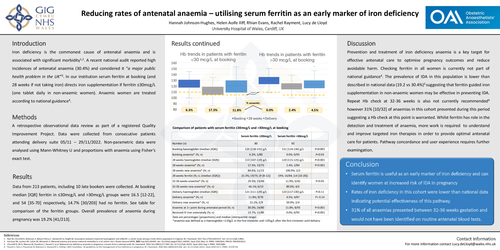
Iron deficiency is the commonest cause of antenatal anaemia and is associated with significant morbidity1,2. A recent national audit reported high incidences of antenatal anaemia (30.4%) and considered it “a major public health problem in the UK”3. In our institution serum ferritin at booking (and 28 weeks if not taking iron) directs iron supplementation if ferritin ≤30mcg/L (one tablet daily in non-anaemic women). Anaemic women are treated according to national guidance4.
Methods
A retrospective observational data review as part of a registered Quality Improvement Project. Data were collected from consecutive patients attending delivery suite 05/11 – 29/11/2022. Non-parametric data were analysed using Mann-Whitney U and proportions with anaemia using Fisher’s exact test.
Results
Data from 213 patients, including 10 late bookers were collected. At booking median [IQR] ferritin in ≤30mcg/L and >30mcg/L groups were 16.5 [12-22], and 54 [35-70] respectively, 14.7% [30/203] had no ferritin. See table for comparison of the ferritin groups. Overall prevalence of anaemia during pregnancy was 19.2% [41/213].
Discussion
Prevention and treatment of iron deficiency anaemia is a key target for effective antenatal care to optimise pregnancy outcomes and reduce avoidable harm. Checking ferritin in all women is currently not part of national guidance4. The prevalence of IDA in this population is lower than described in national data (19.2 vs 30.4%)3suggesting that ferritin guided iron supplementation in non-anaemic women may be effective in preventing IDA.Repeat Hb check at 32-36 weeks is also not currently recommended4 however 31% [10/32] of anaemias in this cohort presented during this period suggesting a Hb check at this point is warranted. Whilst ferritin has role in the detection and treatment of anaemia, more work is required to understand and improve targeted iron therapies in order to provide optimal antenatal care for patients. Pathway concordance and user experience requires further examingation.
Conclusion
References