191 posters, 5 topics, 20 sessions, 393 authors, 116 institutions
ePostersLive by SciGen Technologies S.A. All rights reserved.
Obstetric Anaesthesia Annual Scientific Meeting 2023
18 - 19 May, 2023 | EICC Edinburgh

5790581
Establishing Entonox cracking in maternity care, a quality improvement project
Poster Presenter
Part of Topic
ESTABLISHING ENTONOX CRACKING IN MATERNITY CARE,
A QUALITY IMPROVEMENT PROJECT
G Pitchers, E Pugh, M Bray and C Oliver, University Hospital of Wales, Cardiff, UK
Introduction
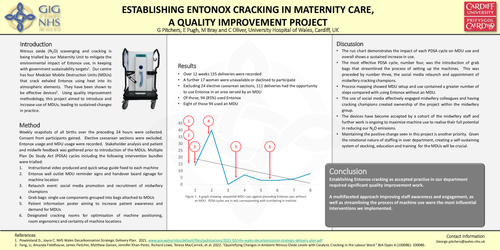
Nitrous oxide (N2O) scavenging and cracking is being trialled by our Maternity Unit to mitigate the environmental impact of Entonox use, in keeping with government sustainability targets1. Our centre has four Medclair Mobile Destruction Units (MDUs) that crack exhaled Entonox using heat into its atmospheric elements. They have been shown to be effective devices2. Using quality improvement methodology, this project aimed to introduce and increase use of MDUs, leading to sustained changes in practice.
Method
Weekly snapshots of all births over the preceding 24 hours were collected. Consent from participants gained. Elective caesarean sections were excluded. Entonox usage and MDU usage were recorded. Stakeholder analysis and patient and midwife feedback was gathered prior to introduction of the MDUs. Multiple Plan Do Study Act (PDSA) cycles including the following intervention bundles were trialled:
1. Instructional video produced and quick setup guide fixed to each machine
2. Entonox wall outlet MDU reminder signs and handover board signage for machine location
3. Relaunch event: social media promotion and recruitment of midwifery champions
4. Grab bags: single use components grouped into bags attached to MDUs
5. Patient information poster aiming to increase patient awareness and demand for MDUs
Results
Conclusion
Establishing Entonox cracking as accepted practise in our department required significant quality improvement work.
A multifaceted approach improving staff awareness and engagement, as well as streamlining the process of machine use were the most influential interventions we implemented.