191 posters, 5 topics, 20 sessions, 393 authors, 116 institutions
ePostersLive by SciGen Technologies S.A. All rights reserved.
Obstetric Anaesthesia Annual Scientific Meeting 2023
18 - 19 May, 2023 | EICC Edinburgh

5809896
Entonox® unplugged; a cracking project. Usage of Entonox® in maternity with unplugging of Schrader valves at Leeds Teaching Hospitals Trust (LTHT).
Poster Presenter
Authors
Part of Topic
Quality Improvement
Entonox unplugged; a cracking project
usage of entonox in maternity with unplugging of schrader valves at Leeds Teaching Hospitals Trust (LTHT)
INTRODUCTION
Identified problems with Entonox® are:
Risks to health - With prolonged exposure, nitrous oxide (N2O) may cause subfertility and B12 deficiency anaemia. Hospitals are becoming increasingly aware of these potential exposure risks for staff and patients. LTHT maternity units have identified 11-16 times work-place exposure limits.
Global warming - Anaesthesia contributes up to 2% of the NHS carbon footprint. Nitrous Oxide makes up 75% of the anaesthetic gas footprint within the UK.
Rising costs - Entonox® has almost doubled in price over past 18 months.
Replacing pipeline supply with cylinders fails to eliminate exposure risk with lack of scavenging in maternity.
Work done locally suggested leakage of Entonox® at Schrader valves accounted for 87% of usage [1].
Entonox® use in year preceding the project equates to 986 tonnes of CO2e (on RCOA calculator) which equals 5.8 million km driven.
OBJECTIVE
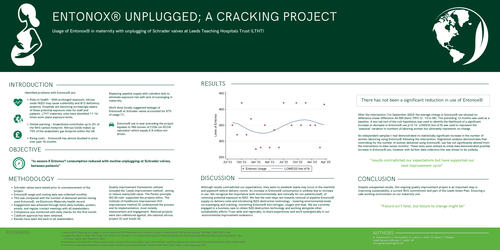
"to assess if Entonox® consumption reduced with routine unplugging at Schrader valves, between patients"
METHODOLOGY
Schrader valves were tested prior to commencement of the project.
Entonox® usage and costing data was collected monthly.
This was compared with the number of delivered women having used Entonox®, via Electronic Maternity health record. Engagement was achieved through twice daily huddles, posters, emails, and regular contact meetings with all stakeholders. Compliance was monitored with daily checks for the first month. Caldicott approval has been obtained.
Results have been fed back to all stakeholders.
Quality improvement frameworks utilized included the ‘Leeds improvement method’, aiming to reduce waste/add value. The Pareto principle (80:20 rule) supported the projects ethos. The Institute of Healthcare Improvement (IHI) improvement method [2] underpinned the process and its implementation; most notably measurement and engagement. National projects were also referenced against; the national nitrous project [3] and SusQI [4].
Although results contradicted our expectations, they seem to establish waste may occur in the manifold and pipework before delivery rooms. An increase in Entonox® consumption is unlikely due to increase in use. We recognize the importance both environmentally and clinically for our patients/staff, of removing potential exposure to N2O. We feel the next steps are towards removal of pipeline Entonox® supply on delivery suite and introducing N2O destruction technology – lowering environmental levels via scavenging and cracking, converting Entonox® into nitrogen, oxygen and heat. We are currently engaged in a business case to obtain N20 destruction technology and working alongside other sustainability efforts Trust-wide and regionally, to share experiences and work synergistically in our environmental improvement endeavors.
DISCUSSION
There has not been a significant reduction in use of Entonox®
After the intervention (1st September 2022) the average change in Entonox® use showed no difference (mean difference 34 000 liters) [95% CI -15 to 84]. The preceding 12 months was used as a baseline. A two tail test of the null hypothesis was used to identify the likelihood of a significant increase or decrease in Entonox® use p=0.16. LOWESS line of fit was used to represent the 'seasonal' variation in numbers of laboring women but ultimately represents no change.
An independent samples t-test demonstrated no statistically significant increase in the number of women labouring using Entonox® following the intervention. Regression analysis demonstrates that controlling for the number of women delivered using Entonox®, use has not significantly altered from the intervention to date (seven months). These tests were utilised as initial data demonstrated possible increase in Entonox® use, however with further data collection this was shown to be unlikely.
"results contradicted our expectations but have supported our next improvement cycle”
CONCLUSION
Despite unexpected results, this ongoing quality improvement project is an important step in improving sustainability, a current NHS commitment and part of the Leeds Green Plan. Ensuring a safe working environment on our maternity unit.
”Failure isn't fatal, but failure to change might be"
AUTHORS
A. Greenwood1, E. Horncastle1, E. Lowis1, L. Holt1, D. Gilpin1, T Halsey1 Leeds General Infirmary 1, Leeds, UK
anna.greenwood1@nhs.net