191 posters, 5 topics, 20 sessions, 393 authors, 116 institutions
ePostersLive by SciGen Technologies S.A. All rights reserved.
Obstetric Anaesthesia Annual Scientific Meeting 2023
18 - 19 May, 2023 | EICC Edinburgh

5784019
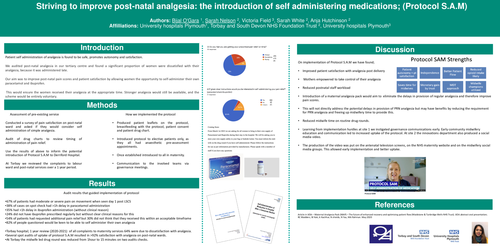
Striving to improve post natal analgesia: the introduction of Self Administering Medication (S.A.M)
Poster Presenter
Authors
Part of Topic
Quality Improvement
Introduction
Patient self administration of analgesia is found to be safe, promotes autonomy and satisfaction.
We audited post-natal analgesia in our tertiary centre and found a significant proportion of women were dissatisfied with their analgesia, because it was administered late.
Our aim was to improve post-natal pain scores and patient satisfaction by allowing women the opportunity to self-administer their own paracetamol and ibuprofen.
This would ensure the women received their analgesia at the appropriate time. Stronger analgesia would still be available, and the scheme would be entirely voluntary.
Methods
Assessment of pre-existing service
Conducted a survey of pain satisfaction on post-natal • ward and asked if they would consider self
administration of simple analgesia.
Audit of drug charts to review timing of •administration of pain relief.
Use the results of above to inform the potential
introduction of Protocol S.A.M to Derriford Hospital. •
At Torbay we reviewed the complaints to labour •ward and post-natal services over a 1 year period.
How we implemented the protocol
Produced patient leaflets on the protocol, breastfeeding with the protocol, patient consent and patient drug chart.
Introduced protocol to elective patients only, as they all had anaesthetic pre-assessment appointments.
Once established introduced to all in maternity.
Communication to the involved teams via governance meetings.
Results
Audit results
that guided implementation of protocol
•67% of patients had moderate or severe pain on movement when seen day 1 post LSCS
•38% of cases on spot check had >1h delay in paracetamol administration
•35% had >1h delay in ibuprofen administration (without clinical reason)
•24% did not have ibuprofen prescribed regularly but without clear clinical reasons for this
•54% of patients had requested additional pain relief but 30% did not think that they received this within an acceptable timeframe •82% of people questioned would be keen to be able to self administer their own analgesia
•Torbay hospital; 1 year review (2020-2021) of all complaints to maternity services 64% were due to dissatisfaction with analgesia. •Several spot audits of uptake of protocol S.A.M resulted in >92% satisfaction with analgesia on post-natal wards.
•At Torbay the midwife led drug round was reduced from 1hour to 15 minutes on two audits checks.
Discussion
On implementation of Protocol S.A.M we found:
-
Improved patient satisfaction with analgesia post delivery
-
Mothers empowered to take control of their analgesia
-
Reduced postnatal staff workload
-
Introduction of a maternal analgesia pack would aim to eliminate the delays in provision of regular analgesia and therefore improve pain scores.
-
This will not directly address the potential delays in provision of PRN analgesia but may have benefits by reducing the requirement for PRN analgesia and freeing up midwifery time to provide this.
-
Reduced midwife time on routine drug rounds.
-
Learning from implementation hurdles at site 1 we instigated governance communications early. Early community midwifery
education and communication led to increased uptake of the protocol. At site 2 the innovations department also produced a social media video.
-
The production of the video was put on the antenatal television screens, on the NHS maternity website and on the midwifery social media groups. This allowed early implementation and better uptake.
References
Article in IJOA – Maternal Analgesia Pack (MAP) – The future of enhanced recovery and optimising patient flow (Maidstone & Tunbridge Wells NHS Trust). IJOA abstract oral presentation; RC Madders, W Kok, A Kochhar, N shields, N Yau, MA Rahman. May 2020