191 posters, 5 topics, 20 sessions, 393 authors, 116 institutions
ePostersLive by SciGen Technologies S.A. All rights reserved.
Obstetric Anaesthesia Annual Scientific Meeting 2023
18 - 19 May, 2023 | EICC Edinburgh

5798243
A review of the use of cell salvage in Queen Elizabeth University Hospital Maternity Unit, Glasgow
Poster Presenter
Authors
Part of Topic
Quality Improvement
INTRODUCTION There are many advantages to the use of cell salvage that have been widely described in the literature and these are particularly applicable to the obstetric population1 . The implementation of cell salvage routinely involves the training of staff in the use of the cell salvage machine. For multiple reasons only a limited number of staff in our unit are able to run the cell salvage machine and the use is often restricted to the elective theatre. The purpose of this review was to evaluate the use of cell salvage in our department in the last year to show the positive impact it can have on our patient group
METHODS Caldicott Guardian approval was sought and obtained. A record of patients who had cell salvage used during their caesarean birth was available from January 2022 to January 2023. The electronic record of each of these patients was then reviewed. From their record the following was documented: - Estimated blood loss - Volume of autologous transfusion - Body Mass Index - Pre-operative haemoglobin (g/L) - Post operative haemoglobin (g/L) – within 72 hours of delivery - Indication for use of cell salvage - Category of caesarean birth - Evidence of blood transfusion prior to discharge home
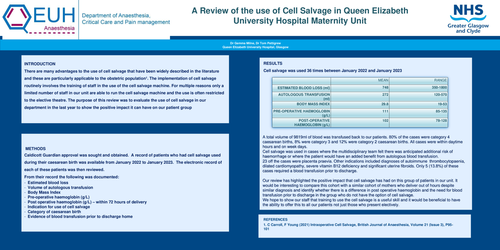
RESULTS Cell salvage was used 36 times between January 2022 and January 2023.A total volume of 9819ml of blood was transfused back to our patients. 80% of the cases were category 4 caesarean births, 8% were category 3 and 12% were category 2 caesarean births. All cases were within daytime hours and on week days. Cell salvage was used in cases where the multidisciplinary team felt there was anticipated additional risk of haemorrhage or where the patient would have an added benefit from autologous blood transfusion. 23 off the cases were placenta praevia. Other indications included diagnoses of autoimmune thrombocytopaenia, dilated cardiomyopathy, severe vitamin B12 deficiency and significant uterine fibroids. Only 5 (13.8%) of these cases required a blood transfusion prior to discharge. Our review has highlighted the positive impact that cell salvage has had on this group of patients in our unit. It would be interesting to compare this cohort with a similar cohort of mothers who deliver out of hours despite similar diagnosis and identify whether there is a difference in post operative haemoglobin and the need for blood transfusion prior to discharge in the group who do not have the option of cell salvage. We hope to show our staff that training to use the cell salvage is a useful skill and it would be beneficial to have the ability to offer this to all our patients not just those who present electively.
REFERENCES 1. C Carroll, F Young (2021) Intraoperative Cell Salvage, British Journal of Anaesthesia, Volume 21 (Issue 3), P95- 101