191 posters, 5 topics, 20 sessions, 393 authors, 116 institutions
ePostersLive by SciGen Technologies S.A. All rights reserved.
Obstetric Anaesthesia Annual Scientific Meeting 2023
18 - 19 May, 2023 | EICC Edinburgh

5794406
Safer handover in obstetric anaesthesia
Poster Presenter
Authors
Part of Topic
Quality Improvement
SAFER Handover in Obstetric Anaesthesia
Dr F Auld, Dr P Moffitt, Dr H Clancy, Dr N Aitken, Dr J Critchley, Dr C Collinson
Royal Infirmary of Edinburgh
Introduction
•Clear handover of patients in obstetric anaesthesia is essential in provision of safe continuity of care. A national survey has shown that utilising a formalised handover can reduce likelihood of critical incidents(1).
•The aim of this quality improvement project was to investigate the handover process in a local obstetric unit and provide a structure to improve patient safety.
Methods
•Data regarding the handover process was collected over 7 days in July 2022, including whether the safety brief was performed, handover location and whether every labour ward patient was handed over.
•
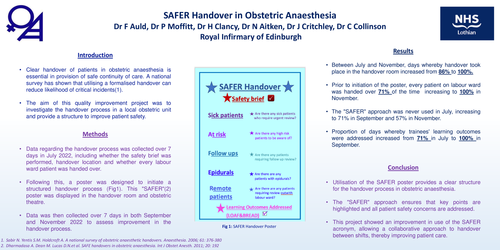
•Following this, a poster was designed to initiate a structured handover process (Fig1). This "SAFER"(2) poster was displayed in the handover room and obstetric theatre.
•
•Data was then collected over 7 days in both September and November 2022 to assess improvement in the handover process.
Results
•Between July and November, days whereby handover took place in the handover room increased from 86% to 100%.
•
•Prior to initiation of the poster, every patient on labour ward was handed over 71% of the time increasing to 100% in November.
•
•The "SAFER" approach was never used in July, increasing to 71% in September and 57% in November.
•Proportion of days whereby trainees' learning outcomes were addressed increased from 71% in July to 100% in September.
Conclusion
•Utilisation of the SAFER poster provides a clear structure for the handover process in obstetric anaesthesia.
•
•The "SAFER" approach ensures that key points are highlighted and all patient safety concerns are addressed.
•
•This project showed an improvement in use of the SAFER acronym, allowing a collaborative approach to handover between shifts, thereby improving patient care.