191 posters, 5 topics, 20 sessions, 393 authors, 116 institutions
ePostersLive by SciGen Technologies S.A. All rights reserved.
Obstetric Anaesthesia Annual Scientific Meeting 2023
18 - 19 May, 2023 | EICC Edinburgh

5761295
Educating midwives in safe management of labour epidurals: design and delivery of a multi-modal learning session
Poster Presenter
Part of Topic
Quality Improvement
Educating midwives in safe management of labour epidurals: Design and delivery of a multi-modal learning session
Introduction
As a result of the Ockenden review, there is a renewed drive to improve safety within obstetric anaesthesia. Within our trust, a need to further improve safe management of labour epidurals was identified as a key priority. To address this, an educational programme was designed and delivered to midwives which aimed to improve confidence in identifying and managing epidural complications.
Methods
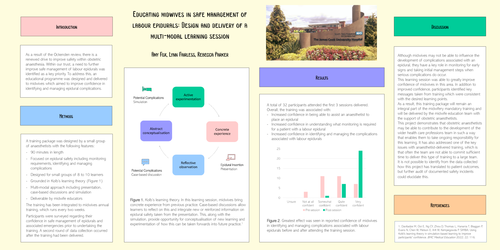
A training package was designed by a small group of anaesthetists with the following features:
The training has been integrated to midwives annual training, which runs every two weeks.
Participants were surveyed regarding their confidence in safe management of epidurals and associated emergencies prior to undertaking the training. A second round of data collection occurred after the training had been delivered.
Results
A total of 32 participants attended the first 3 sessions delivered. Overall, the training was associated with:
Although midwives may not be able to influence the development of complications associated with an epidural, they have a key role in monitoring for early signs and taking initial management steps when serious complications do occur.
This learning session was able to greatly improve confidence of midwives in this area. In addition to improved confidence, participants identified key messages taken from training which were consistent with the desired learning points.
As a result, this training package will remain an integral part of the midwifery mandatory training and will be delivered by the midwife education team with the support of obstetric anaesthetists.
This project demonstrates that obstetric anaesthetists may be able to contribute to the development of the wider health care professions team in such a way that enables them to take ongoing responsibility for this learning. It has also addressed one of the key issues with anaesthetist-delivered training, which is that often the team are not able to commit sufficient time to deliver this type of training to a large team.
It is not possible to identify from the data collected how this project has translated to patient outcomes, but further audit of documented safety incidents could elucidate this.