586 posters, 8 topics, 23 sessions, 1,077 authors, 622 institutions
ePostersLive by SciGen Technologies S.A. All rights reserved.
ISQua's 40th International Conference 2024
24th - 27th September 2024 | Istanbul, Türkiye

P662
Effects of social isolation due to COVID-19 for childhood asthma
Poster Presenter
Authors
Affiliations
null,
Part of Topic
External Evaluation
Effects of social isolation due to COVID-19 for childhood asthma
INTRODUCTION
•The COVID-19 pandemic has had far-reaching global effects and resulted in huge changes to our daily lifestyles. The government enforces social isolation and establishes preventive measures to restrict the original lifestyle.
•Social policies implement the closure of the education system, changing living habits and social behaviors. These changes have had a great impact on the incidence of respiratory diseases as it affects existing healthcare-seeking habits.
•In particular, follow-up treatment is important for childhood asthma. If asthma is uncontrolled, it may be life-threatening in severe cases.
AIM
•The aim of this study is to examine the impact of the COVID-19 pandemic social isolation on healthcare-seeking behavior.
METHOD
• This was a retrospective cohort study of children aged 0– 18 years with a diagnosis of asthma receiving asthma treatment in a medical center in Taiwan with 10 branches. Data were collected from January 2015 to October 2023.
• Healthcare utilization in five time periods were compared according to the extent of COVID-19 pandemic:
• 1.baseline (January 2015 to December 2019)
• 2.defense stage (January 2020 to April 2021)
• 3.social distancing stage (May 2021 to March 2022)
• 4.peak stage (April 2022 to March 2023)
• 5.alleviation stage (April to September 2023).
• Five stages of the COVID-19 pandemic were statistically analyzed for the purpose of comparative analysis.
RESULTS
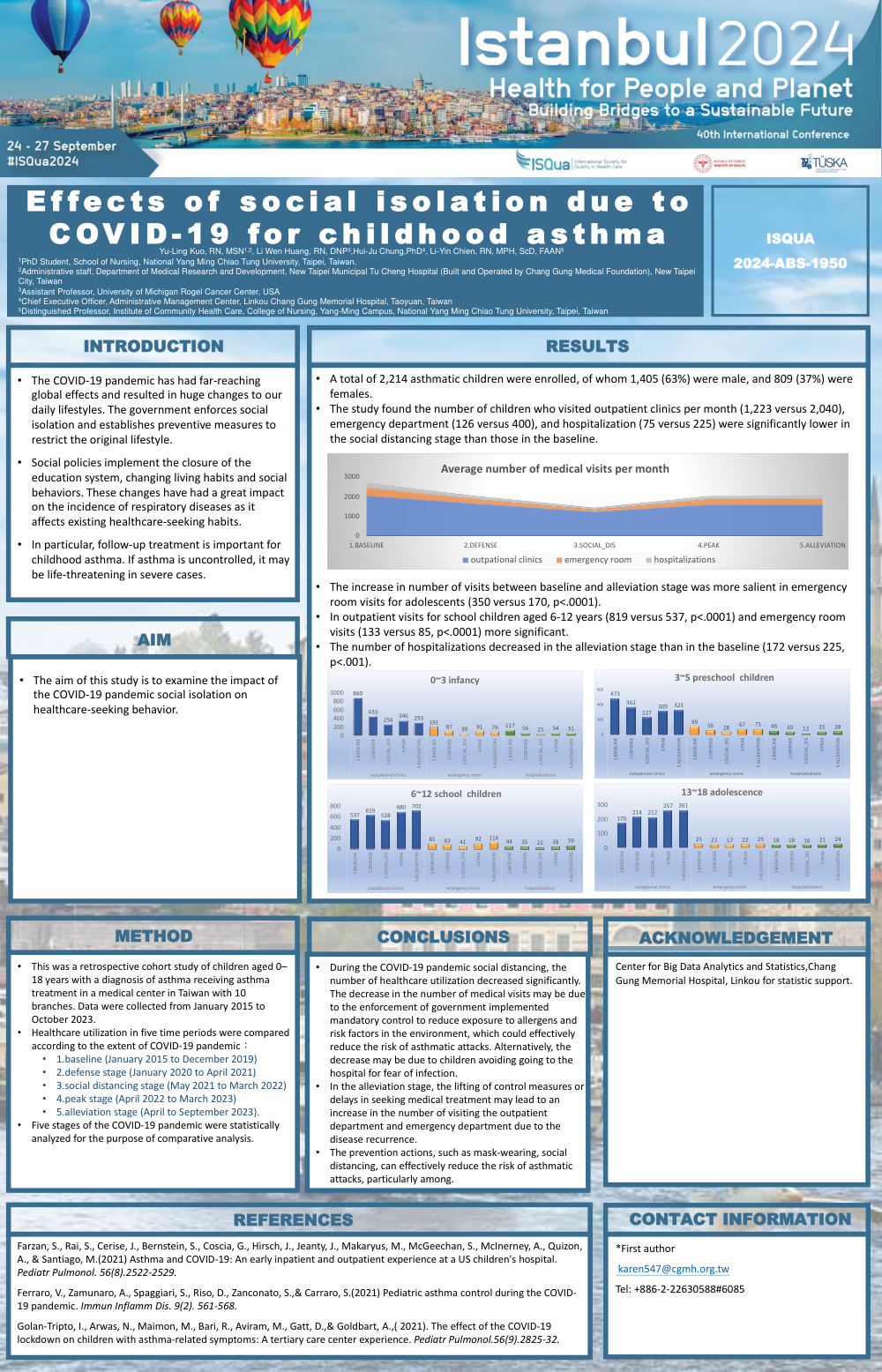
•A total of 2,214 asthmatic children were enrolled, of whom 1,405 (63%) were male, and 809 (37%) were females.
•The study found the number of children who visited outpatient clinics per month (1,223 versus 2,040), emergency department (126 versus 400), and hospitalization (75 versus 225) were significantly lower in the social distancing stage than those in the baseline.
•The increase in number of visits between baseline and alleviation stage was more salient in emergency room visits for adolescents (350 versus 170, p<.0001).•In outpatient visits for school children aged 6-12 years (819 versus 537, p<.0001) and emergency room visits (133 versus 85, p<.0001) more significant.
•The number of hospitalizations decreased in the alleviation stage than in the baseline (172 versus 225, p<.001).
CONCLUSIONS
•During the COVID-19 pandemic social distancing, the number of healthcare utilization decreased significantly. The decrease in the number of medical visits may be due to the enforcement of government implemented mandatory control to reduce exposure to allergens and risk factors in the environment, which could effectively reduce the risk of asthmatic attacks. Alternatively, the decrease may be due to children avoiding going to the hospital for fear of infection.
•In the alleviation stage, the lifting of control measures or delays in seeking medical treatment may lead to an increase in the number of visiting the outpatient department and emergency department due to the disease recurrence.
•The prevention actions, such as mask-wearing, social distancing, can effectively reduce the risk of asthmatic attacks, particularly among.
Keywords: COVID-19, childhood asthma, social isolation