586 posters, 8 topics, 23 sessions, 1,077 authors, 622 institutions
ePostersLive by SciGen Technologies S.A. All rights reserved.
ISQua's 40th International Conference 2024
24th - 27th September 2024 | Istanbul, Türkiye

P638
Performance Management of Generalist Care for Hospitalised Multimorbid Patients - A Scoping Review for Value-Based Care
Poster Presenter
Part of Topic
External Evaluation
Performance Management of Generalist Care for Hospitalised Multimorbid Patients - A Scoping Review for Value-Based Care
J.E.J.KHOO1,2, C.W. LIM 1,3 and Y.F. LAI1,4,5
1 MOH Office for Healthcare Transformation, Singapore
2 Department of Life Sciences, Faculty of Science, National University of Singapore, Singapore
3 Saw Swee Hock School of Public Health, National University of Singapore, Singapore
4 Department of Pharmacy, Faculty of Science, National University of Singapore, Singapore
5 School of Public Health, University of Illinois at Chicago, Chicago, United States
Generalist care is increasingly recognised as important in responding to rising multimorbidity. There has also been a shift from fee-for-service to value-based healthcare (VBHC) globally, where value is often evaluated based on health outcomes of the patient against the cost. Given these shifts, enacting VBHC for generalist care is critical. However, multimorbidity is a challenge to the implementation of VBHC which has focused on individual diseases. Implementation of VBHC has also fallen behind in the inpatient setting.
This work responds to the generalist inpatient gap in the current disease-specific, ambulatory care focused implementation of value-based care globally. It aims to shed light on how to conduct performance management of generalist care to facilitate value-based care, with a focus on medical care of hospitalised patients. The review will identify the level of existing research in this area and draw insights to inform implementation of performance management for value-based generalist inpatient care.
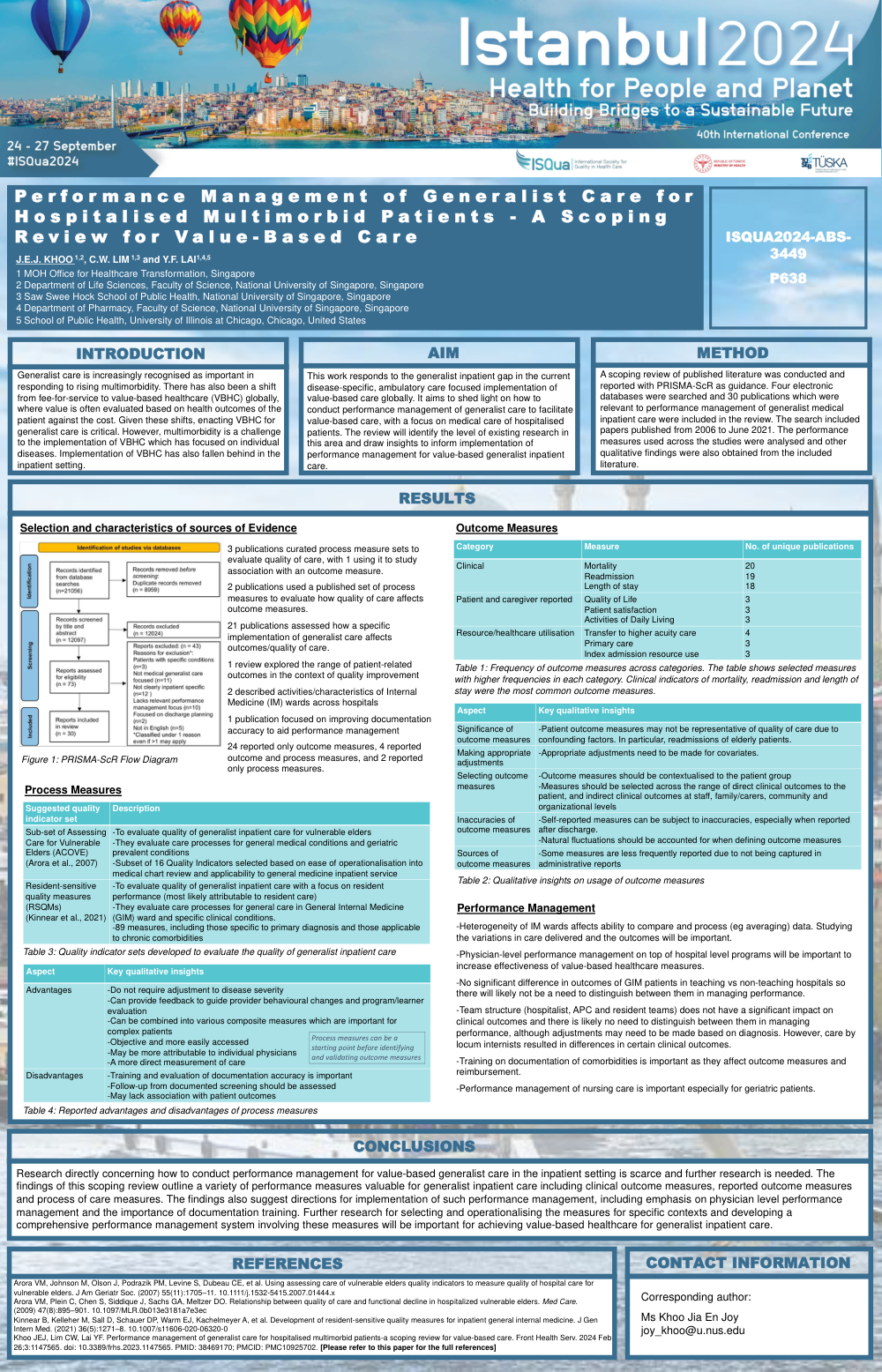
A scoping review of published literature was conducted and reported with PRISMA-ScR as guidance. Four electronic databases were searched and 30 publications which were relevant to performance management of generalist medical inpatient care were included in the review. The search included papers published from 2006 to June 2021. The performance measures used across the studies were analysed and other qualitative findings were also obtained from the included literature.
3 publications curated process measure sets to evaluate quality of care, with 1 using it to study association with an outcome measure.
2 publications used a published set of process measures to evaluate how quality of care affects outcome measures.
21 publications assessed how a specific implementation of generalist care affects outcomes/quality of care.
1 review explored the range of patient-related outcomes in the context of quality improvement
2 described activities/characteristics of Internal Medicine wards across hospitals
1 publication focused on improving documentation accuracy to aid performance management
24 reported only outcome measures, 4 reported outcome and process measures, and 2 reported only process measures.
Performance Management
Heterogeneity of IM wards affects ability to compare and process (eg averaging) data. Studying the variations in care delivered and the outcomes will be important.
-Physician-level performance management on top of hospital level programs will be important to increase effectiveness of value-based healthcare measures.
-No significant difference in outcomes of GIM patients in teaching vs non-teaching hospitals so there will likely not be a need to distinguish between them in managing performance.
-Team structure (hospitalist, APC and resident teams) does not have a significant impact on clinical outcomes and there is likely no need to distinguish between them in managing performance, although adjustments may need to be made based on diagnosis. However, care by locum internists resulted in differences in certain clinical outcomes.
-Training on documentation of comorbidities is important as they affect outcome measures and reimbursement.
-Performance management of nursing care is important especially for geriatric patients.
Research directly concerning how to conduct performance management for value-based generalist care in the inpatient setting is scarce and further research is needed. The findings of this scoping review outline a variety of performance measures valuable for generalist inpatient care including clinical outcome measures, reported outcome measures and process of care measures. The findings also suggest directions for implementation of such performance management, including emphasis on physician level performance management and the importance of documentation training. Further research for selecting and operationalising the measures for specific contexts and developing a comprehensive performance management system involving these measures will be important for achieving value-based healthcare for generalist inpatient care.