586 posters, 8 topics, 23 sessions, 1,077 authors, 622 institutions
ePostersLive by SciGen Technologies S.A. All rights reserved.
ISQua's 40th International Conference 2024
24th - 27th September 2024 | Istanbul, Türkiye

P635
Development of a hospitalization appropriateness screening tool for adult using electronic claim data
Part of Topic
External Evaluation
Development of a Hospitalization Appropriateness Screening Tool for Adult using Electronic Claim Data
H. JUNG 1 2, J.Y. LEE 1 2 3 and J.S. LEE 1 3
1 Department of Health Policy and Management, Seoul National University College of Medicine
2 Institute of Public Health and Medical Service, Seoul National University Hospital
3 Institute of Health Policy and Management, Medical Research Centre, Seoul National University
Introduction
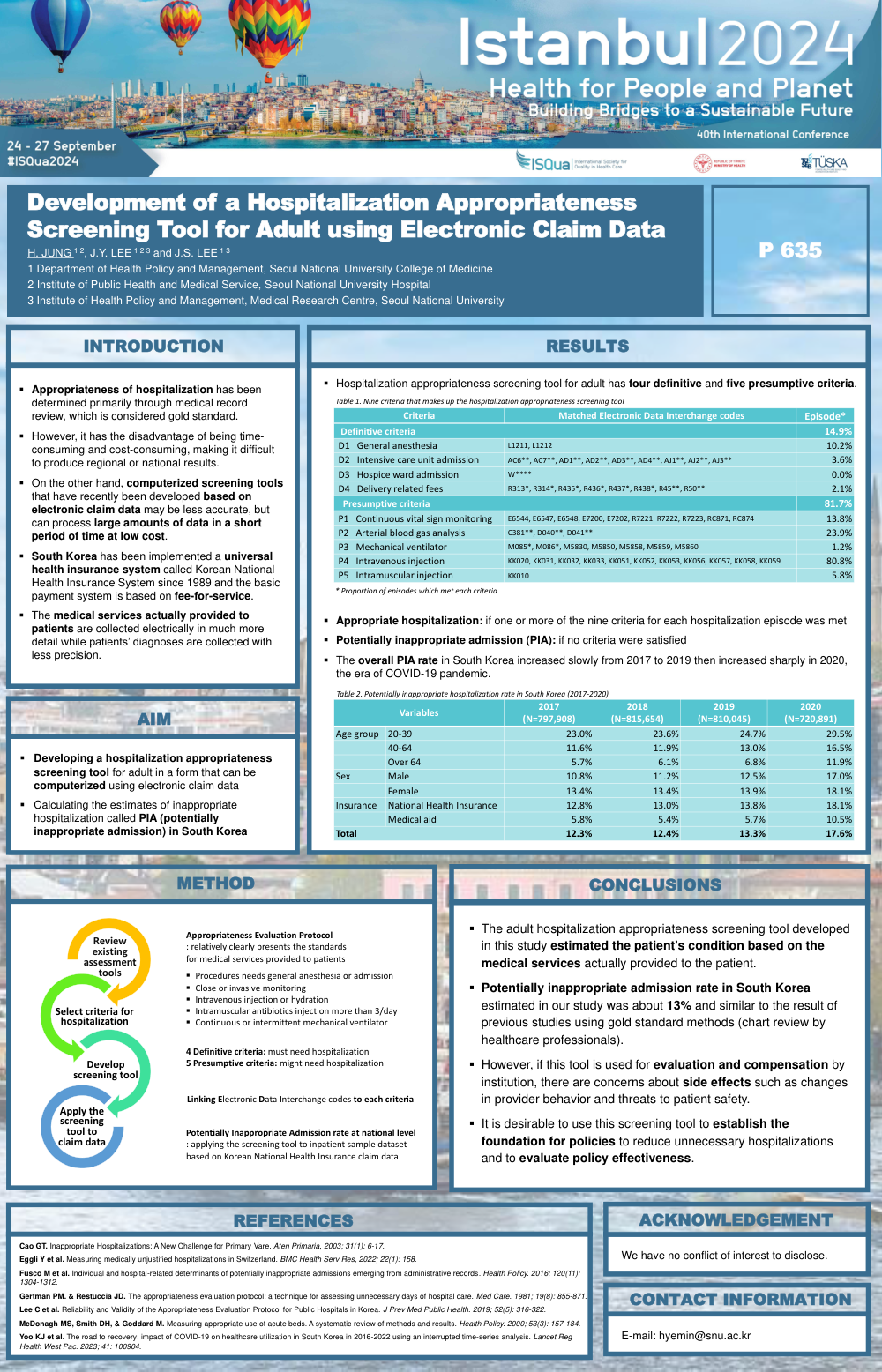
▪ Appropriateness of hospitalization has been determined primarily through medical record review, which is considered gold standard. However, it has the disadvantage of being time-consuming and cost-consuming, making it difficult to produce regional or national results. On the other hand, computerized screening tools that have recently been developed based on electronic claim data may be less accurate, but can process large amounts of data in a short period of time at low cost.
▪ South Korea has been implemented a universal health insurance system called Korean National Health Insurance System since 1989 and the basic payment system is based on fee-for-service. The medical services actually provided to patients are collected electrically in much more detail while patients’ diagnoses are collected with less precision.
▪ Two aims of this study: 1) Developing a hospitalization appropriateness screening tool for adult in a form that can be computerized using electronic claim data 2) Calculating the estimates of inappropriate hospitalization called PIA (potentially inappropriate admission) in South Korea
Results & Conclusions
▪ The adult hospitalization appropriateness screening tool developed in this study estimated the patient's condition based on the medical services actually provided to the patient. Hospitalization appropriateness screening tool for adult has four definitive and five presumptive criteria.
▪ Potentially inappropriate admission rate in South Korea estimated in our study was about 13% and similar to the result of previous studies using gold standard methods (chart review by healthcare professionals).
▪ However, if this tool is used for evaluation and compensation by institution, there are concerns about side effects such as changes in provider behavior and threats to patient safety. It is desirable to use this screening tool to establish the foundation for policies to reduce unnecessary hospitalizations and to evaluate policy effectiveness.