586 posters, 8 topics, 23 sessions, 1,077 authors, 622 institutions
ePostersLive by SciGen Technologies S.A. All rights reserved.
ISQua's 40th International Conference 2024
24th - 27th September 2024 | Istanbul, Türkiye

P654
Challenges of international patient safety goals in radiology and diagnostic imaging - Accreditation in radiology
Poster Presenter
Authors
Affiliations
Part of Topic
External Evaluation
Challenges of international patient safety goals in radiology and diagnostic imaging - Accreditation in radiology
Ruy M. Guimaraes* 1, Cássia Souza1, André André Silva2, Ana Paula Rangel1, Cristina Khawali1
1Certification, CBR - Brazilian College of Radiology and Diagnostic Imaging, São Paulo, 2Certification, CBR - Brazilian College of Radiology and Diagnostic Imaging, SP, Brazil
Introduction: The six international patient safety goals are a set of objectives that aim to improve the safety and quality of care provided to patients. These goals were developed with the aim of providing clear guidelines to improve patient safety and prevent adverse events in healthcare settings. The Brazilian College of Radiology and Imaging Diagnosis, through Padi (Accreditation Program in Imaging Diagnosis), establishes quality and safety standards, related to the 6 international patient safety goals, specific to radiology and imaging diagnostic services.
Methods: Sum of the number of standards classified as Non-Conforming, in the accreditation and maintenance audits, of the Image Diagnosis Accreditation Program, Padi. Data collection, through external audit reports, on the number of non-conformities related to the 6 international patient safety goals, per audited service.
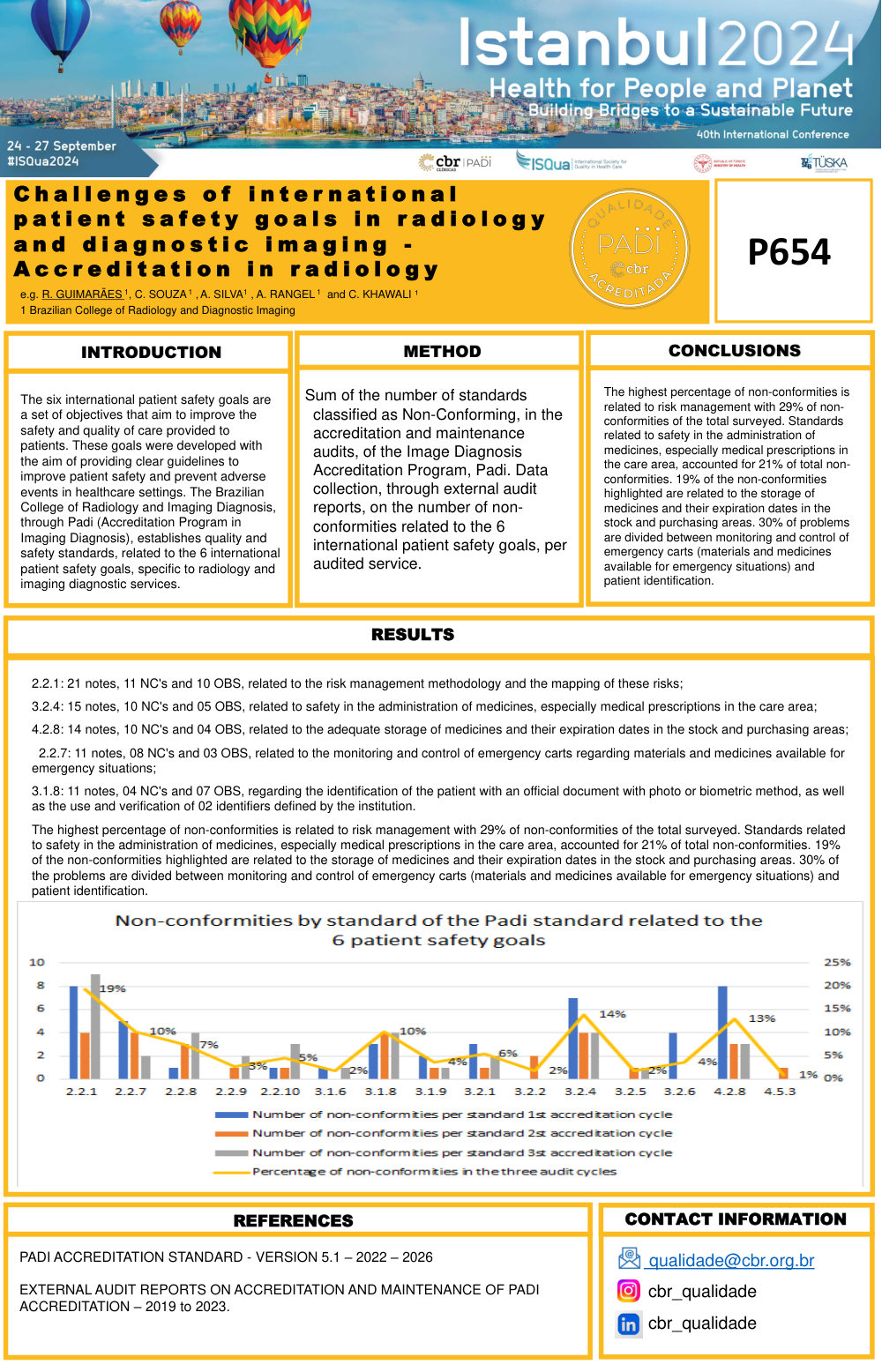
Results: 2.2.1: 21 notes, 11 NC's and 10 OBS, related to the risk management methodology and the mapping of these risks;
3.2.4: 15 notes, 10 NC's and 05 OBS, related to safety in the administration of medicines, especially medical prescriptions in the care area;
4.2.8: 14 notes, 10 NC's and 04 OBS, related to the adequate storage of medicines and their expiration dates in the stock and purchasing areas;
2.2.7: 11 notes, 08 NC's and 03 OBS, related to the monitoring and control of emergency carts regarding materials and medicines available for emergency situations;
3.1.8: 11 notes, 04 NC's and 07 OBS, regarding the identification of the patient with an official document with photo or biometric method, as well as the use and verification of 02 identifiers defined by the institution.
The highest percentage of non-conformities is related to risk management with 29% of non-conformities of the total surveyed. Standards related to safety in the administration of medicines, especially medical prescriptions in the care area, accounted for 21% of total non-conformities. 19% of the non-conformities highlighted are related to the storage of medicines and their expiration dates in the stock and purchasing areas. 30% of the problems are divided between monitoring and control of emergency carts (materials and medicines available for emergency situations) and patient identification.
Conclusion: The highest percentage of non-conformities is related to risk management with 29% of non-conformities of the total surveyed. Standards related to safety in the administration of medicines, especially medical prescriptions in the care area, accounted for 21% of total non-conformities. 19% of the non-conformities highlighted are related to the storage of medicines and their expiration dates in the stock and purchasing areas. 30% of problems are divided between monitoring and control of emergency carts (materials and medicines available for emergency situations) and patient identification.
References: PADI ACCREDITATION STANDARD - VERSION 5.1 – 2022 – 2026
EXTERNAL AUDIT REPORTS ON ACCREDITATION AND MAINTENANCE OF PADI ACCREDITATION – 2019
to 2023.