586 posters, 8 topics, 23 sessions, 1,077 authors, 622 institutions
ePostersLive by SciGen Technologies S.A. All rights reserved.
ISQua's 40th International Conference 2024
24th - 27th September 2024 | Istanbul, Türkiye

P653
Importance of Accreditation in Clinical Engineering in Radiology and Diagnostic Imaging
Poster Presenter
Authors
Affiliations
Part of Topic
External Evaluation
Importance of Accreditation in Clinical Engineering in Radiology and Diagnostic Imaging
Ruy M. Guimaraes* 1, Cássia Souza1, Laura Acauan Acauan1, Anderson Mattozinhos Mattozinhos1, André Silva1
1Certification, CBR - Brazilian College of Radiology and Diagnostic Imaging, São Paulo, Brazil
Introduction: Poorly maintained or inadequately calibrated equipment can pose risks to patient safety. Clinical engineering accreditation helps ensure that equipment is operating correctly and within safe parameters, minimizing risks associated with radiation exposure and other hazards.
Accreditation plays a crucial role in maintaining quality, safety and compliance with regulatory standards in the field of clinical radiology engineering. This results in significant benefits for patient safety, diagnostic reliability and operational efficiency.
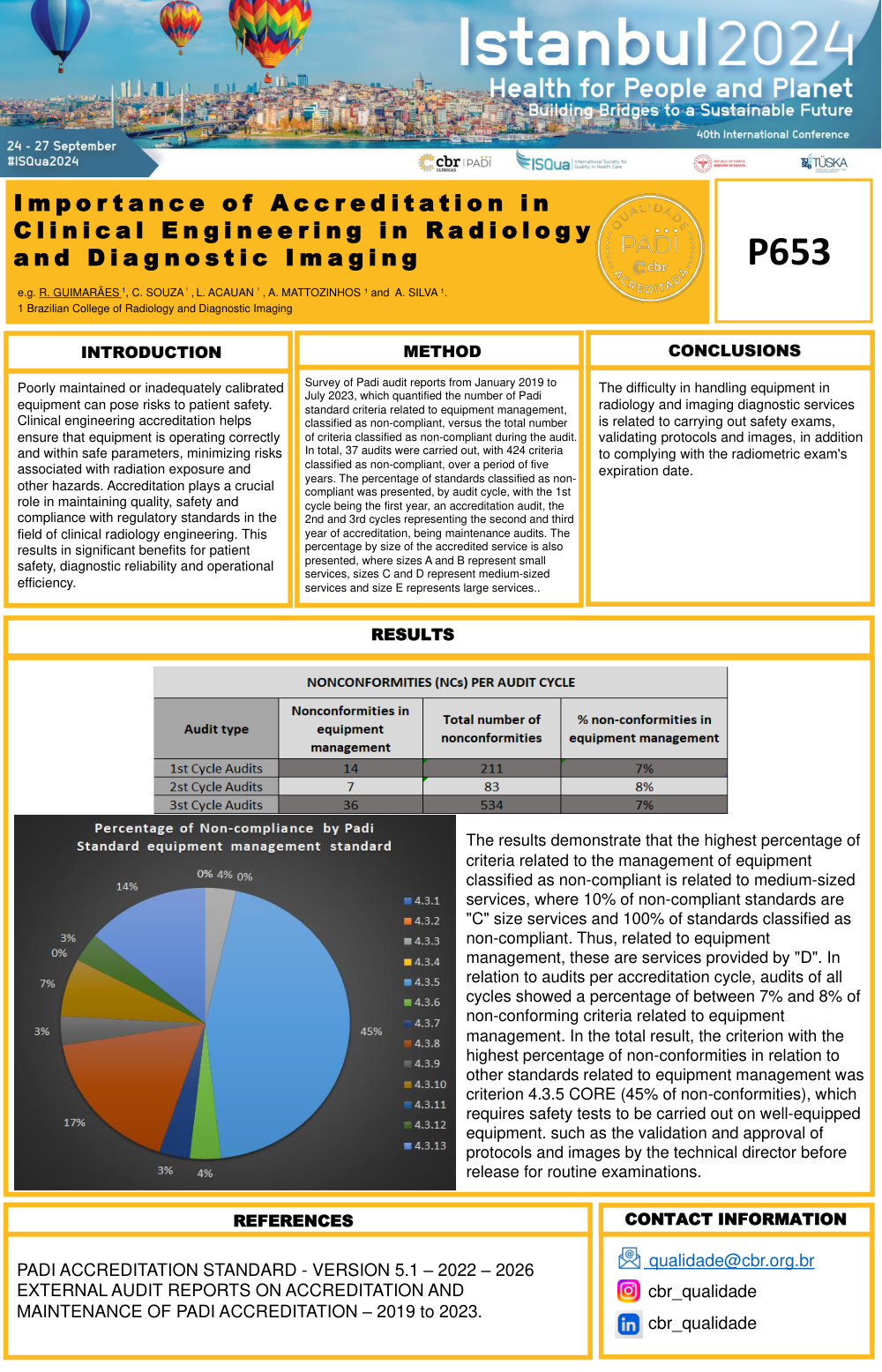
Methods: Survey of Padi audit reports from January 2019 to July 2023, which quantified the number of Padi standard criteria related to equipment management, classified as non-compliant, versus the total number of criteria classified as non-compliant during the audit. In total, 37 audits were carried out, with 424 criteria classified as non-compliant, over a period of five years. The percentage of standards classified as non-compliant was presented, by audit cycle, with the 1st cycle being the first year, an accreditation audit, the 2nd and 3rd cycles representing the second and third year of accreditation, being maintenance audits. The percentage by size of the accredited service is also presented, where sizes A and B represent small services, sizes C and D represent medium-sized services and size E represents large services.
Results: The results demonstrate that the highest percentage of criteria related to the management of equipment classified as non-compliant is related to medium-sized services, where 10% of non-compliant standards are "C" size services and 100% of standards classified as non-compliant. Thus, related to equipment management, these are services provided by "D". In relation to audits per accreditation cycle, audits of all cycles showed a percentage of between 7% and 8% of non-conforming criteria related to equipment management. In the total result, the criterion with the highest percentage of non-conformities in relation to other standards related to equipment management was criterion 4.3.5 CORE (45% of non-conformities), which requires safety tests to be carried out on well-equipped equipment. such as the validation and approval of protocols and images by the technical director before release for routine examinations.
Conclusion: The difficulty in handling equipment in radiology and imaging diagnostic services is related to carrying out safety exams, validating protocols and images, in addition to complying with the radiometric exam's expiration date.
References: PADI ACCREDITATION STANDARD - VERSION 5.1 – 2022 – 2026
EXTERNAL AUDIT REPORTS ON ACCREDITATION AND MAINTENANCE OF PADI ACCREDITATION – 2019 to 2023.