586 posters, 8 topics, 23 sessions, 1,077 authors, 622 institutions
ePostersLive by SciGen Technologies S.A. All rights reserved.
ISQua's 40th International Conference 2024
24th - 27th September 2024 | Istanbul, Türkiye

P626
ASSESSMENT OF ORGANIZATIONAL CULTURE OF HOSPITALS AND ITS ASSOCIATION WITH ACCREDITATION
Poster Presenter
Authors
Affiliations
Part of Topic
External Evaluation
ASSESSMENT OF ORGANIZATIONAL CULTURE OF HOSPITALS AND ITS ASSOCIATION WITH ACCREDITATION
Introduction: Institutions that have an alignment between the dominant organizational culture, the style of their leaders,
the human resources management and quality management, perform better when compared to those without this
alignment (Cameron & Quinn, 2006). Organizational culture can be a barrier to improving the quality of services and
patient safety (Alaraki, 2018). The diagnosis of organizational culture is considered essential in the management of
institutions. The aim of this study was to identify the dominant organizational culture of hospitals and evaluate its
relationship with the accreditation.
Methods: A survey is carried out in 90 Brazilian hospitals, using the Organizational Culture Assessment Instrument
(OCAI) (Cameron & Quinn, 2006). About 56% of the hospitals have some accreditation of which: 41 institutions were
accredited by the National Accreditation Organization (ONA) from Brazil, nine by the Joint Commission International (JCI)
and six had other international accreditations. The questionnaires were, whenever possible, forwarded to the person
responsible for the quality or administrative area of the institution. As an inclusion criterion, a minimum time of six months
in the position was used, in addition to the professional's function. Descriptive and multivariate statistical analysis
(clustering) techniques were applied to analyze the results. Before the data collection phase, the project was approved by
the Ethics Committee. The participants were informed about the study objective, and they signed the Informed Consent
Form.
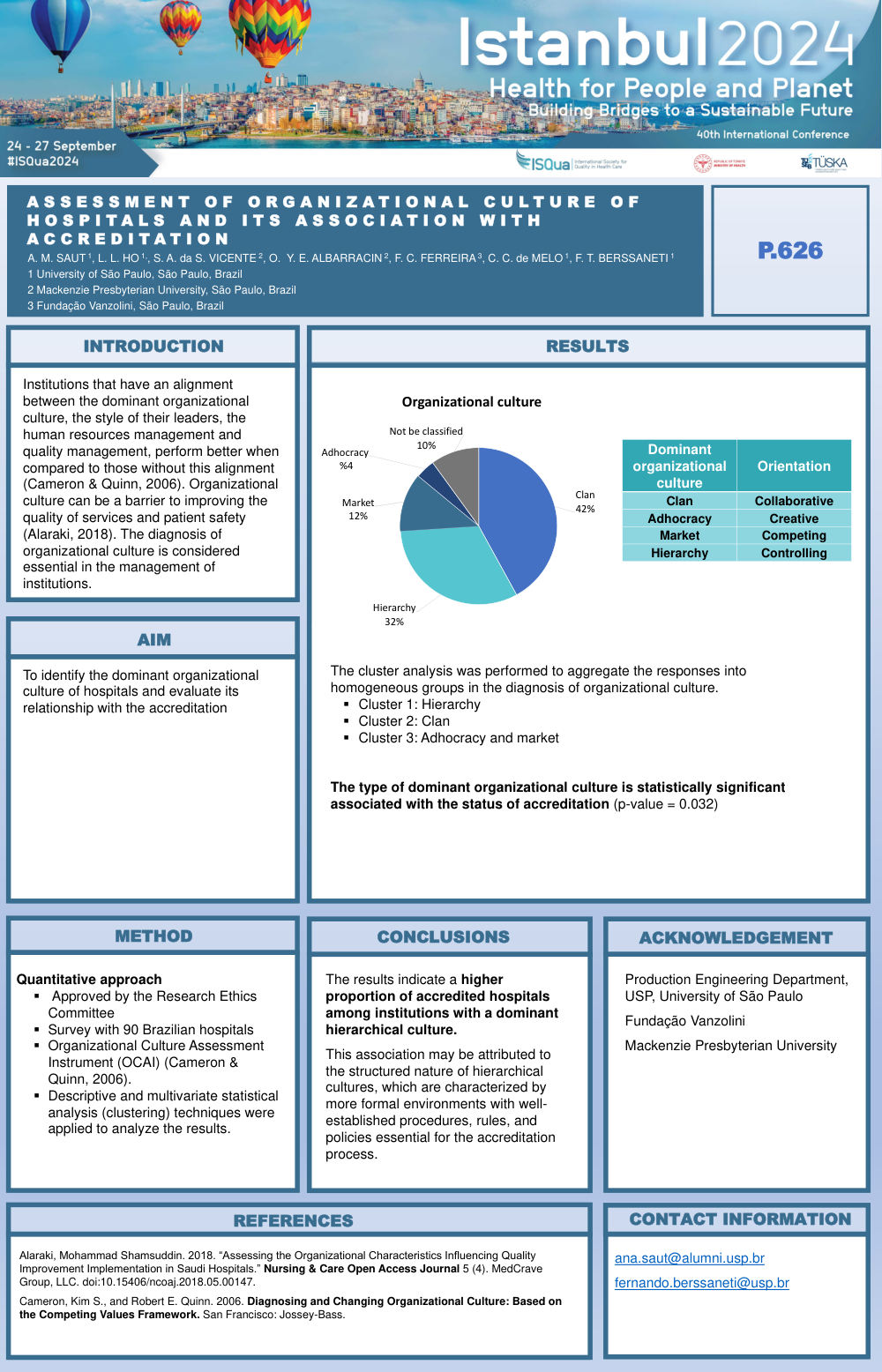
Results: 42% of the participating hospitals had the dominant clan-type culture, 32% hierarchy, 12% market, 4%
adhocracy and 8.88% could not be classified into a single dominant culture. The type of dominant organizational culture
is statistically significant associated with the status of accreditation (p-value = 0.032), as a higher proportion of accredited
hospitals among institutions with dominant hierarchy culture was observed than clan culture.
Conclusion: The results of the research indicate a higher proportion of accredited hospitals among institutions with a
dominant hierarchical culture. This association may be attributed to the structured nature of hierarchical cultures, which
are characterized by more formal environments with well-established procedures, rules, and policies essential for the
accreditation process.