586 posters, 8 topics, 23 sessions, 1,077 authors, 622 institutions
ePostersLive by SciGen Technologies S.A. All rights reserved.
ISQua's 40th International Conference 2024
24th - 27th September 2024 | Istanbul, Türkiye

P641
BRAZILIAN ACCREDITATION AND QUALITY CONTROL PROGRAM - NEW GENERATION STANDARDS PROMOTING SAFETY AND QUALITY CULTURE IN ANATOMIC PATHOLOGY LABORATORY
Part of Topic
External Evaluation
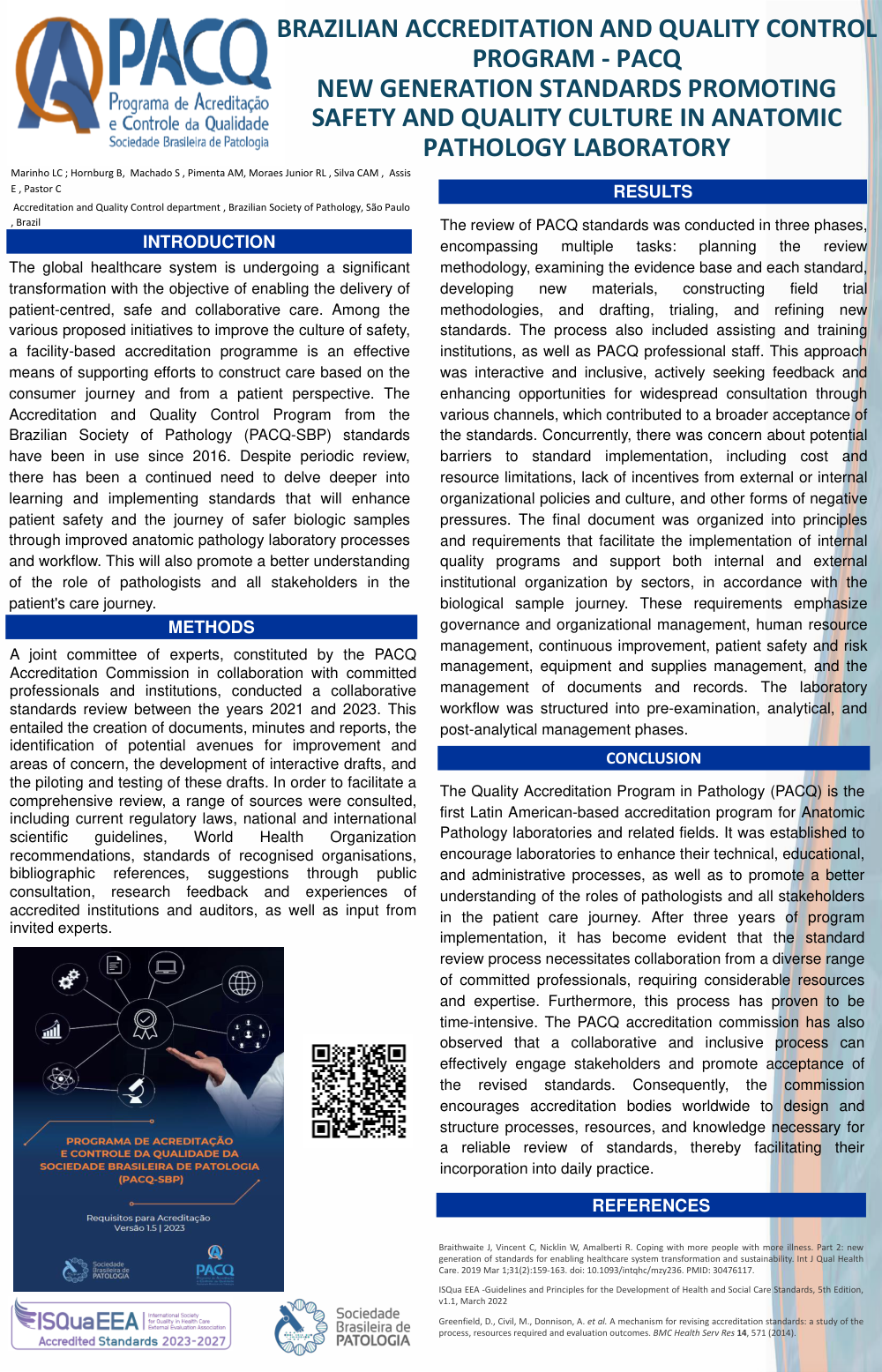
BRAZILIAN ACCREDITATION AND QUALITY CONTROL PROGRAM - PACQ NEW GENERATION STANDARDS PROMOTING SAFETY AND QUALITY CULTURE IN ANATOMIC PATHOLOGY LABORATORY
INTRODUCTION : Healthcare systems worldwide are undergoing substantial transformation to enable delivery of patient-centered, safe and collaborative care. Among various proposed initiatives to improve the culture of safety, a facility-based accreditation program supports efforts to build care based around consumer journey and from a patient perspective. The Accreditation and Quality Control Program from Brazilian Society of Pathology (PACQ- SBP) standards have been in use since 2016 and despite periodic review we were rechallenged to delve deeper into learning and implementing standards that will enhance patient safety and safer biologic samples journey through improved anatomic pathology laboratory processes and workflow and promote better understanding of pathologists and all role on the patient's care journey.
METHODS : An expert group constituted by PACQ accreditation commission in collaboration with committed professionals and institutions led between years 2021 and 2023 collaboratively standards review in stages, elaborating documents, minutes and reports, identifying opportunities and problem areas, developing interactive drafts, piloting and testing. For its review, current regulatory laws, national and international scientific guidelines, World Health
Organization recommendations, standards of recognized organizations, bibliographic references ,suggestions through public consultation, research feedback and experiences of accredited institutions and auditors, invited expert, among others were used.
RESULTS : PACQ standards review comprised three phases with multiple tasks, including review methodology planning; review of the evidence base and each standard; new material development; constructing field trial methodology; drafting, trialling and refining new standards and finally assisting and training institutions and PACQ professional staff. The approach was an interactive and inclusive process, seeking and incorporating feedback and enhancing the scope for widespread consultation through as many channels as possible and these processes resulted in greater acceptance of the standards. As the same time we were worried about avoiding factors that hind standard implementation: cost and resource constraints, lack of external or internal (organisational policies and culture) incentives and any other kind of negative pressure. Final document version was organized into principles and requirements that facilitates internal quality program implementation as well as internal and external institutional organization by sectors and according to biological sample journey. These requirements focus on governance and organizational management, people management, continuous improvement management, patient safety and risk management, equipment and supplies management and documents and records management. The lab workflow has been organized in pre-examination, analytical and postanalytical management phases.
CONCLUSION: PACQ is the first Latin American based accreditation program for Anatomic Pathology laboratories and related areas, created to encourage laboratories to improve their technical, educational and administrative processes and promote better understanding of pathologists and all role on the
patient's care journey. After eight three years program experience is very clear that standard review process requires collaboration from a diverse range of committed professionals, with considerable resources and expertise, and the process is time consuming. PACQ accreditation commission also noted
that collaborative and inclusive process can engage stakeholders and promote acceptance of the revised standards and encourage accreditation bodies around the world to design and structure processes, resources and knowledge necessary for reliable review of standards, so that they can be incorporated into daily practice.
