586 posters, 8 topics, 23 sessions, 1,077 authors, 622 institutions
ePostersLive by SciGen Technologies S.A. All rights reserved.
ISQua's 40th International Conference 2024
24th - 27th September 2024 | Istanbul, Türkiye

P650
Impact of surveyor training on the development of surveyor competencies and good practices as healthcare professionals
Poster Presenter
Authors
Affiliations
Part of Topic
External Evaluation
Title:
Impact of surveyor training on the development of surveyor competencies and good practices as healthcare professionals
Authors:
R. Slouma; M. Chraiet ; S. Essaafi ; C.Hamouda
Introduction
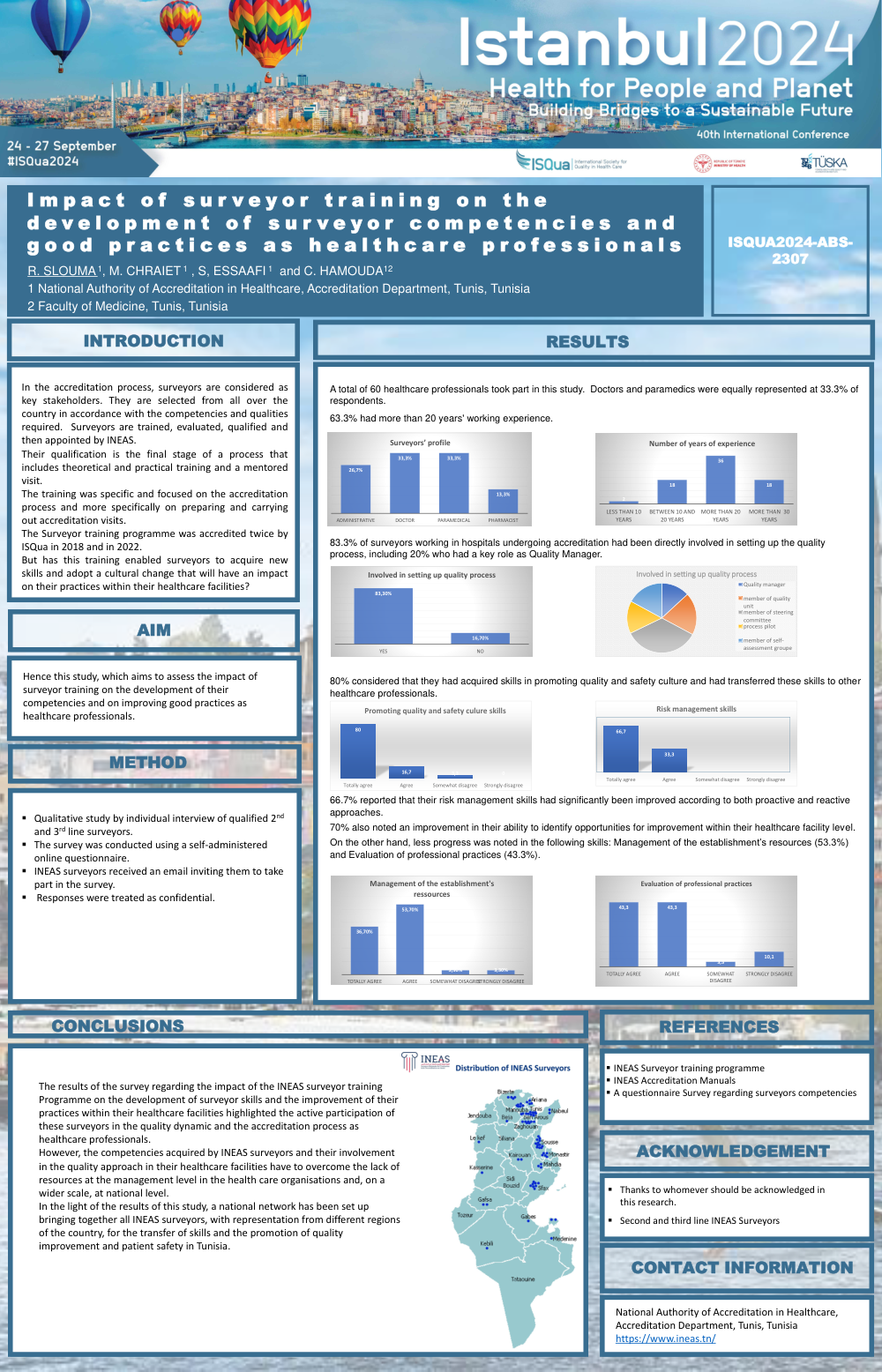
In the accreditation process, surveyors are considered as key stakeholders. They are selected from all over the country in accordance with the competencies and qualities required. Surveyors are trained, evaluated, qualified and then appointed by INEAS. Their qualification is the final stage of a process that includes theoretical and practical training and a mentored visit.
The training was specific and focused on the accreditation process and more specifically on preparing and carrying out accreditation visits.
The Surveyor training programme was accredited twice by ISQua in 2018 and in 2022.
But has this training enabled surveyors to acquire new skills and adopt a cultural change that will have an impact on their practices within their healthcare facilities?
Hence this study, which aims to assess the impact of surveyor training on the development of their competencies and on improving good practices as healthcare professionals.
Method
Qualitative study by individual interview of qualified 2nd and 3rd line surveyors.
The survey was conducted using a self-administered online questionnaire. INEAS surveyors received an email inviting them to take part in the survey. Responses were treated as confidential.
Results
A total of 60 healthcare professionals took part in this study. Doctors and paramedics were equally represented at 33.3% of respondents.
63.3% had more than 20 years' working experience.
83.3% of surveyors working in hospitals undergoing accreditation had been directly involved in setting up the quality process, including 20% who had a key role as Quality Manager.
80% considered that they had acquired skills in promoting quality and safety culture and had transferred these skills to other healthcare professionals.
66.7% reported that their risk management skills had significantly been improved according to both proactive and reactive approaches.
70% also noted an improvement in their ability to identify opportunities for improvement within their healthcare facility level.
On the other hand, less progress was noted in the following skills: Management of the establishment’s resources (53.3%) and Evaluation of professional practices (43.3%).
Conclusion
The results of the survey regarding the impact of the INEAS surveyor training Programme on the development of surveyor skills and the improvement of their practices within their healthcare facilities highlighted the active participation of these surveyors in the quality dynamic and the accreditation process as healthcare professionals.
However, the competencies acquired by INEAS surveyors and their involvement in the quality approach in their healthcare facilities have to overcome the lack of resources at the management level in the health care organisations and, on a wider scale, at national level.
In the light of the results of this study, a national network has been set up bringing together all INEAS surveyors, with representation from different regions of the country, for the transfer of skills and the promotion of quality improvement and patient safety in Tunisia.