586 posters, 8 topics, 23 sessions, 1,077 authors, 622 institutions
ePostersLive by SciGen Technologies S.A. All rights reserved.
ISQua's 40th International Conference 2024
24th - 27th September 2024 | Istanbul, Türkiye

P642
Latest Developments in Quality Management at PHC level in Tajikistan
Poster Presenter
Authors
Lola Olimova, Gulruz Bobov, Davlatmurod Olimov, Peter Campbell, Bakhtiyor Yorakov
Affiliations
Part of Topic
External Evaluation
LATEST DEVELOPMENTS IN QUALITY MANAGEMENT
AT RURAL PHC LEVEL IN TAJIKISTAN
L. Olimova1; G. Bobov2; P. Campbell3; D. Olimov4; B. Yorakov5
1.Deputy Program Manager forImproved Maternal, Infant and Child Nutrition in Rural Tajikistan, Deutsche Gesellschaft für Internationale Zusammenarbeit (GIZ) GmbH, GIZ Office Dushanbe, Diar Business Centre/ N. Huvaydulloev Street 2/1, 734049 Dushanbe, Tajikistan. Also Deputy Program Manager Mother-Neonatal and Child Health in Tajikistan, Building a System on Integrated Primary Health Care in Tajikistan (BaSIC): partof Health Development Programme co-fundedbythe EU and BMZ
2. Specialistfor Quality Improvement (QI) and Accreditation in Health Care Facilities, Improved Maternal, Infant and Child Nutrition in Rural Tajikistan / Mother-Neonatal and Child Health in Tajikistan Building a System on Integrated Primary Health Care in Tajikistan (BaSIC) Part of Health Development Programme co-fundedbythe European Union and BMZ; Deutsche Gesellschaft fur Internationale Zusammenarbeit (GIZ) GmbH
3. International Consultant in Quality Management for BaSIC Project
4. Deputy Director of the Service for State Supervision of Health and Social Protection of the Population, RepublicofTajikistan
5. Directorof Medical Accreditation Center, RepublicofTajikistan
Introduction: For full accreditation of Tajikistan’s Primary Health Care (PHC) facilities, around 150 standards must be followed. Compliance with these standards through self-assessment
and external assessment is overseen by the Medical Accreditation Center of Tajikistan (MAC).
However, with around 4500 health facilities mandated to be accredited throughout the country, the process is going slowly. Therefore, with support from international partners, a streamlined preparatory mechanism has been developed to guide the PHC facilities to begin the process of accreditation with minimal supervision.
The leading partner in this work is the project “Building a System on Integrated Primary Health Care in Tajikistan” (BaSIC) which currently runs from June 2021 - May 2025. It works in cooperation with the Government of the Republic of Tajikistan, primarily the Ministry of Health and Social Protection (MOHSPP) and the Ministry of Finance (MoF). The BaSIC project is the main component of the €52 million EU Health Development Programme (EU HDP) together with funds from the German “Das Bundesministerium für wirtschaftliche Zusammenarbeit und Entwicklung“ (BMZ).
The BaSIC project aims to support 460 rural PHC facilities in the 4 regions of the country (see shaded areas in map) to conduct the self-assessments and Facility Improvement Plans (FIPs).
Methods: As a first step, 38 core PHC facility standards were developed out of the full list of 150 PHC accreditation standards - covering the four thematic areas of (i) management, (ii) clinical safety, (iii) quality of medical services and (iv) infrastructure/logistics (material and technical basis, environmental safety, inventory management). The Ministry of Health approved these as part of the streamlined preparatory process towards accreditation (also called the “Committed to Accreditation Process”- CAP).
The CAP focuses mainly on steering the PHC facility staff at rural health centers to perform an initial self-assessment (form is shown in TABLE 1) to highlight the level of compliance with the standards. Each standard is graded 0-5 (depending on the value of the standard) by the facility staff, and a final overall grade is then calculated. This process also educates the facility staff about the standards and the assessment form is specially designed to include detailed aspects (shown in red) of the standards for easy reference and understanding. A special database was developed by the BaSIC project to easily input the detailed grades per standard, and to sum up a final overall grade.
Having analysed the results of the self-assessment and identified areas for improvement, the staff then develop a Facility Improvement Plan (FIP) to begin to address identified issues (form is shown in TABLE 2). This form also includes a monitoring table (shown shaded in gray) to follow implementation progress.
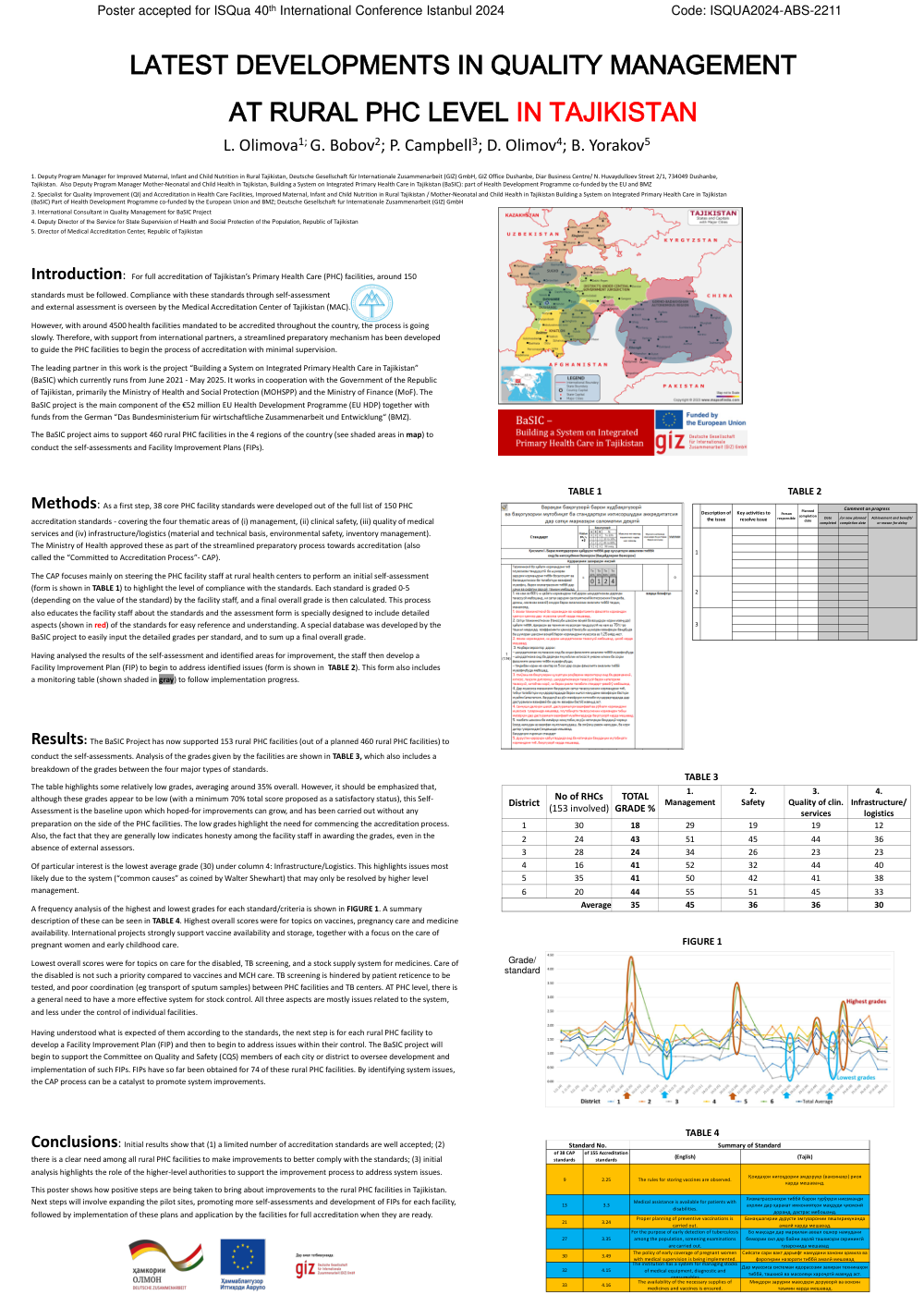
Results: The BaSIC Project has now supported 153 rural PHC facilities (out of a planned 460 rural PHC facilities) to conduct the self-assessments. Analysis of the grades given by the facilities are shown in TABLE 3, which also includes a breakdown of the grades between the four major types of standards.
The table highlights some relatively low grades, averaging around 35% overall. However, it should be emphasized that, although these grades appear to be low (with a minimum 70% total score proposed as a satisfactory status), this Self-Assessment is the baseline upon which hoped-for improvements can grow, and has been carried out without any preparation on the side of the PHC facilities. The low grades highlight the need for commencing the accreditation process. Also, the fact that they are generally low indicates honesty among the facility staff in awarding the grades, even in the absence of external assessors.
Of particular interest is the lowest average grade (30) under column 4: Infrastructure/Logistics. This highlights issues most likely due to the system (“common causes” as coined by Walter Shewhart) that may only be resolved by higher level management.
A frequency analysis of the highest and lowest grades for each standard/criteria is shown in FIGURE 1. A summary description of these can be seen in TABLE 4. Highest overall scores were for topics on vaccines, pregnancy care and medicine availability. International projects strongly support vaccine availability and storage, together with a focus on the care of pregnant women and early childhood care.
Lowest overall scores were for topics on care for the disabled, TB screening, and a stock supply system for medicines. Care of the disabled is not such a priority compared to vaccines and MCH care. TB screening is hindered by patient reticence to be tested, and poor coordination (eg transport of sputum samples) between PHC facilities and TB centers. AT PHC level, there is a general need to have a more effective system for stock control. All three aspects are mostly issues related to the system, and less under the control of individual facilities.
Having understood what is expected of them according to the standards, the next step is for each rural PHC facility to develop a Facility Improvement Plan (FIP) and then to begin to address issues within their control. The BaSIC project will begin to support the Committee on Quality and Safety (CQS) members of each city or district to oversee development and implementation of such FIPs. FIPs have so far been obtained for 74 of these rural PHC facilities. By identifying system issues, the CAP process can be a catalyst to promote system improvements.
Conclusions: Initial results show that (1) a limited number of accreditation standards are well accepted; (2) there is a clear need among all rural PHC facilities to make improvements to better comply with the standards; (3) initial analysis highlights the role of the higher-level authorities to support the improvement process to address system issues.
This poster shows how positive steps are being taken to bring about improvements to the rural PHC facilities in Tajikistan. Next steps will involve expanding the pilot sites, promoting more self-assessments and development of FIPs for each facility, followed by implementation of these plans and application by the facilities for full accreditation when they are ready.