586 posters, 8 topics, 23 sessions, 1,077 authors, 622 institutions
ePostersLive by SciGen Technologies S.A. All rights reserved.
ISQua's 40th International Conference 2024
24th - 27th September 2024 | Istanbul, Türkiye

P647
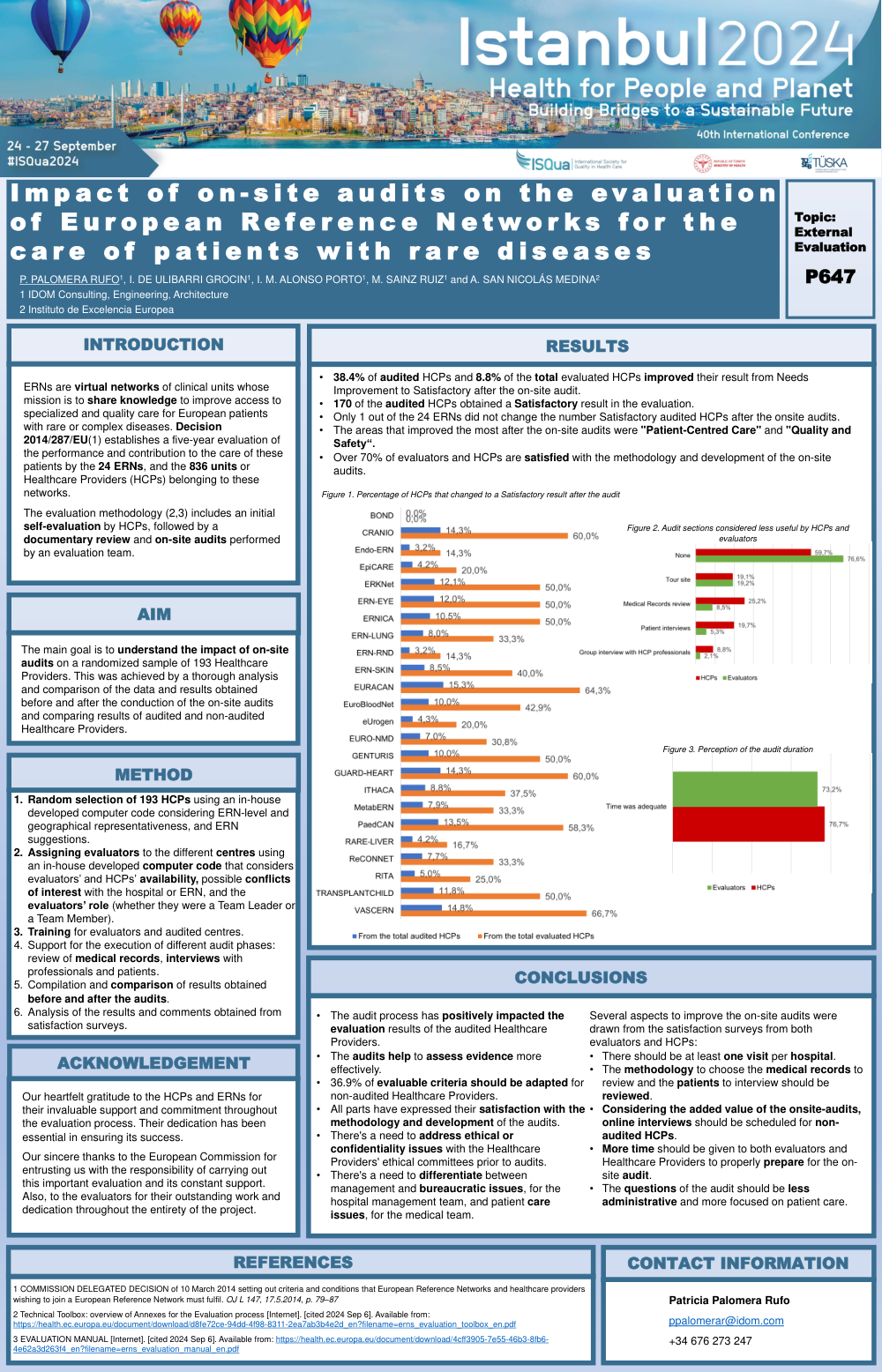
IMPACT OF ON-SITE AUDITS ON THE EVALUATION OF EUROPEAN REFERENCE NETWORKS FOR THE CARE OF PATIENTS WITH RARE DISEASES
Poster Presenter
Authors
Affiliations
Part of Topic
External Evaluation
Impact of on-site audits on the evaluation of European Reference Networks for the care of patients with rare diseases
P. PALOMERA RUFO1, I. DE ULIBARRI GROCIN1, I. M. ALONSO PORTO1, M. SAINZ RUIZ1 and A. SAN NICOLÁS MEDINA2
1 IDOM Consulting, Engineering, Architecture
2 Instituto de Excelencia Europea
Topic: External Evaluation
P647
INTRODUCTION:
ERNs are virtual networks of clinical units whose mission is to share knowledge to improve access to specialized and quality care for European patients with rare or complex diseases. Decision 2014/287/EU(1) establishes a five-year evaluation of the performance and contribution to the care of these patients by the 24 ERNs, and the 836 units or Healthcare Providers (HCPs) belonging to these networks.
The evaluation methodology (2,3) includes an initial self-evaluation by HCPs, followed by a documentary review and on-site audits performed by an evaluation team.
AIM:
The main goal is to understand the impact of on-site audits on a randomized sample of 193 Healthcare Providers. This was achieved by a thorough analysis and comparison of the data and results obtained before and after the conduction of the on-site audits and comparing results of audited and non-audited Healthcare Providers.
METHOD:
RESULTS:
CONCLUSIONS:
Several aspects to improve the on-site audits were drawn from the satisfaction surveys from both evaluators and HCPs:
ACKNOWLEDGEMENT:
Our heartfelt gratitude to the HCPs and ERNs for their invaluable support and commitment throughout the evaluation process. Their dedication has been essential in ensuring its success.
Our sincere thanks to the European Commission for entrusting us with the responsibility of carrying out this important evaluation and its constant support. Also, to the evaluators for their outstanding work and dedication throughout the entirety of the project.
REFERENCES:
1 COMMISSION DELEGATED DECISION of 10 March 2014 setting out criteria and conditions that European Reference Networks and healthcare providers wishing to join a European Reference Network must fulfil. OJ L 147, 17.5.2014, p. 79–87
2 Technical Toolbox: overview of Annexes for the Evaluation process [Internet]. [cited 2024 Sep 6]. Available from: https://health.ec.europa.eu/document/download/d8fe72ce-94dd-4f98-8311-2ea7ab3b4e2d_en?filename=erns_evaluation_toolbox_en.pdf
3 EVALUATION MANUAL [Internet]. [cited 2024 Sep 6]. Available from: https://health.ec.europa.eu/document/download/4cff3905-7e55-46b3-8fb6-4e62a3d263f4_en?filename=erns_evaluation_manual_en.pdf
CONTACT INFORMATION:
Patricia Palomera Rufo
+34 676 273 247