586 posters, 8 topics, 23 sessions, 1,077 authors, 622 institutions
ePostersLive by SciGen Technologies S.A. All rights reserved.
ISQua's 40th International Conference 2024
24th - 27th September 2024 | Istanbul, Türkiye

P634
How does patient safety culture impact the performance of public healthcare organizations in accreditation?
Poster Presenter
Authors
Talal ALFadhalah, Hossam Elamir, Gheed Al Salem, Nahla Abdelsalam, Esraa Najjar
Affiliations
Quality and Accreditation Directorate, Ministry of Health, Kuwait, Kuwait, Research and Technical Support Department, Quality and Accreditation Directorate, Ministry of Health, Kuwait, Kuwait, Accreditation Affairs Department, Quality and Accreditation Directorate, Ministry of Health, Kuwait, Kuwait
Part of Topic
External Evaluation
How does patient safety culture impact the performance of public healthcare organizations in accreditation?
INTRODUCTION
Patient safety remains a top priority within healthcare systems around the world. How well an organization performs in regard to patient safety, and the quality of the healthcare it delivers, is shaped by its culture concerning patient safety. Safety is an integral dimension of many different models of healthcare quality. Although the concept of quality varies in definition and assessment,4 the global consensus is that the performance of a healthcare organization is inextricably linked to the quality of its care. A culture of patient safety is essential for the continual improvement of service and reducing errors.
In the healthcare sector, accreditation is a tool for assessing the quality of care and can serve as a leveraging strategy for its optimisation. There is evidence for the positive impact of healthcare accreditation programs on an organization’s performance, quality of care, patient safety culture and safety practices. One study concluded that accreditation, among other interventions, resulted in a statistically significant increase in all patient safety culture composites and almost all patient safety culture items.
AIM
This study aims to examine how the scores of patient safety culture items impact accreditation compliance percentages in primary care settings in Kuwait.
METHOD
This was a multi-method study conducted with cross-sectional and retrospective quantitative approaches in government primary care settings in Kuwait. The study was conducted in all primary health centres (PHCs) which had undergone accreditation surveying (75 PHCs). For the cross-sectional approach, we circulated an adapted version of a validated and reliable tool developed by the Agency for Healthcare Research and Quality (AHRQ) to assess the patient safety culture reported by providers and staff. In the retrospective approach, we reviewed and included scores on accreditation standards compliance. The analysis of the quantitative data included univariate descriptive (frequencies, percentages) and bivariate analyses to examine the correlations between the patient safety culture items and accreditation compliance.
The AHRQ tool includes 38 items, grouped into 10 composites, which assess various aspects of patient safety culture. The composites are Teamwork, Patient Care Tracking/Follow-up, Organizational Learning, Overall Perceptions of Patient Safety and Quality, Staff Training, Owner/Managing Partner/Leadership Support for Patient Safety, Communication about Error, Communication Openness, Office Processes and Standardization, and Work Pressure and Pace.
RESULTS
We distributed 6,916 questionnaires among the 75 eligible PHCs; 6,032 (87.2%) were returned. We screened the returned questionnaires for their eligibility and excluded a further 744, yielding a final response rate of 76.5% (n = 5,288).
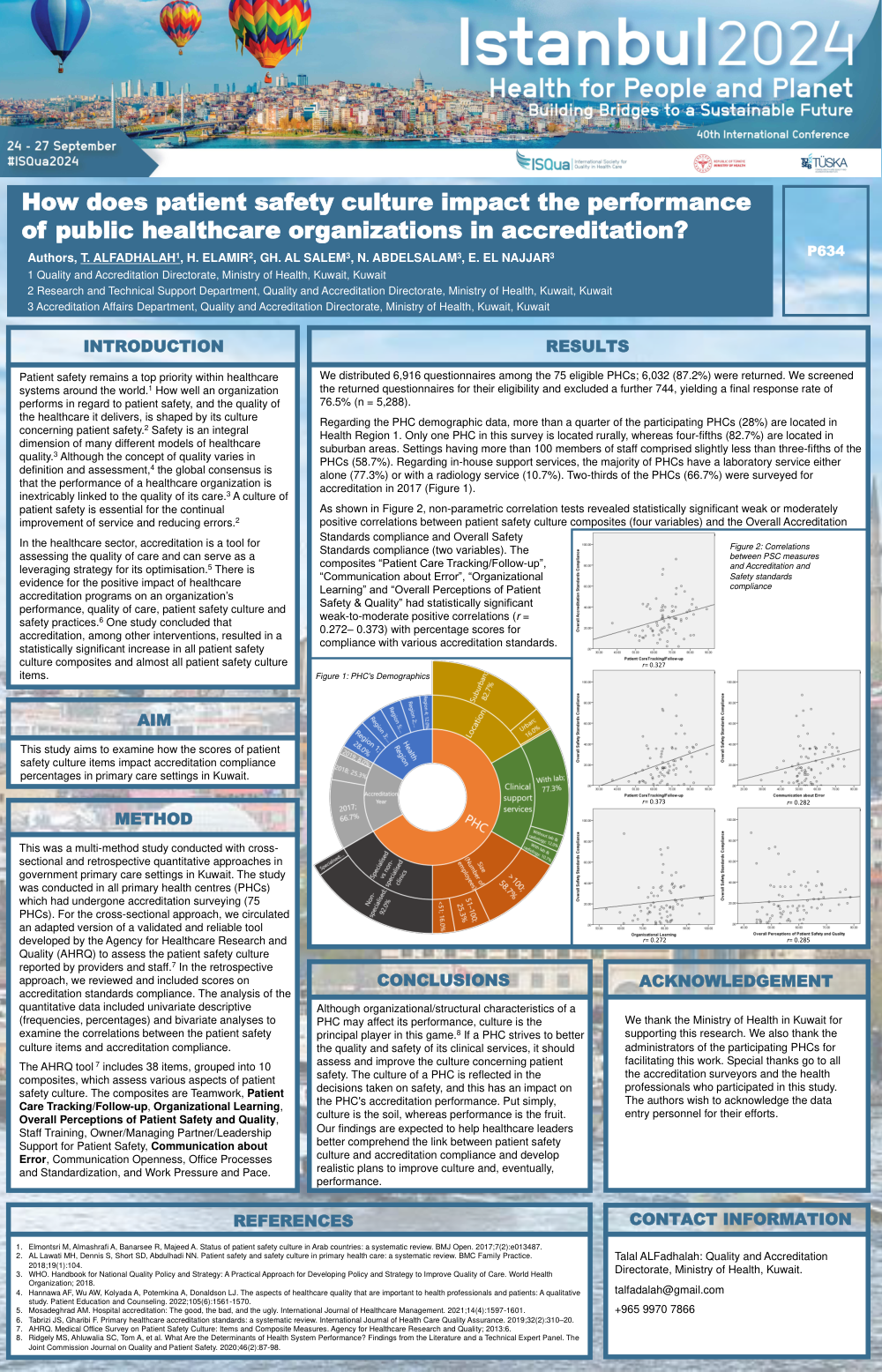
Regarding the PHC demographic data, more than a quarter of the participating PHCs (28%) are located in Health Region 1. Only one PHC in this survey is located rurally, whereas four-fifths (82.7%) are located in suburban areas. Settings having more than 100 members of staff comprised slightly less than three-fifths of the PHCs (58.7%). Regarding in-house support services, the majority of PHCs have a laboratory service either alone (77.3%) or with a radiology service (10.7%). Two-thirds of the PHCs (66.7%) were surveyed for accreditation in 2017 (Figure 1).
As shown in Figure 2, non-parametric correlation tests revealed statistically significant weak or moderately positive correlations between patient safety culture composites (four variables) and the Overall Accreditation Standards compliance and Overall Safety Standards compliance (two variables). The composites “Patient Care Tracking/Follow-up”, “Communication about Error”, “Organizational Learning” and “Overall Perceptions of Patient Safety & Quality” had statistically significant weak-to-moderate positive correlations (r = 0.272– 0.373) with percentage scores for compliance with various accreditation standards.
CONCLUSIONS
Although organizational/structural characteristics of a PHC may affect its performance, culture is the principal player in this game.8 If a PHC strives to better the quality and safety of its clinical services, it should assess and improve the culture concerning patient safety. The culture of a PHC is reflected in the decisions taken on safety, and this has an impact on the PHC's accreditation performance. Put simply, culture is the soil, whereas performance is the fruit. Our findings are expected to help healthcare leaders better comprehend the link between patient safety culture and accreditation compliance and develop realistic plans to improve culture and, eventually, performance.