586 posters, 8 topics, 23 sessions, 1,077 authors, 622 institutions
ePostersLive by SciGen Technologies S.A. All rights reserved.
ISQua's 40th International Conference 2024
24th - 27th September 2024 | Istanbul, Türkiye

ISQUA2024-ABS-3030
The Impact of the Co-Production Model on the Health Accreditation Process in Brazil
Poster Presenter
Part of Topic
External Evaluation
The Impact of the Co-Production Model on the Health Accreditation Process in Brazil
isqua2024.0a70138
Introduction
The concept of co-production is widely discussed in the literature, encompassing a series of interrelated practices. This approach involves the active collaboration between citizens, communities, and healthcare professionals, who share and integrate knowledge and experiences to achieve more effective and lasting outcomes, while also enriching the experience of all those involved. The literature presents multiple interpretations and practices related to co-production, such as co-creation and co-design, all converging toward a common goal of promoting improvements in healthcare services and the care experience (NHS, 2023).
Two approaches particularly relevant in this context are Experience-Based Co-Design (EBCD) and Always Events®. Both stand out for characteristics that include valuing the experiences of users and service providers, with a specific focus on people’s interactions throughout different stages of the service, aiming to design experiences rather than just systems or processes. These approaches also emphasize partnership and shared leadership between users and service providers. People with lived experience work collaboratively with the team to identify improvement priorities, develop effective solutions, and systematically implement changes.
In the realm of accreditation, co-production is emerging as a promising approach to revolutionize how healthcare organizations and accreditation agencies interact and collaborate. Unlike traditional approaches, which tend to be unilateral, co-production fosters an active partnership among stakeholders, resulting in an accreditation or certification process that is more relevant, effective, and focused on adding value to the patient and the ecosystem in which they are embedded.
In this context, the implementation of accreditation projects combined with integration and monitoring methods encourages the active participation of individuals in collaborative processes, where the sharing of knowledge and experiences is prioritized. American Accreditation Commission International (AACI) Brazil has innovated by redesigning contemporary practices in accreditation or certification programs, developing a more inclusive operational model that adds greater value to client organizations.
The introduction of the Client Manager role within this operational model, along with the use of computerized tools to monitor the progress of accreditation projects, facilitates closer collaboration between the accreditation agency and healthcare institutions. This results in continuous knowledge exchange and effective monitoring of improvement plans and their performance. The Client Manager acts as a facilitator in understanding processes and standards alongside the quality management team, providing technical support in the preparation for self-assessment and external evaluations. This generates a relationship of trust, proximity, and security in the accreditation model. It leads to fewer uncertainties, a clarity of purpose, ongoing exchange of ideas, greater empathy, and interaction among professionals.
By adapting the Experience-Based Co-Design (EBCD) approach to the context of accreditation, the foundations for genuine co-production were established, structured in phases that ensure proper engagement, clear definition of roles and responsibilities, facilitation of individual contributions, and shared responsibility in implementing necessary changes. This model not only enhances the quality of services provided but also strengthens the confidence and capability of professionals to engage in continuous improvement processes.
Creating the Conditions for Genuine Co-Production:
Phase 1: Engaging the Right People at the Right Time -The first step was to understand senior management’s expectations regarding the goal of the cycle and accreditation. The second step involved presenting the AACI standards, which would provide support in achieving the desired outcomes. The third step was the participation of all managers and professionals in a training session on AACI, with the aim of aligning their understanding of the methodology and standards. This allowed everyone to have a clearer understanding of the objectives and goals of the accreditation project, along with the strategies to be used to achieve them, making them more capable and engaged in working together with the Client Manager.
Phase 2: Clearly Establishing the Roles and Responsibilities of All Involved, Including Senior Management, the Quality Management Group, Managers, the Operational Team, and the Client Manager. It is important to highlight that the Client Manager does not act as a consultant but as an essential technical support to ensure the institution’s confidence and security in the accreditation process.
Phase 3: Facilitating Individual Contributions, Valuing and Respecting Their Opinions through the Creation of a Quality Management Group. This group is composed of professionals from different areas and hierarchical levels, and the criteria required for participation include effective communication skills, the ability to navigate across various areas, a willingness to learn, and comfort in sharing opinions and experiences. The willingness to adopt or accept the perspectives of other stakeholders forms the fundamental foundation that supports the co-design process.
Phase 4: Sharing Responsibility for Implementing Changes and Results.
Building trust was crucial for the institution to understand how much AACI could contribute to achieving the goals set by senior management, and thereby co-deliver the necessary improvements. Additionally, it was vital to understand the current knowledge and skills of the professionals to offer opportunities for them to acquire new competencies and gain confidence in the continuous improvement of services and quality.
Developing the Capacity and Confidence to Engage Professionals in Co-Production
With the formation of the quality management group, individuals with lived experience were recruited based on appropriate skills and behaviors and received the necessary training and development to support the improvement work. [CQC 2018]
The training related to the standards manual, topics developed by AACI, and provided support and guidance to professionals on how to engage with individuals with lived experience in genuine co-production, including guidance on the role these individuals play in this approach.
The training also addressed the professionals’ beliefs regarding the relevance and representativeness of individual experiences related to the accreditation processes they had gone through and the ability of these individuals to contribute to improvement.
As co-production continues to gain relevance in the accreditation landscape, it becomes evident that this approach not only promotes the continuous improvement of healthcare services but also strengthens the relationship between institutions and accreditation bodies. Through active collaboration and shared responsibilities, organizations are empowered to achieve higher quality standards and develop innovative solutions that reflect the needs and expectations of the patients and communities they serve.
This article explores how the American Accreditation Commission International (AACI) has implemented and adapted co-production practices in its accreditation processes, highlighting the critical phases involved, the challenges faced, and the observed impacts. By examining these experiences, we hope to provide valuable insights into how co-production can be effectively utilized to transform accreditation into a more inclusive, collaborative, and value-driven process.
OBJECTIVE
To assess the impact of co-production on accreditation for managers and active leaders in the accreditation project at five healthcare institutions that are clients of AACI Brazil.
METHODS
After 6 months of the co-production model beingimplemented, a standardized questionnaire (available via QR Code) was administered to professionals who were directly involved in the accreditation projects. The questionnaire included questions that assessed the role of the Client Manager and the co-production model across the following dimensions: trust, engagement, interpretation of standards, and evaluation of the model's impact on the project. Ethical considerations, including informed consent and protection of participant confidentiality, were ensured throughout the study.
RESULTS
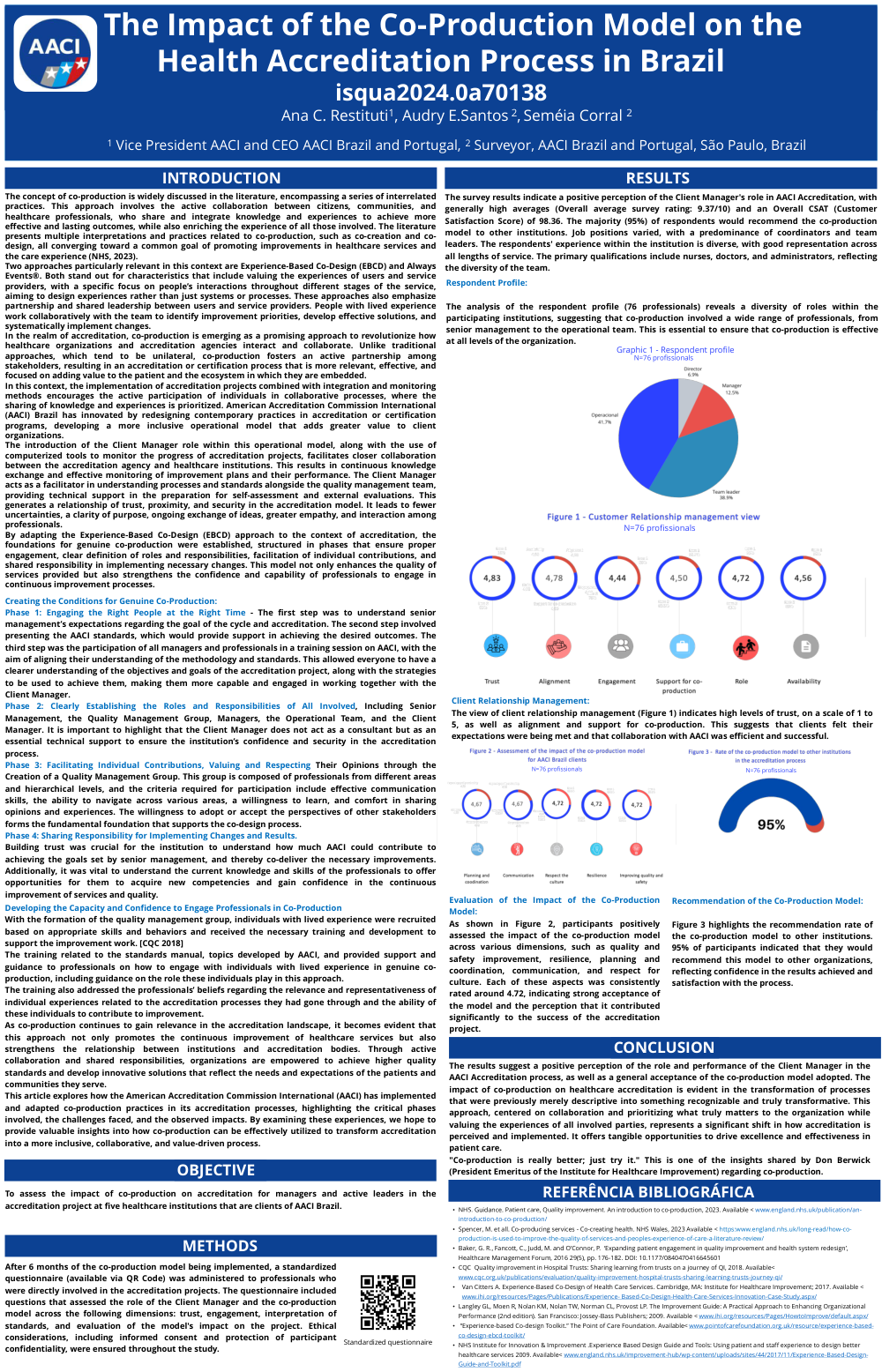
The survey results indicate a positive perception of the Client Manager's role in AACI Accreditation, with generally high averages (Overall average survey rating: 9.37/10) and an Overall CSAT (Customer Satisfaction Score) of 98.36. The majority (95%) of respondents would recommend the co-production model to other institutions. Job positions varied, with a predominance of coordinators and team leaders. The respondents' experience within the institution is diverse, with good representation across all lengths of service. The primary qualifications include nurses, doctors, and administrators, reflecting the diversity of the team.
Respondent Profile:
The analysis of the respondent profile (76 professionals) reveals a diversity of roles within the participating institutions, suggesting that co-production involved a wide range of professionals, from senior management to the operational team. This is essential to ensure that co-production is effective at all levels of the organization.
Client Relationship Management:
The view of client relationship management (Figure 1) indicates high levels of trust, on a scale of 1 to 5, as well as alignment and support for co-production. This suggests that clients felt their expectations were being met and that collaboration with AACI was efficient and successful.
Evaluation of the Impact of the Co-Production Model:
As shown in Figure 2, participants positively assessed the impact of the co-production model across various dimensions, such as quality and safety improvement, resilience, planning and coordination, communication, and respect for culture. Each of these aspects was consistently rated around 4.72, indicating strong acceptance of the model and the perception that it contributed significantly to the success of the accreditation project.
Recommendation of the Co-Production Model:
Figure 3 highlights the recommendation rate of the co-production model to other institutions. 95% of participants indicated that they would recommend this model to other organizations, reflecting confidence in the results achieved and satisfaction with the process.
CONCLUSION
The results suggest a positive perception of the role and performance of the Client Manager in the AACI Accreditation process, as well as a general acceptance of the co-production model adopted. The impact of co-production on healthcare accreditation is evident in the transformation of processes that were previously merely descriptive into something recognizable and truly transformative. This approach, centered on collaboration and prioritizing what truly matters to the organization while valuing the experiences of all involved parties, represents a significant shift in how accreditation is perceived and implemented. It offers tangible opportunities to drive excellence and effectiveness in patient care.
"Co-production is really better; just try it." This is one of the insights shared by Don Berwick (President Emeritus of the Institute for Healthcare Improvement) regarding co-production.
REFERÊNCIA BIBLIOGRÁFICA