586 posters, 8 topics, 23 sessions, 1,077 authors, 622 institutions
ePostersLive by SciGen Technologies S.A. All rights reserved.
ISQua's 40th International Conference 2024
24th - 27th September 2024 | Istanbul, Türkiye

ISQUA2024-ABS-3029
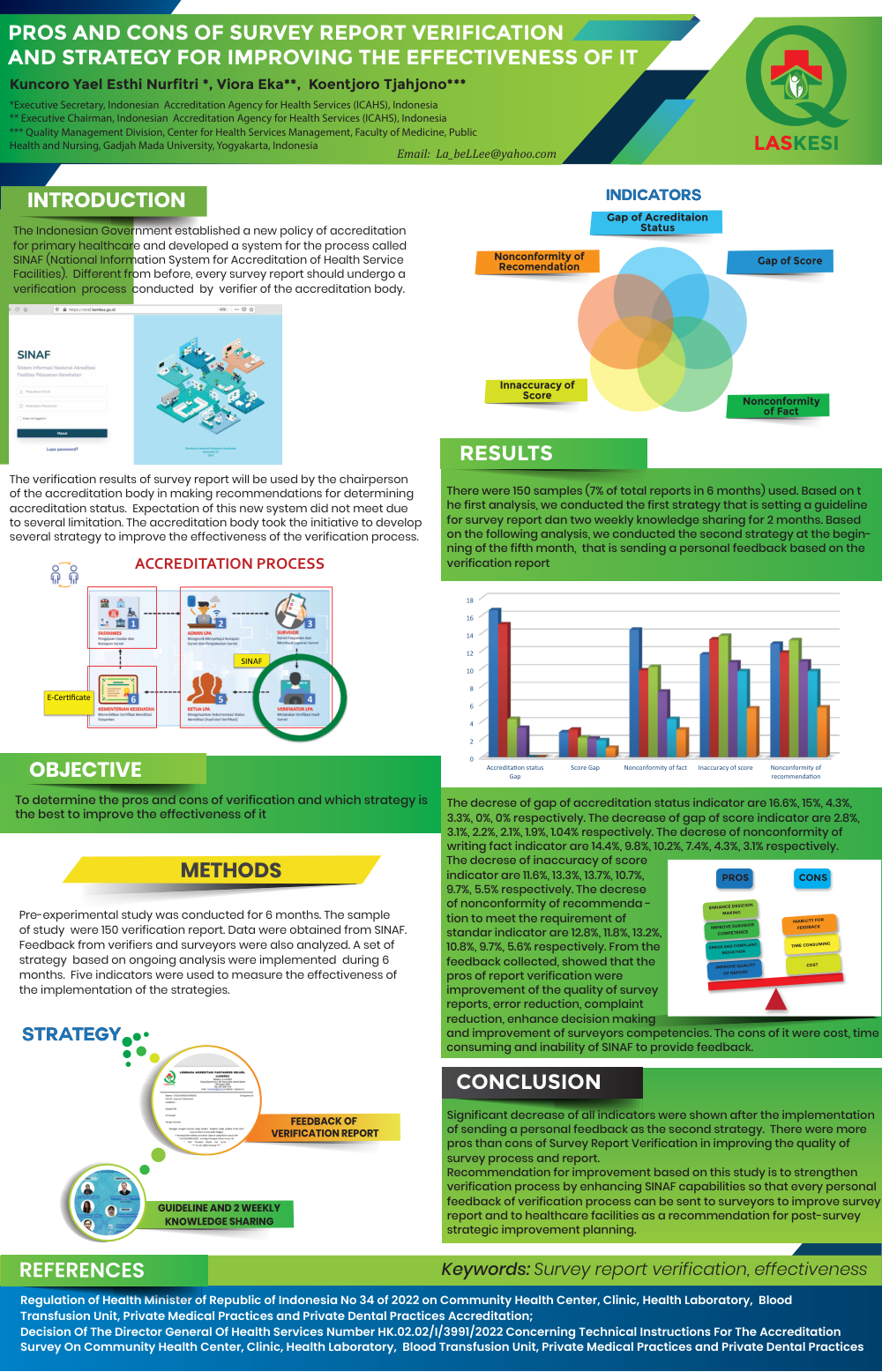
Pros and Cons of Survey Report Verification and Strategy for Improving The Effectiveness of It
Poster Presenter
Part of Topic
External Evaluation
Pros and Cons of Survey Report Verification and Strategy for Improving The Effectiveness of It
Kuncoro Yael Esthi Nurfitri *, Viora Eka**, Koentjoro Tjahjono***
*Executive Secretary, Indonesian Accreditation Agency for Health Services (ICAHS), Indonesia
** Executive Chairman, Indonesian Accreditation Agency for Health Services (ICAHS), Indonesia
*** Quality Management Division, Center for Health Services Management, Faculty of Medicine, Public Health and Nursing, Gadjah Mada University, Yogyakarta, Indonesia
Introduction: The Indonesian Government established a new policy of accreditation for primary healthcare and developed a system for the process called SINAF (National Information System for Accreditation of Health Service Facilities). Different from before, every survey report should undergo a verification process conducted by verifier of the accreditation body. The verification results of survey report will be used by the chairperson of the accreditation body in making recommendations for determining accreditation status. Expectation of this new system did not meet due to several limitation. The accreditation body took the initiative to develop several strategy to improve the effectiveness of the verification process.
Objective: To determine the pros and cons of verification and which strategy is the best to improve the effectiveness of it.
Methods: Pre-experimental study was conducted for 6 months. The sample of study were 150 verification report. Data were obtained from SINAF. Feedback from verifiers and surveyors were also analyzed. A set of strategy based on ongoing analysis were implemented during 6 months. Five indicators were used to measure the effectiveness of the implementation of the strategies.
Results: There were 150 samples (7% of total reports in 6 months) used. Based on the first analysis, we conducted the first strategy that is setting a guideline for survey report dan two weekly knowledge sharing for 2 months. Based on the following analysis, we conducted the second strategy at the beginning of the fifth month, that is sending a personal feedback based on the verification report. The decrese of gap of accreditation status indicator are 16.6%, 15%, 4.3%, 3.3%, 0%, 0% respectively. The decrease of gap of score indicator are 2.8%, 3.1%, 2.2%, 2.1%, 1.9%, 1.04% respectively. The decrese of nonconformity of writing fact indicator are 14.4%, 9.8%, 10.2%, 7.4%, 4.3%, 3.1% respectively. The decrese of inaccuracy of score indicator are 11.6%, 13.3%, 13.7%, 10.7%, 9.7%, 5.5% respectively. The decrese of nonconformity of recommendation to meet the requirement of standar indicator are 12.8%, 11.8%, 13.2%, 10.8%, 9.7%, 5.6% respectively. From the feedback collected, showed that the pros of report verification were improvement of the quality of survey reports, error reduction, complaint reduction, enhance decision making and improvement of surveyors competencies. The cons of it were cost, time consuming and inability of SINAF to provide feedback.
Conclusion: Significant decrease of all indicators were shown after the implementation of sending a personal feedback as the second strategy. There were more pros than cons of Survey Report Verification in improving the quality of survey process and report. Recommendation for improvement based on this study is to strengthen verification process by enhancing SINAF capabilities so that every personal feedback of verification process can be sent to surveyors to improve survey report and to healthcare facilities as a recommendation for post-survey strategic improvement planning
Keywords: Survey report verification, effectiveness
References :
Regulation of Health Minister of Republic of Indonesia No 34 of 2022 on Community Health Center, Clinic, Health Laboratory, Blood Transfusion Unit, Private Medical Practices and Private Dental Practices Accreditation;
Decision Of The Director General Of Health Services Number HK.02.02/I/3991/2022 Concerning Technical Instructions For The Accreditation Survey On Community Health Center, Clinic, Health Laboratory, Blood Transfusion Unit, Private Medical Practices and Private Dental Practices