708 posters, 8 topics, 16 sessions, 1,190 authors, 600 institutions
ePostersLive by SciGen Technologies S.A. All rights reserved.
ISQua's 39th International Conference 2023
August 27 - 30, 2023 | Seoul, Republic of Korea

P442
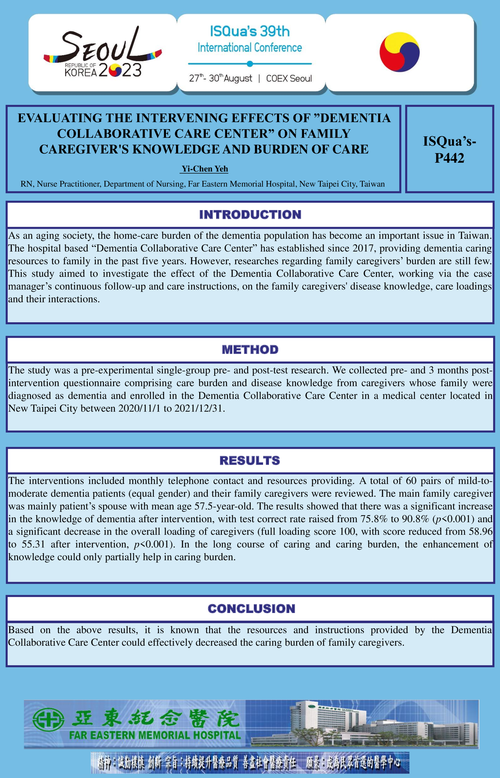
EVALUATING THE INTERVENING EFFECTS OF ”DEMENTIA COLLABORATIVE CARE CENTER” ON FAMILY CAREGIVER'S KNOWLEDGE AND BURDEN OF CARE
Poster Presenter
Authors
Affiliations
Part of Topic
Integrated Care
INTRODUCTION
As an aging society, the home-care burden of the dementia population has become an important issue in Taiwan. The hospital based “Dementia Collaborative Care Center” has established since 2017, providing dementia caring resources to family in the past five years. However, researches regarding family caregivers’ burden are still few. This study aimed to investigate the effect of the Dementia Collaborative Care Center, working via the case manager’s continuous follow-up and care instructions, on the family caregivers' disease knowledge, care loadings and their interactions.
METHOD
The study was a pre-experimental single-group pre- and post-test research. We collected pre- and 3 months post-intervention questionnaire comprising care burden and disease knowledge from caregivers whose family were diagnosed as dementia and enrolled in the Dementia Collaborative Care Center in a medical center located in New Taipei City between 2020/11/1 to 2021/12/31.
RESULTS
The interventions included monthly telephone contact and resources providing. A total of 60 pairs of mild-to-moderate dementia patients (equal gender) and their family caregivers were reviewed. The main family caregiver was mainly patient’s spouse with mean age 57.5-year-old. The results showed that there was a significant increase in the knowledge of dementia after intervention, with test correct rate raised from 75.8% to 90.8% (p<0.001) and a significant decrease in the overall loading of caregivers (full loading score 100, with score reduced from 58.96 to 55.31 after intervention, p<0.001). In the long course of caring and caring burden, the enhancement of knowledge could only partially help in caring burden.
CONCLUSION
Based on the above results, it is known that the resources and instructions provided by the Dementia Collaborative Care Center could effectively decreased the caring burden of family caregivers.