708 posters, 8 topics, 16 sessions, 1,190 authors, 600 institutions
ePostersLive by SciGen Technologies S.A. All rights reserved.
ISQua's 39th International Conference 2023
August 27 - 30, 2023 | Seoul, Republic of Korea

P441
INTEGRATED GENERAL HOSPITAL INPATIENT MODEL IMPROVES CARE OUTCOMES AND PRODUCTIVITY: AN OBSERVATIONAL STUDY
Poster Presenter
Authors
Affiliations
Part of Topic
Integrated Care
ISQUA2023-ABS-2082
INTEGRATED GENERAL HOSPITAL INPATIENT MODEL IMPROVES CARE OUTCOMES AND PRODUCTIVITY:
AN OBSERVATIONAL STUDY
Introduction: With the increasing complexity of healthcare problems worldwide, the demand for better-coordinated care
delivery is on the rise. However, current hospital-based practices remain largely disease-centric and specialist-driven,
resulting in fragmented care. This study aimed to evaluate the effectiveness and feasibility of an integrated general
hospital (IGH) inpatient care model.
Methods: Retrospective analysis of medical records between June 2018 and August 2019 compared patients admitted
under the IGH model and patients receiving usual care in public hospitals. The IGH model managed patients from one
location with a multidisciplinary team, performing needs-based care transition utilizing acuity tagging to match the
intensity of care to illness acuity.
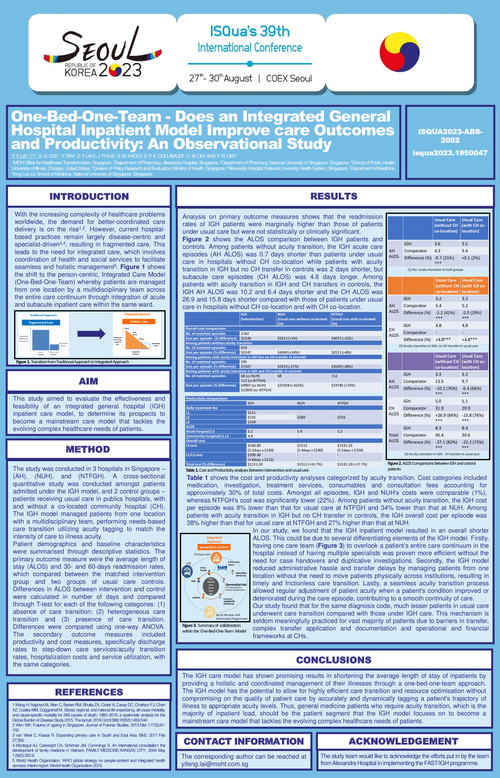
Results: 5,000 episodes of IGH care entered analysis. In the absence of care transition in intervention and control, IGH
average length of stay (ALOS) was 0.7 days shorter than control. In the group with care transition in intervention but not
in control, IGH acute ALOS was 2 days shorter, whereas subacute ALOS was 4.8 days longer. In the presence of care
transition in intervention and control, IGH acute ALOS was 6.4 and 10.2 days shorter and subacute ALOS was 15.8 and
26.9 days shorter compared with patients under usual care at acute hospitals with and without co-located community
hospitals, respectively. The 30- and 60-days readmission rates of IGH patients were marginally higher than usual care,
though not clinically significant.
Conclusion: The IGH care model maybe associated with shorter ALOS of inpatients and optimize resource allocation and
service utilization. Patients with dynamic acuity transition benefited from a seamless care transition process.
Disclosure of Interest: None Declared
Keywords: care innovation, care transition, integrated care