708 posters, 8 topics, 16 sessions, 1,190 authors, 600 institutions
ePostersLive by SciGen Technologies S.A. All rights reserved.
ISQua's 39th International Conference 2023
August 27 - 30, 2023 | Seoul, Republic of Korea

P430
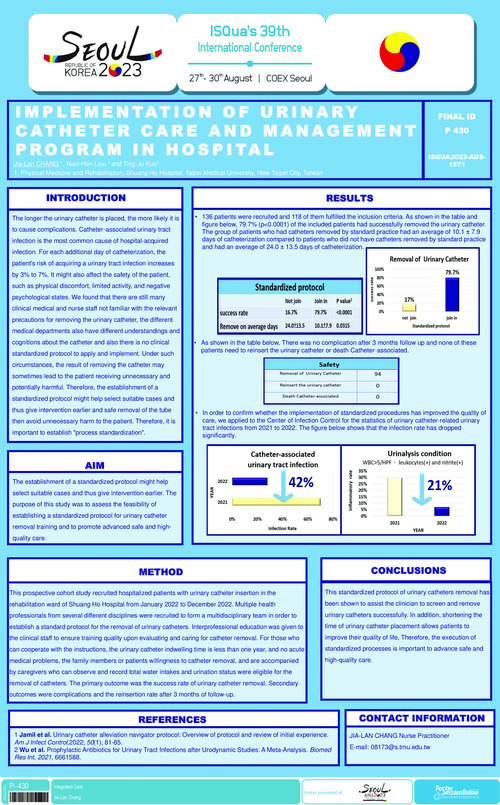
IMPLEMENTATION OF URINARY CATHETER CARE AND MANAGEMENT PROGRAM IN HOSPITAL
Poster Presenter
Authors
Affiliations
Part of Topic
Integrated Care
IMPLEMENTATION OF URINARY CATHETER CARE AND MANAGEMENT PROGRAM IN HOSPITAL
INTRODUCTION
The longer the urinary catheter is placed, the more likely it is to cause complications. Catheter‐associated urinary tract infection is the most common cause of hospital-acquired infection. For each additional day of catheterization, the patient's risk of acquiring a urinary tract infection increases by 3% to 7%. It might also affect the safety of the patient, such as physical discomfort, limited activity, and negative psychological states. We found that there are still many clinical medical and nurse staff not familiar with the relevant precautions for removing the urinary catheter, the different medical departments also have different understandings and cognitions about the catheter and also there is no clinical standardized protocol to apply and implement. Under such circumstances, the result of removing the catheter may sometimes lead to the patient receiving unnecessary and potentially harmful. Therefore, the establishment of a standardized protocol might help select suitable cases and thus give intervention earlier and safe removal of the tube then avoid unnecessary harm to the patient. Therefore, it is important to establish "process standardization".
AIM
The establishment of a standardized protocol might help select suitable cases and thus give intervention earlier. The purpose of this study was to assess the feasibility of establishing a standardized protocol for urinary catheter removal training and to promote advanced safe and high-quality care.
METHOD
This prospective cohort study recruited hospitalized patients with urinary catheter insertion in the rehabilitation ward of Shuang Ho Hospital from January 2022 to December 2022. Multiple health professionals from several different disciplines were recruited to form a multidisciplinary team in order to establish a standard protocol for the removal of urinary catheters. Interprofessional education was given to the clinical staff to ensure training quality upon evaluating and caring for catheter removal. The primary outcome was the success rate of urinary catheter removal. Secondary outcomes were complications and the reinsertion rate after 3 months of follow-up.
RESULTS
CONCLUSIONS
This standardized protocol of urinary catheters removal has been shown to assist the clinician to screen and remove urinary catheters successfully. In addition, shortening the time of urinary catheter placement allows patients to improve their quality of life, Therefore, the execution of standardized processes is important to advance safe and high-quality care.
Keyword: standardized protocol、urinary catheter、quality