708 posters, 8 topics, 16 sessions, 1,190 authors, 600 institutions
ePostersLive by SciGen Technologies S.A. All rights reserved.
ISQua's 39th International Conference 2023
August 27 - 30, 2023 | Seoul, Republic of Korea

P418
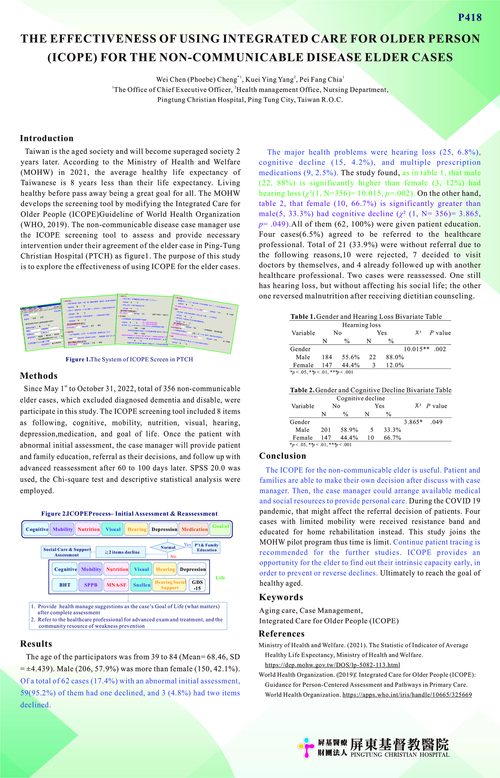
THE EFFECTIVENESS OF USING INTEGRATED CARE FOR OLDER PERSON (ICOPE) FOR THE NON-COMMUNICABLE DISEASE ELDER CASES
Poster Presenter
Authors
Affiliations
Part of Topic
Integrated Care
THE EFFECTIVENESS OF USING INTEGRATED CARE FOR OLDER PERSON (ICOPE) FOR THE NON-COMMUNICABLE DISEASE ELDER CASES
Wei-Chen (Phoebe) Cheng
Introduction
Taiwan is the aged society and will become superaged society 2 years later. According to the Ministry of Health and Welfare (MOHW) in 2021, the average healthy life expectancy of Taiwanese is 8 years less than their life expectancy. Living healthy before pass away being a great goal for all. The MOHW develops the screening tool by modifying the Integrated Care for Older People (ICOPE) Guideline of World Health Organization (WHO, 2019). The non-communicable disease case manager use the ICOPE screening tool to assess and provide necessary intervention under their agreement of the elder case in our hospital (Figure 1). The purpose of this study is to explore the effectiveness of using ICOPE for the elder cases.
Methods
Since May 1st to October 31, 2022, total of 356 non-communicable elder cases, which excluded diagnosed dementia and disable, were participate in this study. The ICOPE screening tool included 8 items as following, cognitive, mobility, nutrition, visual, hearing, depression, medication, and goal of life. Once the patient with abnormal initial assessment, the case manager will provide patient and family education, referral as their decisions, and follow up with advanced reassessment after 60 to 100 days later. SPSS 20.0 was used, the Chi- square test and descriptive statistical analysis were employed.
Results
The age of the participants was from 39 to 84 (Mean=68.46, SD=±4.439). Male (206, 57.9%) was more than female (150, 42.1%). Of a total of 62 cases (17.4%) with an abnormal initial assessment, 59 (95.2%) of them had one declined, and 3 (4.8%) had two items declined. The major health problems were hearing loss (25, 6.8%), cognitive decline (15, 4.2%), and multiple prescription medications (9, 2.5%). The study found, as in Table 1, that male (22, 88%) is significantly higher than female (3, 12%) had hearing loss (p=0.002). On the other hand, Table 2, that female (10, 66.7%) is significantly greater than male (5, 33.3%) had cognitive decline (p=0.049). All of them (62, 100%) were given patient education. Four cases (6.5%) agreed to be referred to the healthcare professional. A total of 21 (33.9%) were without referral due to the following reasons, 10 were rejected, 7 decided to visit doctors by themselves, and 4 already followed up with another healthcare professional. Two cases were reassessed. One still has hearing loss, but without affecting his social life; the other one reversed malnutrition after receiving dietitian counseling.
Conclusion
The ICOPE for the non-communicable elder is useful. Patient and families are able to make their own decision after discuss with case manager. Then, the case manager could arrange available medical and social resources to provide personal care. During the COVID 19 pandemic, that might affect the referral decision of patients. Four cases with limited mobility were received resistance band and educated for home rehabilitation instead. This study joins the MOHW pilot program thus time is limit. Continue patient tracing is recommended for the further studies. ICOPE provides an opportunity for the elder to find out their intrinsic capacity early, in order to prevent or reverse declines. Ultimately to reach the goal of healthy aged.
Keywords
Aging care, Case Management, Integrated Care for Older People (ICOPE)
References
Ministry of Health and Welfare. (2021). The Statistic of Indicator of Average Healthy Life Expectancy, Ministry of Health and Welfare. https://dep.mohw.gov.tw/DOS/lp-5082-113.html
World Health Organization. (2019). Integrated Care for Older People (ICOPE): Guidance for Person-Centered Assessment and Pathways in Primary Care. World Health Organization. https://apps.who.int/iris/handle/10665/325669