708 posters, 8 topics, 16 sessions, 1,190 authors, 600 institutions
ePostersLive by SciGen Technologies S.A. All rights reserved.
ISQua's 39th International Conference 2023
August 27 - 30, 2023 | Seoul, Republic of Korea

P414
IMPROVING QUALITY IN DIABETES CARE: DEVELOPMENT AND IMPLEMENTATION OF INTEGRATED CLINICAL PATHWAYS IN TWO MEXICAN STATES
Poster Presenter
Authors
PEDRO JESÚS SATURNO-HERNÁNDEZ, OFELIA POBLANO-VERÁSTEGUI, ARTURO CUAUHTÉMOC BAUTISTA-MORALES, OMAR ACOSTA-RUIZ, SERGIO FLORES-HERNÁNDEZ, LAURA TORRES-ARREOLA, SAÚL DÍAZ-SÁNCHEZ, DIANA GALICIA-PEÑALOZA
Affiliations
Chair on Healthcare Quality, National Institute of Public Health, Secretary of Health, Campeche, Secretary of Health, Ozumba, Mexico
Part of Topic
Integrated Care
Improving quality in diabetes care: development and implementation of integrated clinical pathways in two Mexican Satates
Instroduction:
The increase in type 2 diabetes (DM2) prevalence and the deficiencies in the quality of its care in the Mexican health system make it essential to strengthen the integration of actions and the implementation of evidence-based interventions for diabetes care. In Mexico, Integrated Care Pathways (ICP) for diabetes is a novel tool to test for improvement.
Objetive:
Develop, implement and assess the effect of an ICP in improving the quality of DM2 care in Primary Health Centers (PHCs) of the States of Campeche and Mexico.
Method:
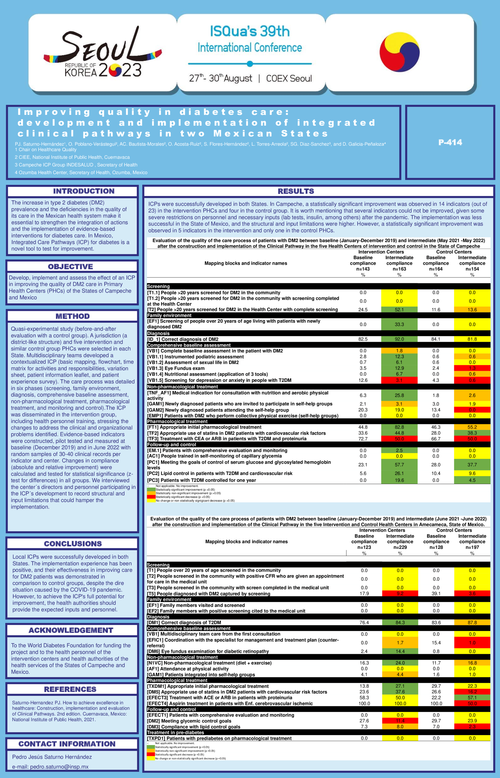
Quasi-experimental study (before-and-after evaluation with a control group). A jurisdiction (a district-like structure) and five intervention and similar control group PHCs were selected in each State. Multidisciplinary teams developed a contextualized ICP (basic mapping, flowchart, time matrix for activities and responsibilities, variation sheet, patient information leaflet, and patient experience survey). The care process was detailed in six phases (screening, family environment, diagnosis, comprehensive baseline assessment, non-pharmacological treatment, pharmacological treatment, and monitoring and control).The ICP was disseminated in the intervention group, including health personnel training, stressing the changes to address the clinical and organizational problems identified. Evidence-based indicators were constructed, pilot tested and measured at baseline (December 2019) and in June 2022 with random samples of 30-40 clinical records per indicator and center. Changes in compliance (absolute and relative improvement) were calculated and tested for statistical significance (z-test for differences) in all groups. We interviewed the center´s directors and personnel participating in the ICP´s development to record structural and input limitations that could hamper the implementation.
Results:
ICPs were successfully developed in both States. In Campeche, a statistically significant improvement was observed in 14 indicators (out of 23) in the intervention PHCs and four in the control group. It is worth mentioning that several indicators could not be improved, given some severe restrictions on personnel and necessary inputs (lab tests, insulin, among others) after the pandemic. The implementation was less successful in the State of Mexico, and the structural and input limitations were higher. However, a statistically significant improvement was observed in 5 indicators in the intervention and only one in the control PHCs.
Conclusion:
Local ICPs were successfully developed in both States. The implementation experience has been positive, and their effectiveness in improving care for DM2 patients was demonstrated in comparison to control groups, despite the dire situation caused by the COVID-19 pandemic. However, to achieve the ICP's full potential for improvement, the health authorities should provide the expected inputs and personnel.
Acknowledgement:
To the World Diabetes Foundation for funding the project and to the health personnel of the intervention centers and health authorities of the health services of the States of Campeche and Mexico.