708 posters, 8 topics, 16 sessions, 1,190 authors, 600 institutions
ePostersLive by SciGen Technologies S.A. All rights reserved.
ISQua's 39th International Conference 2023
August 27 - 30, 2023 | Seoul, Republic of Korea

P410
FACTORS AFFECTING PATIENT SATISFACTION OF PRIMARY HEALTHCARE DOCTOR HOME VISIT PILOT PROJECT
Poster Presenter
Authors
Affiliations
Part of Topic
Integrated Care
INTRODUCTION
◆ The elderly have complex needs for medical and long-term care due to mobility impairment caused by frailty or multiple chronic diseases.
◆ Health care delivery system in Korea is designed for patients to visit medical institutions directly. But considering rapid aging trend of Korea, the Ministry of Health and Welfare launched doctor home visitation program in 2019 to provide home-based primary healthcare.
◆ Clinic doctor can visit to homebound patients and deliver medical services (c.f. consultation, prescription, screening test, and education for diseases).
◆ Brief of Home visitation pilot Program(Dec.’19.~Dec.’25.)
➢ Eligibility: National Health Insurance, Medical Aid
➢ Provider: local clinic doctors
➢ Payment: doctors can choice the payment type
(type1) fixed-payment per visit, (type2) Fee for service
➢ Co-payment ratio: 30%, but Medical Aid 5~10%
➢ Status: voluntarily participated (as of April.’22)
(n. of clinics) 335, (n. of patient) 3,285
AIM
◆ This study investigated factors affecting patient satisfaction & doctor’s willingness for future participation to evaluate the effectiveness of the project.
METHOD
1. Data collection
◆A questionnaire-based survey (mobile web · cell phone) in the aspects of service beneficiary as well as provider from 27.April. ’22 to 13.May. ’22.
2. Subject
◆ Patient : 381 beneficiary of the 1,753, responded to the survey (21.7% response rate)
◆ Doctor : 103 home visiting doctors of the 335, responded to the survey (30.7% response rate)
3. Data analysis
◆ Frequency analysis, chi-square test, Fisher's exact test and logistic regression analyses were performed using SAS Enterprise Guide 7.1
◆ P-value < 0.05 : considered statistically significant
RESULTS
1. Patient Satisfaction
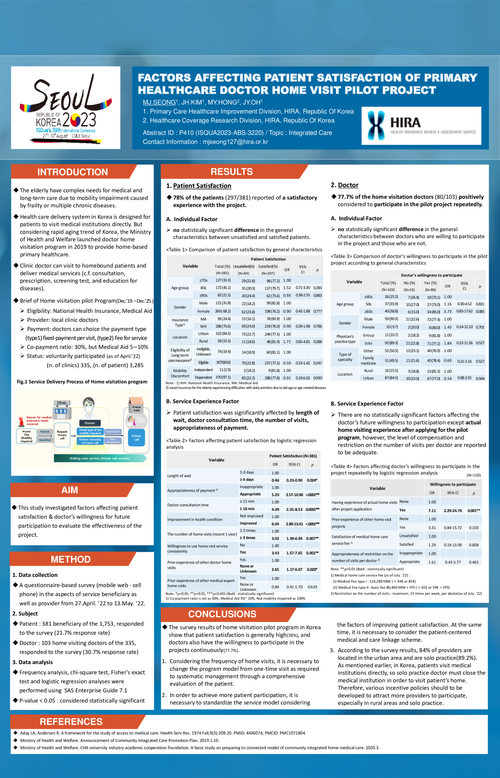
◆ 78% of the patients (297/381) reported of a satisfactory experience with the project.
A. Individual Factor
➢ no statistically significant difference in the general characteristics between unsatisfied and satisfied patients.
B. Service Experience Factor
➢ Patient satisfaction was significantly affected by length of wait, doctor consultation time, the number of visits, appropriateness of payment.
2. Doctor
◆ 77.7% of the home visitation doctors (80/103) positively considered to participate in the pilot project repeatedly.
A. Individual Factor
➢ no statistically significant difference in the general characteristics between doctors who are willing to participate in the project and those who are not.
B. Service Experience Factor
➢ There are no statistically significant factors affecting the doctor’s future willingness to participation except actual home visiting experience after applying for the pilot program, however, the level of compensation and restriction on the number of visits per doctor are reported to be adequate.
CONCLUSIONS
◆ The survey results of home visitation pilot program in Korea show that patient satisfaction is generally high(78%), and doctors also have the willingness to participate in the projects continuously(77.7%).
1. Considering the frequency of home visits, it is necessary to change the program model from one-time visit as required to systematic management through a comprehensive evaluation of the patient.
2. In order to achieve more patient participation, it is necessary to standardize the service model considering the factors of improving patient satisfaction. At the same time, it is necessary to consider the patient-centered medical and care linkage scheme.
3. According to the survey results, 84% of providers are located in the urban area and are solo practice(89.2%). As mentioned earlier, in Korea, patients visit medical institutions directly, so solo practice doctor must close the medical institution in order to visit patient’s home. Therefore, various incentive policies should to be developed to attract more providers to participate, especially in rural areas and solo practice.
REFERENCES
◆ Aday LA, Andersen R. A framework for the study of access to medical care. Health Serv Res. 1974 Fall;9(3):208-20. PMID: 4436074; PMCID: PMC1071804.
◆ Ministry of Health and Welfare. Announcement of Community Integrated Care Promotion Plan. 2019.1.10.
◆ Ministry of Health and Welfare, CHA university industry academic cooperation foundation. A basic study on preparing to connected model of community integrated home medical care. 2020.3.