708 posters, 8 topics, 16 sessions, 1,190 authors, 600 institutions
ePostersLive by SciGen Technologies S.A. All rights reserved.
ISQua's 39th International Conference 2023
August 27 - 30, 2023 | Seoul, Republic of Korea

P399
A 73-YEAR-OLD WOMAN WITH CHEST PAIN AND SHOCK : A CASE REPORT
Poster Presenter
Authors
Affiliations
Part of Topic
Integrated Care
A 73-YEAR-OLD WOMAN WITH CHEST PAIN AND SHOCK : A CASE REPORT
Hsieh Mei-Huei
Emergency department, E-Da hospital, Kaohsiung, Taiwan
Introduction
Acute chest pain is one of the most common complaints associated with some life-threatening diseases encountered in the emergency department, including acute coronary heart disease, aortic dissection, tension pneumothorax, pericardial tamponade (Simon A et al., 2016). After fatal chest pain has been ruled out, the patient needs to be continually evaluated for other acute medical conditions. Chinese herbal medicines are often used by people to maintain health, but toxicity is often ignored. Among them, Aconitum carmichaelii and kusnezoff monkshood root contain aconitum alkaloids (Chan, TY, 2015).
Methods
Domestic and foreign literature reviews show that the toxicity can be manifested in the three major systems of the human body, including the nervous system, cardiovascular system, and gastrointestinal tract, especially the cardiovascular system; the cause of the poisoning can come from accidental ingestion, incomplete brewing, insufficient cooking time, or excessive dosage (Coulson, J. M et al., 2017). A 73-year-old woman who took Chuanwu and Caowu formulas without a prescription from a licensed Chinese medicine doctor was sent to the emergency department due to insufficient decoction time and incomplete brewing which led to arrhythmia and shock reactions.
Results
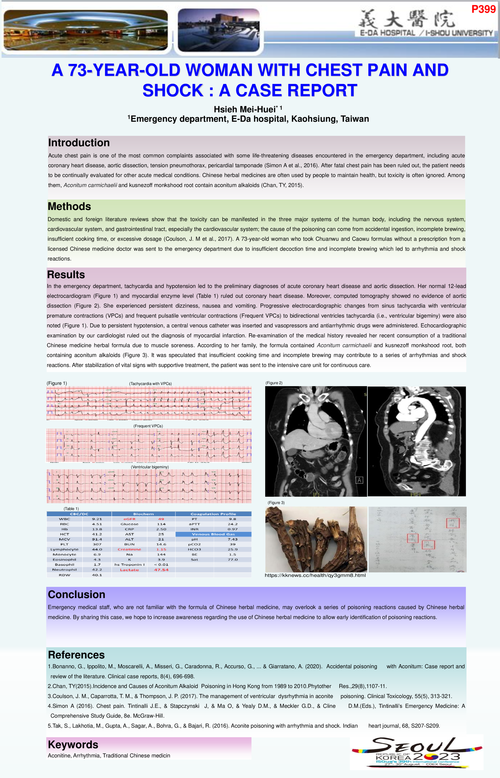
In the emergency department, tachycardia and hypotension led to the preliminary diagnoses of acute coronary heart disease and aortic dissection. Her normal 12-lead electrocardiogram (Figure 1) and myocardial enzyme level (Table 1) ruled out coronary heart disease. Moreover, computed tomography showed no evidence of aortic dissection (Figure 2). She experienced persistent dizziness, nausea and vomiting. Progressive electrocardiographic changes from sinus tachycardia with ventricular premature contractions (VPCs) and frequent pulsatile ventricular contractions (Frequent VPCs) to bidirectional ventricles tachycardia (i.e., ventricular bigeminy) were also noted (Figure 1). Due to persistent hypotension, a central venous catheter was inserted and vasopressors and antiarrhythmic drugs were administered. Echocardiographic examination by our cardiologist ruled out the diagnosis of myocardial infarction. Re-examination of the medical history revealed her recent consumption of a traditional Chinese medicine herbal formula due to muscle soreness. According to her family, the formula contained Aconitum carmichaelii and kusnezoff monkshood root, both containing aconitum alkaloids (Figure 3). It was speculated that insufficient cooking time and incomplete brewing may contribute to a series of arrhythmias and shock reactions. After stabilization of vital signs with supportive treatment, the patient was sent to the intensive care unit for continuous care.
Conclusion
Emergency medical staff, who are not familiar with the formula of Chinese herbal medicine, may overlook a series of poisoning reactions caused by Chinese herbal medicine. By sharing this case, we hope to increase awareness regarding the use of Chinese herbal medicine to allow early identification of poisoning reactions.
References
1.Bonanno, G., Ippolito, M., Moscarelli, A., Misseri, G., Caradonna, R., Accurso, G., ... & Giarratano, A. (2020). Accidental poisoning with Aconitum: Case report and review of the literature. Clinical case reports, 8(4), 696-698.
2.Chan, TY(2015).Incidence and Causes of Aconitum Alkaloid Poisoning in Hong Kong from 1989 to 2010.Phytother Res.,29(8),1107-11.
3.Coulson, J. M., Caparrotta, T. M., & Thompson, J. P. (2017). The management of ventricular dysrhythmia in aconite poisoning. Clinical Toxicology, 55(5), 313-321.
4.Simon A (2016). Chest pain. Tintinalli J.E., & Stapczynski J, & Ma O, & Yealy D.M., & Meckler G.D., & Cline D.M.(Eds.), Tintinalli’s Emergency Medicine: A Comprehensive Study Guide, 8e. McGraw-Hill.
5.Tak, S., Lakhotia, M., Gupta, A., Sagar, A., Bohra, G., & Bajari, R. (2016). Aconite poisoning with arrhythmia and shock. Indian heart journal, 68, S207-S209.
Keywords
Aconitine, Arrhythmia, Traditional Chinese medicin