708 posters, 8 topics, 16 sessions, 1,190 authors, 600 institutions
ePostersLive by SciGen Technologies S.A. All rights reserved.
ISQua's 39th International Conference 2023
August 27 - 30, 2023 | Seoul, Republic of Korea

P393
ACUTE CARE FOR THE ELDERLY (ACE) MODEL OF CARE IS USED TO IMPROVE THE DELAYED DISABILITY OF PRE-FRAIL ELDERLY IN ORTHOPEDIC WARDS.
Poster Presenter
Authors
Affiliations
Part of Topic
Integrated Care
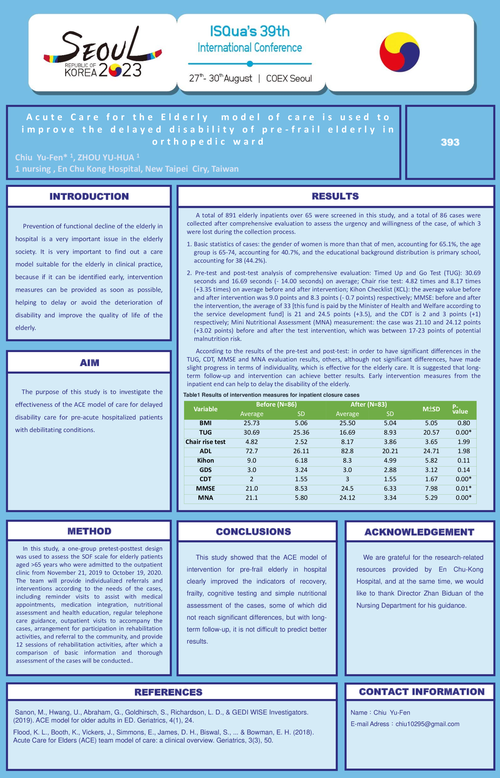
Introduction: The purpose of this study is to investigate the effectiveness of the ACE model of care for delayed disability care for pre-acute hospitalized patients with debilitating conditions.
Methods: In this study, a one-group pretest-posttest design was used to assess the SOF scale for elderly patients aged >65 years who were admitted to the outpatient clinic from November 21, 2019 to October 19, 2020. The team will provide individualized referrals and interventions according to the needs of the cases, including reminder visits to assist with medical appointments, medication integration, nutritional assessment and health education, regular telephone care guidance, outpatient visits to accompany the cases, arrangement for participation in rehabilitation activities, and referral to the community, and provide 12 sessions of rehabilitation activities, after which a comparison of basic information and thorough assessment of the cases will be conducted.
Results: A total of 891 elderly inpatients over 65 were screened in this study, and a total of 86 cases were collected after comprehensive evaluation to assess the urgency and willingness of the case, of which 3 were lost during the collection process.
Pre-test and post-test analysis of comprehensive evaluation: Timed Up and Go Test (TUG): 30.69 seconds and 16.69 seconds (- 14.00 seconds) on average; Chair rise test: 4.82 times and 8.17 times (+3.35 times) on average before and after intervention; Kihon Checklist (KCL): the average value before and after intervention was 9.0 points and 8.3 points (- 0.7 points) respectively; MMSE: before and after the intervention, the average of 33 [this fund is paid by the Minister of Health and Welfare according to the service development fund] is 21 and 24.5 points (+3.5), and the CDT is 2 and 3 points (+1) respectively; Mini Nutritional Assessment (MNA) measurement: the case was 21.10 and 24.12 points (+3.02 points) before and after the test intervention, which was between 17-23 points of potential malnutrition risk.
Conclusion: This study showed that the ACE model of intervention for pre-frail elderly in hospital clearly improved the indicators of recovery, frailty, cognitive testing and simple nutritional assessment of the cases, some of which did not reach significant differences, but with long-term follow-up, it is not difficult to predict better results.