708 posters, 8 topics, 16 sessions, 1,190 authors, 600 institutions
ePostersLive by SciGen Technologies S.A. All rights reserved.
ISQua's 39th International Conference 2023
August 27 - 30, 2023 | Seoul, Republic of Korea

ISQUA2023-ABS-2202
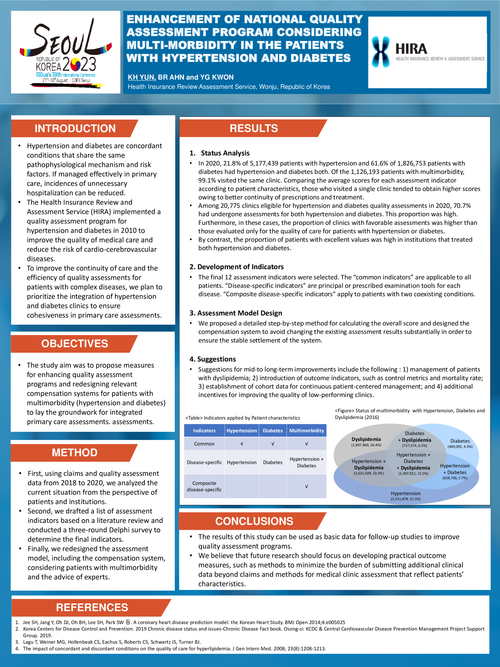
ENHANCEMENT OF NATIONAL QUALITY ASSESSMENT PROGRAM CONSIDERING MULTI-MORBIDITY IN THE PATIENTS WITH HYPERTENSION AND DIABETES
Poster Presenter
Authors
Affiliations
Part of Topic
Integrated Care
1. Introduction: Hypertension and diabetes are concordant conditions that share the same pathophysiological mechanism and risk factors. If managed effectively in primary care, incidences of unnecessary hospitalization can be reduced. The Health Insurance Review and Assessment Service (HIRA) implemented a quality assessment program for hypertension and diabetes in 2010 to improve the quality of medical care and reduce the risk of cardio-cerebrovascular diseases. To improve the continuity of care and the efficiency of quality assessments for patients with complex diseases, we plan to prioritize the integration of hypertension and diabetes clinics to ensure cohesiveness in primary care assessments.
2. Objectives: The study aim was to propose measures for enhancing quality assessment programs and redesigning relevant compensation systems for patients with multimorbidity (hypertension and diabetes) to lay the groundwork for integrated primary care assessments.
3. Method: First, using claims and quality assessment data from 2018 to 2020, we analyzed the current situation from the perspective of patients and institutions. Second, we drafted a list of assessment indicators based on a literature review and conducted a three-round Delphi survey to determine the final indicators. Finally, we redesigned the assessment model, including the compensation system, considering patients with multimorbidity and the advice of experts.
4. Result
(1) Status Analysis: In 2020, 21.8% of 5,177,439 patients with hypertension and 61.6% of 1,826,753 patients with diabetes had hypertension and diabetes both. Of the 1,126,193 patients with multimorbidity, 99.1% visited the same clinic. Comparing the average scores for each assessment indicator according to patient characteristics, those who visited a single clinic tended to obtain higher scores owing to better continuity of prescriptions and treatment. Among 20,775 clinics eligible for hypertension and diabetes quality assessments in 2020, 70.7% had undergone assessments for both hypertension and diabetes. This proportion was high. Furthermore, in these cases, the proportion of clinics with favorable assessments was higher than those evaluated only for the quality of care for patients with hypertension or diabetes. By contrast, the proportion of patients with excellent values was high in institutions that treated both hypertension and diabetes.
(2) Development of Indicators: The final 12 assessment indicators were selected. The “common indicators” are applicable to all patients. “Disease-specific indicators” are principal or prescribed examination tools for each disease. “Composite disease-specific indicators” apply to patients with two coexisting conditions.
(3) Assessment model design: We proposed a detailed step-by-step method for calculating the overall score and designed the compensation system to avoid changing the existing assessment results substantially in order to ensure the stable settlement of the system.
(4) Suggestions: Suggestions for mid-to long-term improvements include the following :1) management of patients with dyslipidemia; 2) introduction of outcome indicators, such as control metrics and mortality rate; 3) establishment of cohort data for continuous patient-centered management; and 4) additional incentives for improving the quality of low-performing clinics.
5. Conclusion: The results of this study can be used as basic data for follow-up studies to improve quality assessment programs. We believe that future research should focus on developing practical outcome measures, such as methods to minimize the burden of submitting additional clinical data beyond claims and methods for medical clinic assessment that reflect patients’ characteristics.