708 posters, 8 topics, 16 sessions, 1,190 authors, 600 institutions
ePostersLive by SciGen Technologies S.A. All rights reserved.
ISQua's 39th International Conference 2023
August 27 - 30, 2023 | Seoul, Republic of Korea

ISQUA2023-ABS-2459
INTOUCH – A STRATEGY FOR COOPERATION AND COPRODUCTION FOR INTEGRATED HEALTH SERVICE DELIVERY
Poster Presenter
Part of Topic
Integrated Care
inTouch – A STRATEGY FOR COOPERATION AND COPRODUCTION FOR INTEGRATED HEALTH SERVICE DELIVERY
isqua2023.020003d
ELJIZ Kathy1, LOY Graeme2, MEDLIN Joanne2, DERRETT, Alison2, ELLIS, Jasmin2, GREENFIELD, David1
Contact: k.eljiz@unsw.edu.au
1 University of New South Wales, Faculty of Medicine and Health, School of Population Health, 2 Western Sydney Local Health District
Introduction
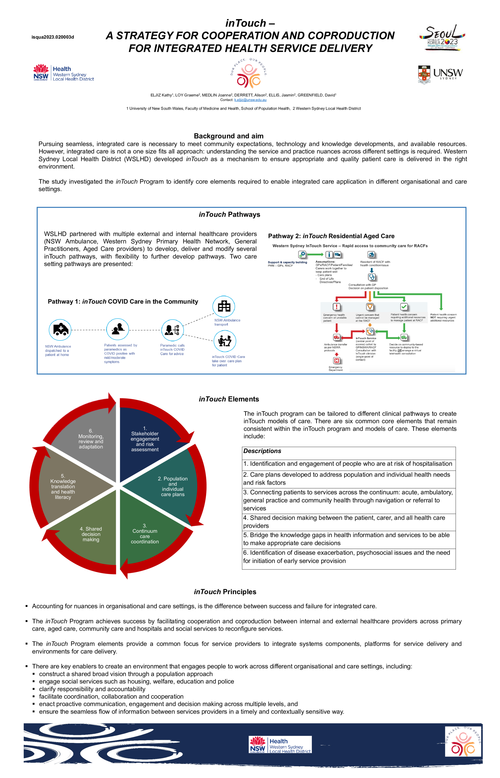
Pursuing seamless, integrated care is necessary to meet community expectations, technology and knowledge developments, and available resources. Integrated care strengthens health services by being flexible, people centred, comorbidity focused and deliverable by multidisciplinary teams across different settings. However, integrated care is not a one size fits all approach: understanding the service and practice nuances across different settings is required. To achieve integrated care, Western Sydney Local Health District (WSLHD) developed inTouch as a mechanism to ensure appropriate and quality patient care is delivered in the right environment. The study investigated the inTouch Program to identify core elements required to enable integrated care application in different organisational and care settings.
Methods
The research setting and focus was the inTouch Program. A case study methodology using document analysis (n=10 documents; 186 pages) and discussions with key informants (n=4) involved in the development, implementation and ongoing evaluation of the inTouch Program was used. Thematic analysis was used to identify, analyse and inform common themes.
Results
WSLHD partnered with multiple external and internal healthcare providers (NSW Ambulance, Western Sydney Primary Health Network, General Practitioners, Aged Care providers) to develop, deliver and modify several inTouch pathways, with flexibility to further develop pathways. Two care setting pathways include 1. inTouch COVID care in the Community, and 2. inTouch Residential Aged Care Facilities. Developed and refined from June 2021 – November 2022, there are six core elements (Table 1).
|
Elements |
Descriptions |
|
1. Stakeholder engagement and risk analysis |
Identification and engagement of people who are at risk of hospitalisation |
|
2. Population and individual care plans |
Care plans developed to address population and individual health needs and risk factors |
|
3. Continuum care coordination |
Connecting patients to services across the continuum: acute, ambulatory, general practice and community health through navigation or referral to services |
|
4. Shared decision making |
Shared decision making between the patient, carer, and all health care providers |
|
5. Knowledge translation and health literacy |
Bridge the knowledge gaps in health information and services to be able to make appropriate care decisions |
|
6. Monitoring, review, and adaptation |
Identification of disease exacerbation, psychosocial issues and the need for initiation of early service provision |
Table 1 inTouch core elements
Conclusion
Accounting for nuances in organisational and care settings, is the difference between success and failure for integrated care. The inTouch Program achieves this by facilitating cooperation and coproduction between internal and external healthcare providers across primary care, aged care, community care and hospitals to reconfigure services. The inTouch Program core elements provide a common focus for service providers to integrate systems components, platforms for service delivery and environments for care delivery.