301 posters, 50 videos, 13 topics, 13 sessions, 739 authors, 192 institutions
ePostersLive by SciGen Technologies S.A. All rights reserved.
ISMICS 2026 Annual Meeting
10 - 13 June, 2026 | Miami, Florida

P70
Quality Of Life Following Robotic Cardiac Surgery: Return To Baseline Within 4 Weeks
Part of Topic
ERAS
Introduction
- Quality of Life (QoL) is an increasingly important outcome after cardiac surgery because it reflects patient-centered recovery, functional status, and overall well-being.
- Traditional median sternotomy is associated with greater surgical trauma, postoperative pain, and delayed recovery, whereas minimally invasive and robotic techniques may accelerate return to normal activities and improve QoL.
- Previous studies have shown QoL recovery around 3 months after minimally invasive or robotic cardiac procedures, but evidence remains inconsistent and predictors of early recovery are not well defined.
- The study aimed to evaluate short-term postoperative QoL recovery after robotic cardiac surgery, determine how many patients return to baseline QoL within 4 weeks, and identify factors associated with recovery.
Methods
- Prospective observational study conducted at a single institution between July 2021 and December 2024.
- Included 168 patients who underwent:
- Robotic mitral valve repair (n = 96)
- Minimally invasive direct coronary artery bypass (MIDCAB, n = 21)
- Totally endoscopic coronary artery bypass (TECAB, n = 51)
Quality of life was measured preoperatively and 4 weeks postoperatively using:
- EQ-5D-5L questionnaire (utility score)
- Best Imaginable Health visual analog scale (0–100)
Return to baseline QoL was defined as a decline in EQ-5D utility score of no more than 0.05 points (ΔEQ-5D ≥ −0.05), based on the minimal clinically important difference (MCID).
Results
- The cohort had a median age of 62 years, and 73.1% were male.
- Median EQ-5D utility scores remained stable from baseline to 4 weeks (0.943 vs. 0.940; p = 0.061), indicating preservation of overall QoL
- Self-rated health significantly improved, with Best Imaginable Health scores increasing from 80 to 85 (p < 0.001).
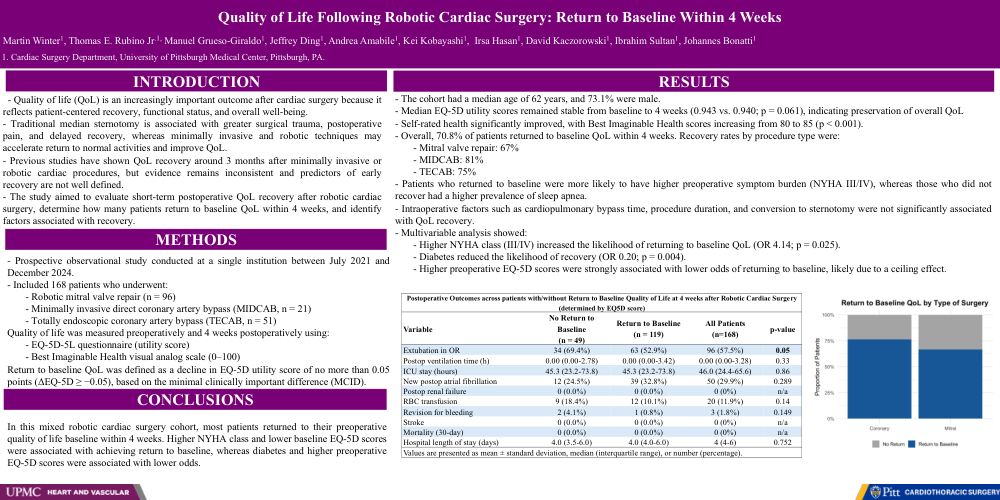
- Overall, 70.8% of patients returned to baseline QoL within 4 weeks. Recovery rates by procedure type were:
- Mitral valve repair: 67%
- MIDCAB: 81%
- TECAB: 75%
- Patients who returned to baseline were more likely to have higher preoperative symptom burden (NYHA III/IV), whereas those who did not recover had a higher prevalence of sleep apnea.
- Intraoperative factors such as cardiopulmonary bypass time, procedure duration, and conversion to sternotomy were not significantly associated with QoL recovery.
- Multivariable analysis showed:
- Higher NYHA class (III/IV) increased the likelihood of returning to baseline QoL (OR 4.14; p = 0.025).
- Diabetes reduced the likelihood of recovery (OR 0.20; p = 0.004).
- Higher preoperative EQ-5D scores were strongly associated with lower odds of returning to baseline, likely due to a ceiling effect.
Conclusions
In this mixed robotic cardiac surgery cohort, most patients returned to their preoperative quality of life baseline within 4 weeks. Higher NYHA class and lower baseline EQ-5D scores were associated with achieving return to baseline, whereas diabetes and higher preoperative EQ-5D scores were associated with lower odds.