301 posters, 50 videos, 13 topics, 13 sessions, 739 authors, 192 institutions
ePostersLive by SciGen Technologies S.A. All rights reserved.
ISMICS 2026 Annual Meeting
10 - 13 June, 2026 | Miami, Florida

D175
The Evolution And Current State Of Minimally Invasive And Robotic Cardiac Surgery
Poster Presenter
Authors
Ahmed Wahba, Aziza Tavakkalova, Fetoh Alaaeldin, Ahmed E. Elkafoury, Amir Bastawisy
Affiliations
Department of Cardiothoracic Surgery, Faculty of Medicine, Port Said University, Port Said, Egypt, Medical School, Central Asian University, Tashkent, Uzbekistan, Lecturer of Cardiothoracic Surgery, Faculty of Medicine, Mansoura University, Mansoura, Egypt, Department of Cardiac Surgery, Mahalla Heart Center, El-Mahalla El-Kubra, Egypt
Part of Topic
Education, Imaging and Facilitating Technologies
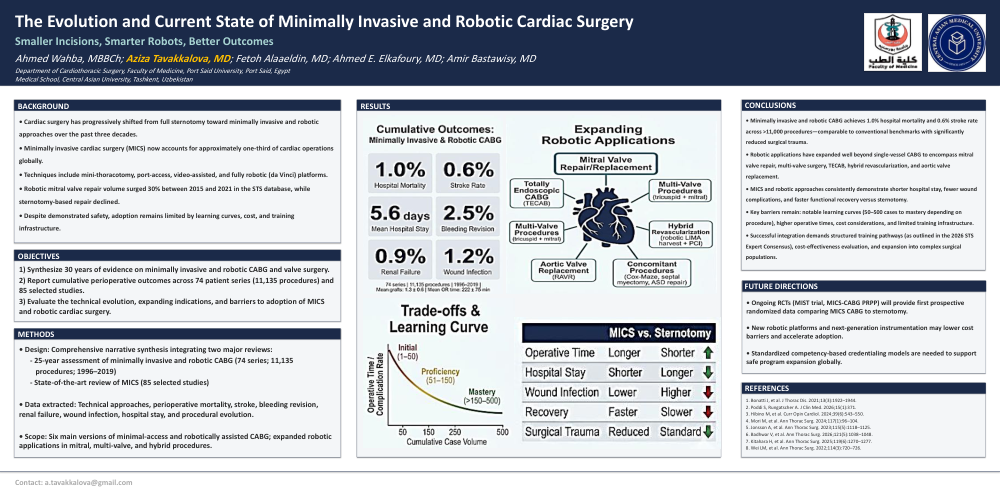
Background: Cardiac surgery has progressively evolved to incorporate minimally invasive and robotic techniques, aiming to reduce surgical trauma while preserving procedural safety and efficacy. This narrative review synthesizes key developments and outcomes in this field over the past three decades.
Methods: We performed a comprehensive narrative synthesis of the literature, drawing on two major reviews: a 25-year assessment of minimally invasive and robotic coronary artery bypass grafting (CABG) and a state-of-the-art review on minimally invasive cardiac surgery (MICS). The analysis integrates data from 74 patient series (encompassing 11,135 procedures) and 85 selected studies to evaluate technical evolution, perioperative outcomes, and historical trends.
Results: Minimally invasive and robotic CABG techniques demonstrated a hospital mortality of 1.0%, a stroke rate of 0.6%, and a mean hospital stay of 5.6 days. Robotic applications, particularly in mitral valve surgery, have expanded significantly, now encompassing multi-valve, coronary (e.g., totally endoscopic CABG), and hybrid procedures. These approaches offer reduced invasiveness and faster recovery compared to sternotomy, albeit with longer operative times and notable learning curves.
Conclusions: Minimally invasive and robotic techniques represent safe and effective alternatives to conventional cardiac surgery for selected procedures. Their successful integration requires structured training programs, evaluation of cost-effectiveness, and further exploration of applications in complex surgical populations.
Keywords: minimally invasive cardiac surgery; robotic surgery; coronary artery bypass grafting; mitral valve repair; TECAB; learning curve