301 posters, 50 videos, 13 topics, 13 sessions, 739 authors, 192 institutions
ePostersLive by SciGen Technologies S.A. All rights reserved.
ISMICS 2026 Annual Meeting
10 - 13 June, 2026 | Miami, Florida

P143
Multidimensional Profiling Of Serum Biomarker Scores In Tavr Using Principal Component Analysis
Poster Presenter
Part of Topic
Valve - Transcatheter Therapies
Multidimensional Profiling of Serum Biomarker Scores in TAVR Using Principal Component Analysis
Massimo Baudo1, Serge Sicouri1, Dimitrios E. Magouliotis1, Fadi Hage2, Scott M. Goldman2, Eric M. Gnall2, Khalid Ridwan2, William A. Gray1,2, Basel Ramlawi1,2
1.Department of Cardiac Surgery Research, Lankenau Institute for Medical Research, Main Line Health, Wynnewood, PA, USA
2.Department of Cardiac Surgery, Lankenau Heart Institute, Main Line Health, Wynnewood, PA, USA
Background
Pre-procedural nutritional status has been proposed as a prognostic marker in transcatheter aortic valve replacement (TAVR), although most studies rely on isolated nutrition scores rather than on a multidimensional assessment. Among the established serum-based indices, including the CONUT score, PNI, and GNRI, their comparative prognostic utility in TAVR populations remains largely unexplored.
This study examined how multiple serum-based nutritional and inflammatory scores characterize patients with severe aortic stenosis and whether these scores influence post-TAVR survival.
Methods
Consecutive patients undergoing TAVR between December 2021 and December 2023 were retrospectively analyzed. Exclusion criteria were emergency procedures, endocarditis, active or prior cancer, immunocompromised status, redo aortic interventions, predominant aortic regurgitation, non-transfemoral access, concomitant coronary revascularization, and conversion to surgery.
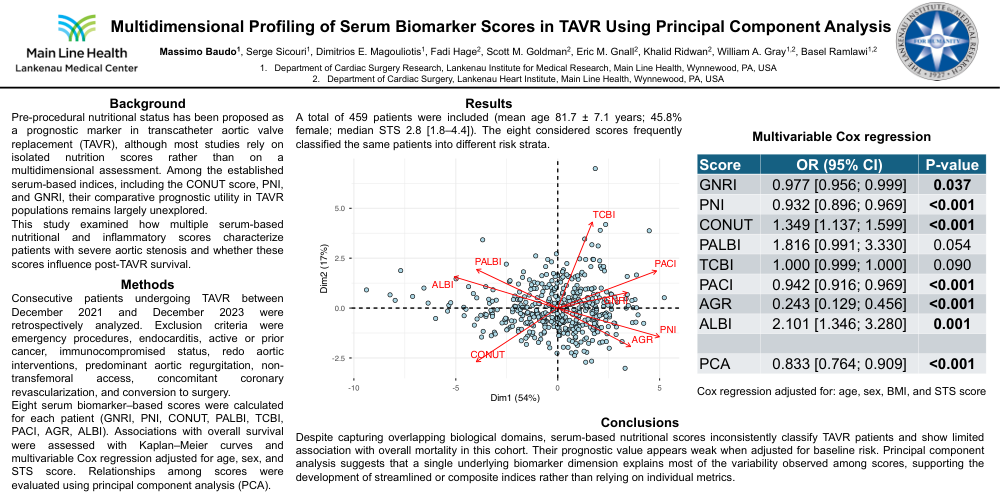
Eight serum biomarker–based scores were calculated for each patient (GNRI, PNI, CONUT, PALBI, TCBI, PACI, AGR, ALBI). Associations with overall survival were assessed with Kaplan–Meier curves and multivariable Cox regression adjusted for age, sex, and STS score. Relationships among scores were evaluated using principal component analysis (PCA).
Results
A total of 459 patients were included (mean age 81.7 ± 7.1 years; 45.8% female; median STS 2.8 [1.8–4.4]). The eight considered scores frequently classified the same patients into different risk strata.
Conclusions
Despite capturing overlapping biological domains, serum-based nutritional scores inconsistently classify TAVR patients and show limited association with overall mortality in this cohort. Their prognostic value appears weak when adjusted for baseline risk. Principal component analysis suggests that a single underlying biomarker dimension explains most of the variability observed among scores, supporting the development of streamlined or composite indices rather than relying on individual metrics.