301 posters, 50 videos, 13 topics, 13 sessions, 739 authors, 192 institutions
ePostersLive by SciGen Technologies S.A. All rights reserved.
ISMICS 2026 Annual Meeting
10 - 13 June, 2026 | Miami, Florida

P140
Management And Outcomes Of Transcatheter Aortic Valve Replacement Valve Embolization: A Single-center Experience
Poster Presenter
Authors
Xander Jacquemyn, Abbad Sultan, Andrea Amabile, Irsa Hasan, Takuya Ogami, Danny Chu, Derek Serna-Gallegos, Dustin Kliner, Catalin Toma, Amber Makani, David West, Ibrahim Sultan
Affiliations
Department of Cardiothoracic Surgery, University of Pittsburgh, UPMC Heart and Vascular Institute, University of Pittsburgh Medical Center
Part of Topic
Valve - Transcatheter Therapies
Management and Outcomes of Transcatheter Aortic Valve Replacement Valve Embolization: A Single-Center Experience
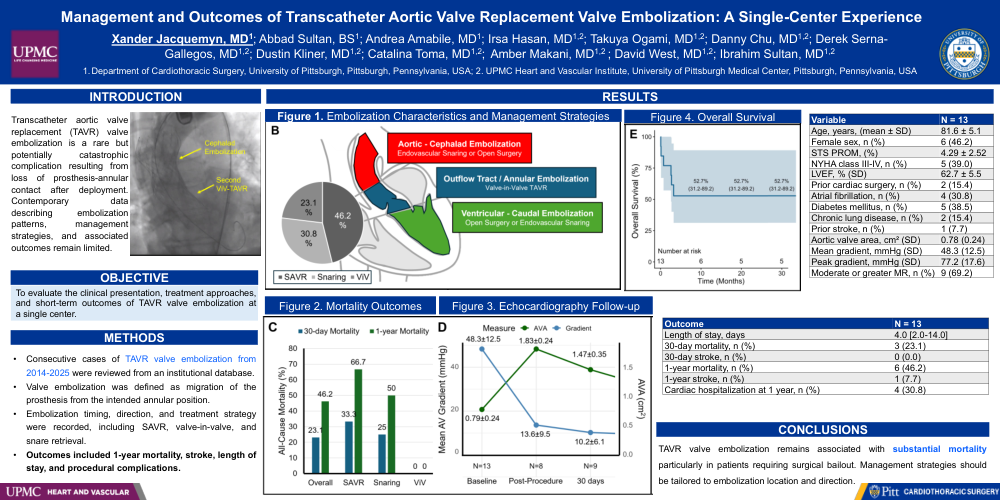
Objective: Transcatheter aortic valve replacement (TAVR) valve embolization is a rare but potentially catastrophic complication resulting from loss of prosthesis-annular contact after deployment. Contemporary data describing embolization patterns, management strategies, and associated outcomes remain limited. This study evaluates the clinical presentation, treatment approaches, and short-term outcomes of TAVR valve embolization at a single center.
Methods: We retrospectively identified 13 patients who experienced valve embolization during or after TAVR (2014-2025). Baseline demographics, comorbidities, procedural characteristics, embolization timing and direction (cephalad vs caudad), management strategy, and clinical outcomes were collected.
Results: The case series had a mean age of 81.6±5.1 years, 46.2% were female, and mean Society of Thoracic Surgeons predicted risk of mortality was 4.29±2.52. At baseline, 39% of patients were New York Heart Association class III-IV, with a preserved left ventricular ejection fraction of 62.7 ± 5.5%. Most patients had a virgin chest (84.6%), while one had a prior sternotomy and one had two prior sternotomies. Atrial fibrillation was present in 30.8% of patients. 12 procedures were performed using self-expanding valves (mean valve size 27.3±1.7 mm). Embolization occurred during deployment in one case and after final deployment in the remainder. Pre- and postdilation were performed in 33.3% and 58.2% of cases, respectively. Embolization was cephalad in 11 patients and caudad in 2. Management included surgical bailout with surgical aortic valve replacement in 6 patients, valve-in-valve (ViV) implantation in 3 patients (all annular or left ventricular outflow tract embolizations), and endovascular snaring in 4 patients. One patient required postprocedural intra-aortic balloon pump support. Median hospital length of stay was 4 days [IQR 2-14]. Thirty-day mortality was 23.1% (n = 3), with no perioperative strokes. Echocardiography demonstrated significant improvements in aortic valve area and mean transvalvular gradients post-intervention. One-year mortality was 46.2% (n = 6) overall and varied by management strategy.
Conclusions: TAVR valve embolization remains associated with substantial mortality particularly in patients requiring surgical bailout. Management strategies should be tailored to embolization location and direction.