301 posters, 50 videos, 13 topics, 13 sessions, 739 authors, 192 institutions
ePostersLive by SciGen Technologies S.A. All rights reserved.
ISMICS 2026 Annual Meeting
10 - 13 June, 2026 | Miami, Florida

P101
Ergonomic Burden Across Operative Modalities In Women In Thoracic Surgery
Poster Presenter
Authors
Mariya Samoylova, Sara Sakowitz, Marianna Papageorge, Madigan Stanley, Rebekah Boyd, Nicole Lin, Busra Cangut, Rajika Jindani, Kaitlin Bevers, Tanisha Rajah, Nimrat Grewal, Laura DiChiacchio, Stephanie Worrell, Amara Watkins, Mara Antonoff
Affiliations
UT MD Anderson Cancer Center, Massachusetts General Hospital, Memorial Sloan Kettering Cancer Center, Brown University, Duke University Hospital, New York Medical College, Icahn School of Medicine at Mount Sinai, Montefiore Medical Center/Albert Einstein College of Medicine, University of Birmingham, Amsterdam University Medical Center, Cedars-Sinai Medical Center, University of Arizona, Lahey Hospital and Medical Center
Part of Topic
Thoracic Surgery � Miscellaneous
Objective
Cardiothoracic surgery is associated with substantial ergonomic strain due to physically demanding and prolonged operations. Women surgeons experience higher rates of work-related musculoskeletal pain and injury. Prior work suggests that minimally invasive (MIS) approaches may reduce ergonomic strain. The potential physical advantages of MIS for women cardiothoracic surgeons remain underexplored. We aimed to compare ergonomic burden across operative approaches for women in this specialty.
Methods
An anonymous survey was distributed to women attending the 2025 Annual Women in Thoracic Surgery Conference via QR-codes and email. Survey domains included demographics, anthropometrics, operative approaches, pain, and ergonomic contributors. Respondents rated pain and its sources using ordinal scales. Quantitative data were summarized descriptively; free-text responses were reviewed to contextualize ergonomic challenges.
Results
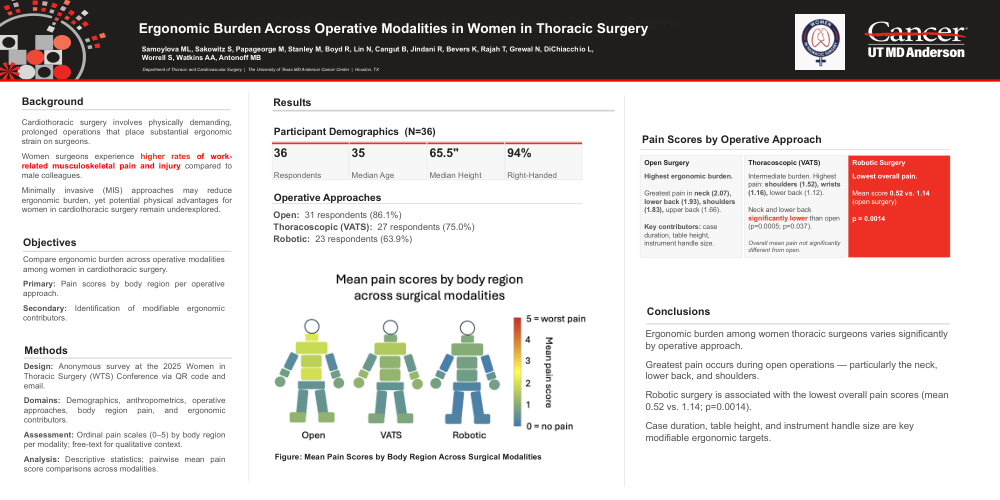
Thirty-six individuals completed the survey, of median age 35 years (interquartile range [IQR]31–41). Career stages included 15 attendings, 16 residents/fellows, and 5 medical students. Most respondents were right-handed (34, 94.4%). Median height was 65.5 inches (IQR63.5–67), and median glove size was 6(IQR 6–6.5).
Open operations were performed by 31(86.1%) respondents, thoracoscopic by 27(75.0%), and robotic by 23 (63.9%). During open procedures, greatest pain scores were reported in the neck (2.07), shoulders (1.83), lower back (1.93), and upper back (1.66). The most significant contributors to ergonomic strain were case duration, table height, and instrument handle size.
During thoracoscopic procedures, pain scores were notable in the shoulders (1.52), wrists (1.16), and lower back (1.12). While overall mean pain score did not significantly differ from open surgery, neck and lower back mean scores were lower for thoracoscopic than for open surgery (p=0.0005 and p=0.037, respectively). Instrument handle size and case duration were the most frequent contributors.
Robotics was associated with lowest overall pain scores (mean pain score 0.52 vs. 1.14 for open procedures, p=0.0014, Figure). Participants reported strain related to console position, grip, and case duration.
Conclusions
Ergonomic burden among women thoracic surgeons varies by operative approach, with greatest pain reported during open operations and lowest during robotic surgery. Recognition of these differences is essential to informing ergonomic optimization and operative decision making for women in cardiothoracic surgery.