293 posters, 56 videos, 24 topics, 13 sessions, 658 authors, 215 institutions
ePostersLive by SciGen Technologies S.A. All rights reserved.
ISMICS 2025 Annual Meeting
28 - 31 May, 2025 | Istanbul, Turkey

P57
A Decade Of Experience With Total Anomalous Pulmonary Venous Connection Repair In Saudi Arabia: Conventional Vs. Sutureless Techniques
Part of Topic
Pediatric
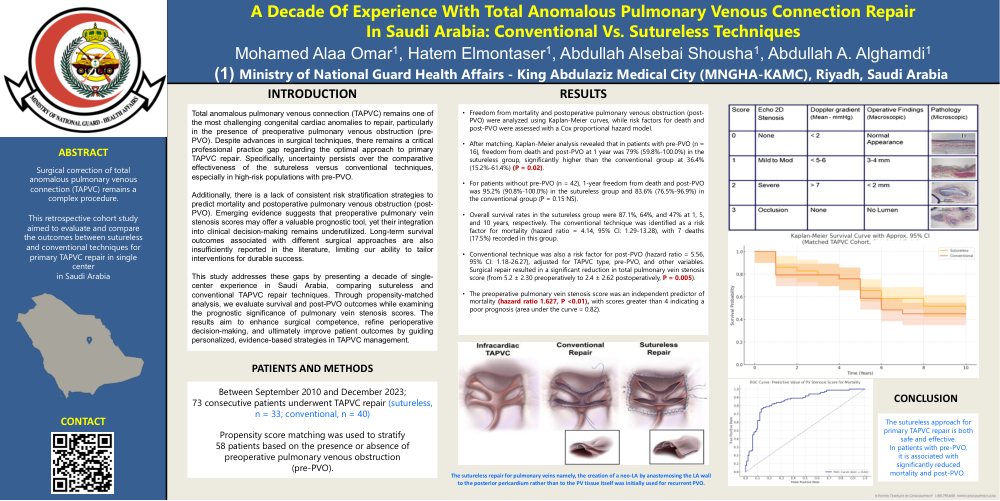
BACKGROUND: Surgical correction of total anomalous pulmonary venous connection (TAPVC) remains acomplex procedure. This retrospective cohort study aimed to evaluate and compare the outcomes between sutureless and conventional techniques for primary TAPVC repair.
METHODS: Between September 2010 and December 2023, 73 consecutive patients underwent TAPVC repair (sutureless, n = 33; conventional, n = 40). Propensity score matching was used to stratify 58 patients based on the presence or absence of preoperative pulmonary venous obstruction (pre-PVO).
RESULTS: Freedom from mortality and postoperative pulmonary venous obstruction (post-PVO) were analyzed using Kaplan-Meier curves, while risk factors for death and post-PVO were assessed with a Cox proportional hazard model. After matching, Kaplan-Meier analysis revealed that in patients with pre-PVO (n = 16), freedom from death and post-PVO at 1 year was 79% (59.8%-100.0%) in the sutureless group, significantly higher than the conventional group at 36.4% (15.2%-61.4%) (P = 0.02). For patients without pre-PVO (n = 42), 1-year freedom from death and post-PVO was 95.2% (90.8%-100.0%) in the sutureless group and 83.6% (76.5%-96.9%) in the conventional group (P = 0.15). Overall survival rates in the sutureless group were 87.1%, 64%, and 47% at 1, 5, and 10 years, respectively. The conventional technique was identified as a risk factor for mortality (hazard ratio = 4.14, 95% CI: 1.29-13.28), with 7 deaths (17.5%) recorded in this group. This technique was also a risk factor for post-PVO (hazard ratio = 5.56, 95% CI: 1.18-26.27), adjusted for TAPVC type, pre-PVO, and other variables. Surgical repair resulted in a significant reduction in total pulmonary vein stenosis score (from 5.2 ± 2.30 preoperatively to 2.4 ± 2.62 postoperatively, P = 0.005). The preoperative pulmonary vein stenosis score was an independent predictor of mortality (hazard ratio 1.627, P < 0.01), with scores greater than 4 indicating a poor prognosis (area under the curve = 0.82).
CONCLUSION: The sutureless approach for primary TAPVC repair is both safe and effective. In patients with pre-PVO, it is associated with significantly reduced mortality and post-PVO.