293 posters, 56 videos, 24 topics, 13 sessions, 658 authors, 215 institutions
ePostersLive by SciGen Technologies S.A. All rights reserved.
ISMICS 2025 Annual Meeting
28 - 31 May, 2025 | Istanbul, Turkey

P105
How Transfemoral Venous Cannulation Facilitates Transaxillary Pediatric Cardiac Surgery
Poster Presenter
Authors
Affiliations
null,
Part of Topic
Video
Video
How Transfemoral Venous Cannulation Facilitates TransaxillaryPediatric Cardiac Surgery
Oleksandr Babliak, Dmytro Babliak
Diagnostic and Treatment Center For Children And Adults Of The Dobrobut Medical Network
Kyiv, Ukraine
Background
Minimally invasive pediatric cardiac surgery via right axillary minithoracotomy offers excellent cosmetic and clinical outcomes but is technically limited by the restricted surgical field and the need for central cannulation in small children. This case highlights the use of a transfemoral venous SmartCanula to overcome these limitations during VSD and RVOT repair in a young child.
Case presentation
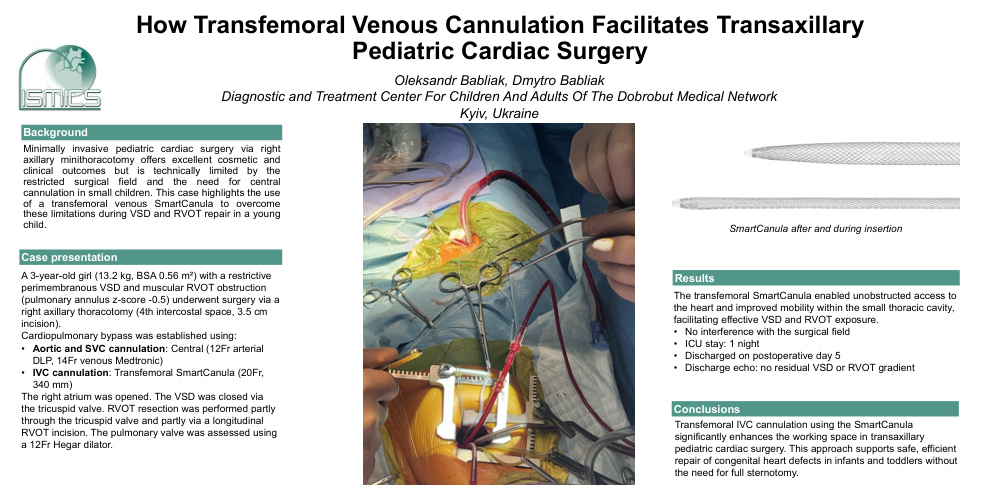
A 3-year-old girl (13.2 kg, BSA 0.56 m²) with a restrictive perimembranous VSD and muscular RVOT obstruction (pulmonary annulus z-score -0.5) underwent surgery via a right axillary thoracotomy (4th intercostal space, 3.5 cm incision).
Cardiopulmonary bypass was established using:
The right atrium was opened. The VSD was closed via the tricuspid valve. RVOT resection was performed partly through the tricuspid valve and partly via a longitudinal RVOT incision. The pulmonary valve was assessed using a 12Fr Hegar dilator.
Results
The transfemoral SmartCanulaenabled unobstructed access to the heart and improved mobility within the small thoracic cavity, facilitating effective VSD and RVOT exposure.
Conclusions
Transfemoral IVC cannulation using the SmartCanulasignificantly enhances the working space in transaxillarypediatric cardiac surgery. This approach supports safe, efficient repair of congenital heart defects in infants and toddlers without the need for full sternotomy.